Routledge International Handbook of Queer Death Studies is OUT!

At the end of October 2025 – which means already five months ago – the long awaited major publication came out!

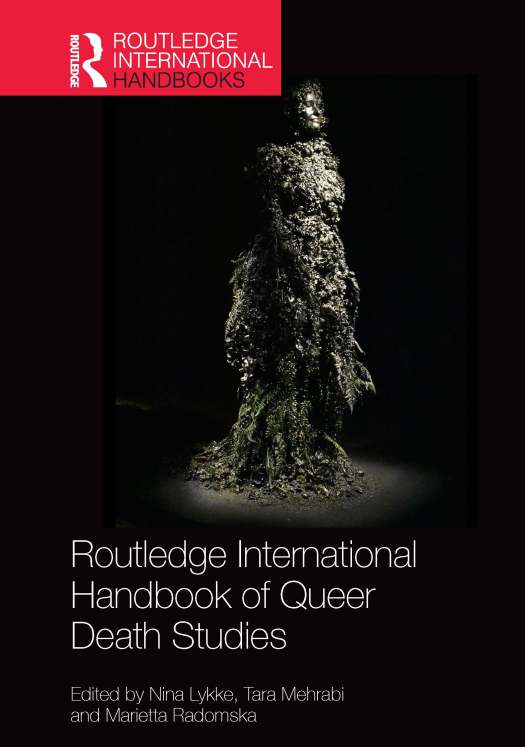
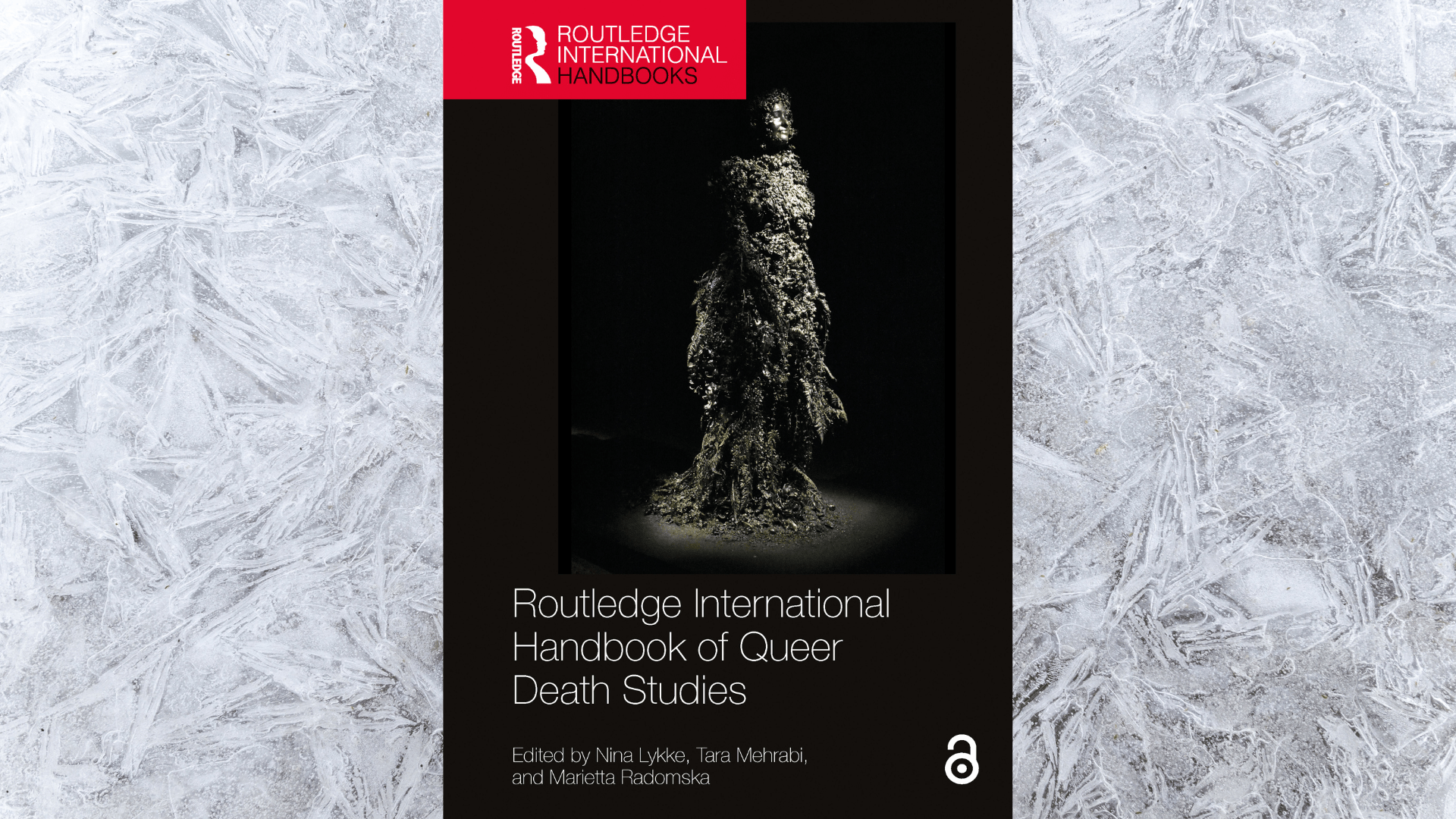
The 758-page volume: Routledge International Hanbook of Queer Death Studies, edited by Nina Lykke, Tara Mehrabi, and Marietta Radomska encompasses 63 chapters, written by 75 authors. The book consists of seven thematic sections: I. Rethinking  Life/Death Ecologies and Temporalities; II. Anthropocene Necropolitics and Extinction; III. Caring Death Activism; IV. Aesthetics and Mediated Imaginaries of Death; V. Politics and Ethics of Grieving Practices and Remembrance; VI. Co-Becoming with the Dead and Spectral Mourning; and VII. Imagining Life/Death Entanglements Differently.

Broadly speaking, the Handbook aims to provide a comprehensive, international cartography of Queer Death Studies, offering broad, in-depth insights into the field and its emergence through tentacular transdisciplinary networking. Taking research and art-making on death, dying, mourning, and afterlife into new directions, it explores the multiple effects of contemporary necropolitics and the proliferation of death-worlds during the current period of Earth’s history, ‘The Anthropocene’ or ‘the Age of Man’.

Informed by queer, critical posthumanist, decolonial, and feminist approaches, the Handbook presents a unique variety of both critical and affirmative reflections upon the world’s intersecting necropowers, and ethico-political potentials for social and environmental change. Contributors speculate on ways to reimagine life/ death-relations as vibrant entanglements. They also investigate modes of mourning differently, resisting necropolitical regimes that deem human and non-human individuals and populations to be disposable and non-grievable when they differ too much from the normative modern subject, Universal Man, in terms of intersections of gender, racialisation, class, sexuality, embodiment, embrainment, geopolitical positioning, or species.

A thought provoking read, this Handbook is intended for broad global audiences of researchers, artists, teachers, students, death-professionals, (health)careworkers, activists, and NGOs interested in tools to rethink and reimagine death, dying, mourning, and afterlife from intersections of queering, decolonising, posthumanising, and feminist perspectives.

The volume includes two chapters that are available in OPEN ACCESS.

The cover of the Routledge International Handbook of Queer Death Studies

News from Utrecht University: NOISE Summer School on Queer Death Studies

Today we have some exciting updates for you directly from our colleagues at Utrecht University, namely, an invitation to sign up for a PhD and MA student-focused NOISE Summer School on “Queer Death Studies: Loss and Grief in Contemporary Bio- and Necropolitics which takes place on 26-30 August 2024 in Utrecht, NL.

The 2024 edition of the summer school is coordinated by Dr Ida Hansen (Utrecht University) and Prof. Em. Nina Lykke (Linköping University).

Here is a brief description taken from the organisers’ website:

“Embedded in the emerging field of Queer Death Studies, this year’s NOISE summer school focuses on the topics of loss and grief by bringing perspectives from the fields of queer feminist, posthuman and eco-critical, anti-racist and post- and decolonial studies to bear on contemporary questions, practices and politics of life and death.

The interdisciplinary field of Queer Death Studies has, in recent years, taken shape as critical interventions in and reconfigurations of the ontologies, epistemologies and ethics that limit the conventional study of death and dying to the anthropocentric, racist, sexed/gendered and otherwise normatively figured human subject and its similarly imagined relations, with little attention paid to the impacts of contemporary bio- and necropolitics (Radomska, Mehrabi and Lykke 2020). Simultaneously, the topic of grief has received heightened attention with its recent realization as psychiatric diagnosis (i.e., the entries of “Prolonged Grief Disorder” in the DSM-5-TR and the ICD-11). Across expert discourse and popular-societal debate, however, resides a tendency to constrain engagement with experiences of loss to the question of whether to perceive of grief as pathology, rather than asking what else this phenomenon might have to tell us about life and death. […]”

READ MORE ABOUT THE SUMMER SCHOOL AND LEARN HOW TO REGISTER.

News from Karlstad University: “Ancestral Conviviality: How I fell in love with queer critters” by Risk Hazekamp and Nina Lykke, 22 March.

We have a pleasure to invite you all to an exciting hybrid event organised by the Centre for Gender Studies at Karlstad University, in collaboration with The Eco-and Bioart Lab and the GEXcel collegium.

Performance Lecture

by Risk Hazekamp and Nina Lykke

Ancestral Conviviality: How I fell in love with queer critters

The performance lecture takes its point of departure in an artistic-philosophic collaboration between Nina Lykke and Risk Hazekamp*), who found each other in their love of micro-organisms, especially Diatoms (a micro-algae with a unique coloured shell) and Cyanobacteria (also called green-blue algae). A warm digital exchange followed, both in words and images, in which the voices of Nina and Risk eventually merged into one shared ‘I’, contemplating co-becomings with the ‘you’ of Diatoms and Cyanobacteria. Speculative, passionate conversations shaped up between these interlocutors, investigating the precarious conditions of in-between-ness, life and death on the planet, and figuring out more-than-human pathways towards joyful, ethical co-existence with the planet body beyond anthropocene extractivism and binary separations of human and non-human bodies. The performance lecture will invite audiences to engage in these conversations.

*) See: Risk Hazekamp & Nina Lykke. 2022. Ancestral Conviviality. How I fell in love with queer critters.
Forum+ Vol 29, Issue 3, p. 30-36
DOI: https://doi.org/10.5117/FORUM2022.3.008.HAZE

Nina Lykke is Professor Emerita of Gender Studies at Linköping University, Sweden, and Adjunct Professor at Aarhus University, Denmark. She* is also a queerfemme-inist philosopher-poet and writer. For many years, she* took part in the building of Feminist Studies in Scandinavia and Europe more broadly. She* has recently co-founded international networks for Queer Death Studies and Ecocritical and Decolonial Research. She* has published numerous books and
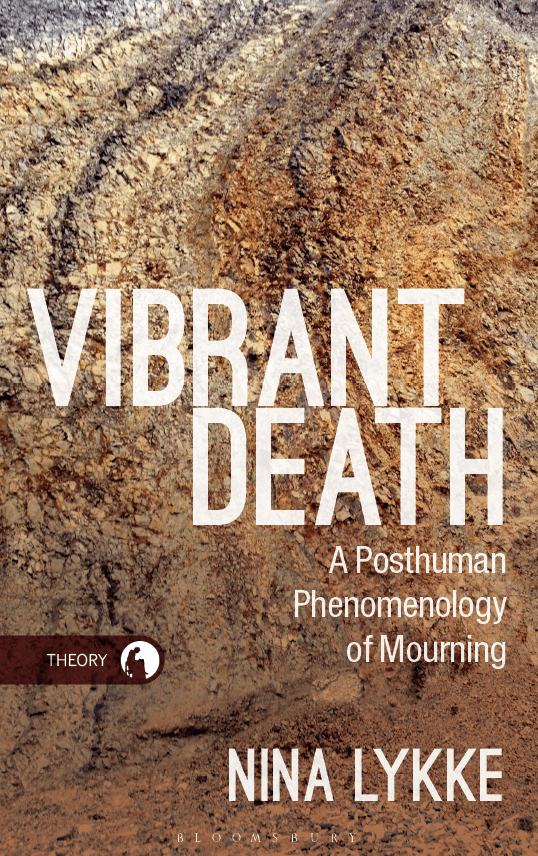
articles, most recently the philosophic-poetic monograph Vibrant Death. A Posthuman Phenomenology of Mourning, Bloomsbury, London 2022 (https://www.bloomsbury.com/us/vibrant-death-9781350149731/)

Risk Hazekamp is a Dutch interdependent visual artist, researcher, art educator, and a trans-person. Hazekamp completed the Advanced Master of Research in Art & Design at St. Lucas School of Arts Antwerp in 2020 and attended the 2020 and 2021 edition of the María Lugones Decolonial Summer School. Since 2015 Risk teaches in the Art & Research department and the minor Arts & Humanity at St. Joost School of Art & Design in Breda and Den Bosch, the Netherlands. They are now a researcher at the Biobased Research Group of CARADT (Avans University, the Netherlands), where as of April 2023, Risk will start their Professional Doctorate.

Registration link:
https://kau-se.zoom.us/…/u50kcOuorjwjE9Q…

The event is organised in collaboration with the Eco-and Bioart Lab and the GEXcel collegium.

For further information on the Eco- and Bioart Lab please follow the link: https://liu.se/en/research/the-eco-and-bioart-lab

Image: Cyanobacteria interacting with analogue photographic material © Risk Hazekamp 2021

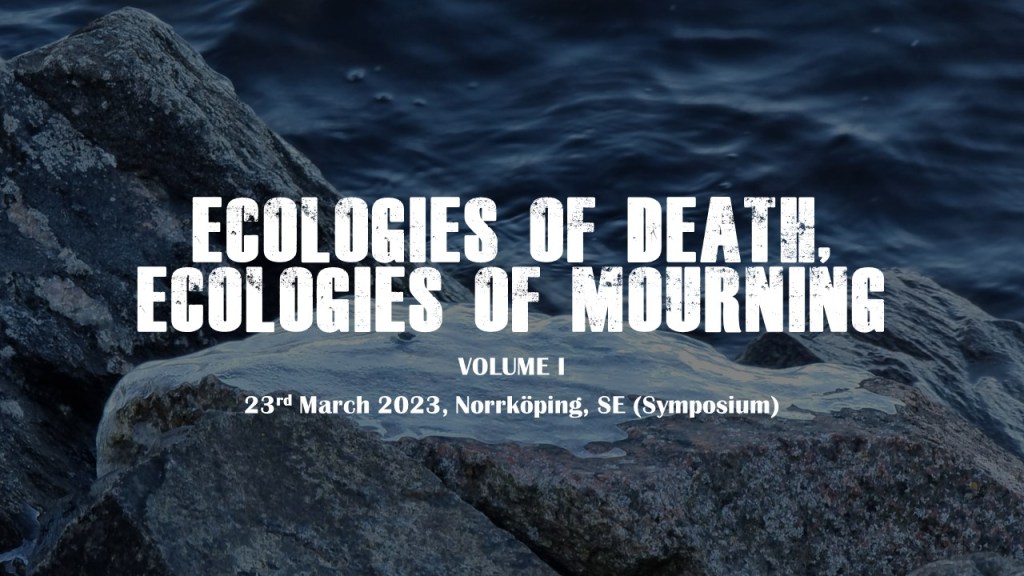
Ecologies of Death, Ecologies of Mourning: Volume I. International Symposium, 23 March 2023 in Norrköping

Ecologies of Death, Ecologies of Mourning: Volume I

International Symposium

23rd March 2023, 13:00 – 18:00

Organised by The Eco- and Bioart Lab, in collaboration with Queer Death Studies Network

Venue: Arbetets Museum (The Museum of Work), Norrköping
Keynote speakers:

Prof. Patricia MacCormack (Anglia Ruskin University, UK)

Prof. Em. Nina Lykke (Linköping University, SE/Aarhus University, DK)

Speakers:

Dr Evelien Geerts (University of Birmingham, UK)

Prof. Christina Fredengren (Uppsala University, SE)

Dr Tara Mehrabi & Dr Wibke Straube (Karlstad University, SE)

Dr Marietta Radomska (Linköping University, SE)

In the Anthropocene, the epoch of climate change and environmental destruction that render certain habitats unliveable and induce socio-economic inequalities and shared ‘more-than-human’ vulnerabilities, death and loss become urgent environmental concerns. As climate scientists indicate, in order to achieve UN Sustainable Development Goals (UN SDGs), a much more radical transformative action is needed from all stakeholders: governments, the private sector, communities and individuals (Höhne et al. 2020).

Simultaneously, planetary environmental disruption, contributing to the mortality of humans and nonhumans, destruction of entire ecosystems, the sixth mass extinction, both abrupt and ‘slow’ violence (Nixon 2011), evoke feelings of anxiety, anger and grief, manifested in popular-scientific and cultural narratives, art, and activism. These feelings are not always openly acknowledged or accepted in society; and the ecological, more-than-human dimensions of death have traditionally been underplayed in public debates. Yet, what we need now – more than ever – is the systematic problematisation of the planetary-scale mechanisms of annihilation of the more-than-human world in their philosophical, socio-cultural, ethico-political and very material dimensions. Only then will it be possible to talk about the issues of responsibility, accountability and care for more-than-human worlds (Radomska & Lykke 2022).

Taking its starting point in critically investigating and challenging conventional normativities, assumptions and expectations surrounding issues of death, dying and mourning in the contemporary world (Radomska, Meharbi & Lykke 2020; https://queerdeathstudies.net/), this interdisciplinary symposium zooms in on more-than-human ecologies of death, dying, grief and mourning across spatial and temporal scales.

The event is combined with the official launch of the four-year research project Ecological Grief, Crisis Imaginaries and Resilience in Nordic Lights (2022-26), led by Dr Marietta Radomska and generously funded by FORMAS: a Swedish Research Council for Sustainable Development.

Programme:

13:00 – 13:15 – Introduction / Launch FORMAS Eco-Grief Project

13:15 – 14:15 – Keynote I: Prof. Patricia MacCormack (Anglia Ruskin University, UK), “The Difficult Joy of Death Activism”

14:15 – 14:45 – Break (fika)

14:45 – 15:15 – Dr Evelien Geerts (University of Birmingham, UK), “The Memorial 22/3’s more-than-human hauntings: Reimaging memory, commemoration & mourning through queer(ing) spacetimematterings”

15:15 – 15:45 – Prof. Christina Fredengren (Uppsala University, SE), “Ancestral ecologies of life, death and regeneration”

15:45 – 16:15 – Dr Tara Mehrabi & Dr Wibke Straube (Karlstad University, SE), “Unsettling Intimacies: On World-Making Practices with the Other in Minoosh Zomorodinia’s Mixed-Media Installation Knots and Ripples

16:15 – 16:45 – Dr Marietta Radomska (Linköping University, SE), “Between Terminal Ecologies and Arts of Eco-Grief: A Queering Reflection”

16:45 – 17:00 – Break

17:00 – 18:00 – Keynote II: Prof. Em. Nina Lykke (Linköping University, SE), “Mourning (with) Diatoms”

REGISTRATION:

The participation in the symposium is free of charge, but we have a limited number of seats. If you wish to take part in the event, please, fill out the form: https://forms.office.com/e/Yb4qXpyVtX

NB! EDIT: the event is now fully booked. In order to be added to the waiting list, please send an email to: ecobioartlab[at]liu.se

NB! In case you have registered and it turns out you can no longer participate, please let us know by sending an email to: ecobioartlab[at]liu.se . In this way we may be able to let in anyone who may be on the waiting list.

Photo/artwork: Marietta Radomska

New Book Coming Out Soon!

Nina Lykke:

Vibrant Death. A Posthuman Phenomenology of Mourning.

Bloomsbury Academic, London.

WILL BE AVAILABLE FROM DECEMBER 2021, MORE INFO:

https://www.bloomsbury.com/uk/vibrant-death-9781350149731/


Vibrant Death links philosophy and poetry-based, corpo-affectively grounded knowledge seeking. It offers a radically new materialist theory of death, critically moving the philosophical argument beyond Christian and secular-mechanistic understandings. The book’s ethico-political figuration of vibrant death is shaped through a pluriversal conversation between Deleuzean philosophy, neo-vitalist materialism and the spiritual materialism of decolonial, queerfeminist poet and scholar Gloria Anzaldua. The book’s posthuman de-exceptionalising of human death unfurls together with a collection of poetry, and autobiographical stories. They are analysed through the lens of a posthuman, queerfeminist revision of the method of autophenomenography (phenomenological analysis of autobiographical material).

Nina Lykke explores the speaking position of a mourning, queerfeminine ”I”, who contemplates the relationship with her dead beloved lesbian life partner. She reflects on her enactment of processes of co-becoming with the phenomenal and material traces of the deceased body, and the new assemblages with which it has merged through death’s material metamorphoses: becoming-ashes through cremation, and becoming-mixed-with-algae-sand when the ashes were scattered across a seabed made of fiftyfive million-year-old, fossilised algae. It is argued that the mourning “I”’s intimate bodily empathising (theorised as symphysising) with her deceased, queermasculine beloved life partner facilitates the processes of vitalist-material and spiritual-material co-becoming, and the rethinking of death from a new and different perspective than that of the sovereign, philosophical subject.

Call for abstracts: Queer Death Studies Reader. Edited by Nina Lykke, Marietta Radomska and Tara Mehrabi

The field of Queer Death Studies

The planned reader will gather a wide range of contributions to the field of Queer Death Studies (QDS). This is an emerging, transdisciplinary field of study which takes research on death, dying, and mourning in new directions, inspired by feminist, posthumanist, decolonial, anti-racist, queer, trans, body- and affect-theoretical scholarship, art and activism (Radomska, Mehrabi and Lykke 2020). What distinguishes QDS from conventional Death Studies such as death sociology or anthropology of death is an overall critical focus on the framing of death and extinction in the contemporary world through Anthropocene necropolitics (Mbembe 2003, Lykke 2019) and necropowers of post/colonialism, racial and extractivist capitalism. Death is approached as an ethico-political issue that is embedded in global power structures. QDS pays attention to systematic, necropolitical productions of death, in dialogue with ethico-political critiques emerging from political movements for social, environmental and planetary justice and change. QDS is also based on critiques of the dichotomous divides, characterising Western modernity, and is marked out through a critical focus on normativities and exclusionary notions of the human, casting the death of those who differ from the normative human subject in terms of gender, racialisation, migration status, class, geopolitical situatedness, able-bodiedness, and species as less grievable or disposable and not counting at all (Butler 2004). In short, QDS aligns itself with critiques of the intra-acting multiplicity of hierarchising divides between appropriate and in/appropriate/d others (Minh-ha 1989), articulated by social, environmental and planetary justice movements.

The Call

With this call, we invite abstracts from researchers, students, artists and activists who see their research and activities as aligned with critiques of the necropowers operating in the contemporary world, and who want to contribute to queering, decolonising and posthumanising death and the onto-epistemololgies and politics conventionally framing death.

Queering, Decolonising and Posthumanising

The verbform, queering, which we use here, encompasses a wide range of meanings. It refers to (1) open-ended deconstructing of normativities and processes of normalisation in various forms, as well as (2) undoing of heteropatriarchy, heteronormativity, binary gender and sexualities governed by reproductive biopowers or, in other words, the normative heterosexual matrix. Queering death is thus on the one hand understood as a critical strange-making, and defamiliarising, which may imply affirmative openings of other horizons than Christian and Cartesian dualist approaches to death, for example a focus on the vibrant entanglement of growing and decomposing (Radomska 2017; Lykke 2022). On the other hand, queering means critically focusing on the ways in which misogyny, trans- and queerphobia lead to social as well as physical death, and how violence and hate crimes towards non-normative individuals seek to render their lives and deaths non-grievable (Puar 2007; Chen 2012; Snorton 2017). Together with this broad spectrum of meanings, we also want to emphasise that queering should be understood in its intersections with decolonising and posthumanising efforts

Decolonising death involves critically dismantling the violent necropowers of colonisation, racial and extractivist capitalism, which for centuries have made death become ”life’s quiet companion” (Lehman 1997) for racialised and indigenous people worldwide, as well as confronting the over-arching racisms which continue to produce (physical, social and cultural) death along racialised lines. Moreover, decolonising death signals a turn towards pluritopic hermeneutics (Tlostanova and Mignolo 2009), i.e. hermeneutics which do not universalise Western modern frameworks, and which reevaluate indigenous philosophies, cosm-ontologies and sensibilities. In terms of life/death thresholds, this implies critically-affirmatively shifting the meanings of death, for example, substituting conceptualisations and imaginaries of death as a final endpoint within a chrononormative linear temporality, and instead opting for understandings, situated in geo- and corpo-political frameworks outside of Western modernity (e.g. Smith 1999; Anzaldua 2015).

Posthumanising death refers to the systematic problematisation of the planetary-scale mechanisms of annihilation of the more-than-human world in their ontological, epistemological and ethico-political dimensions. It involves critical analyses of the human/nonhuman divide and power differentials that have allowed for the reduction of the nonhuman to mere resource and instrument for human endeavours. Furthermore, the posthumanising move entails unpacking philosophical and cultural meanings of extinction and the ways in which it fundamentally disrupts life processes in relation to time, death and generations (e.g. Rose 2012); it draws attention to environmental violence, environmental grief, as well as nonhuman death manufactured en masse through anthropocentric habits of consumption and mechanisms of extractivism.

Consequently, posthumanising death takes seriously the issues of responsibility, accountability and care for/in dying more-than-human worlds, while remaining grounded in radical critiques of human exceptionalism, and affirmative embrace of alternatives (eg. Braidotti 2013; Haraway 2016; MacCormack 2020).

Formats and deadlines:

We call for abstracts of approximately 300 words, to be accompanied by a bio-note of approximately 200 words, as well as by a title of the proposed chapter and an indication of how the chapter relates to the below main themes to be covered in the reader.

Please, send your abstract etc to ninly[at]fastmail.fm , cc: <marietta.radomska[at]liu.se> and <tara.mehrabi[at]kau.se>

Abstract DEADLINE: 1st NOVEMBER, 2021

We will respond to your abstract by MID-JANUARY 2022, and foresee submissions of FIRST DRAFT CHAPTERS by August 1, 2022.

We plan a reader with around 50 contributions, including a few reprints of classics. Scholarly as well as creative and artistic contributions are welcome! We hope together with contributors to build a reader which will be significant and agenda-setting for the field

Thematic clusters:

*Queering Death: Rethinking life/death ecologies

*Histories of necropowers and Anthropocene necropolitics

*Decolonising death

*Posthumanising death

*Demedicalising death

*Politics and Ethics of Mourning

*Alternative Spiritual, Aesthetic and Arts Activist Approaches to Death and After-life

The International Network for Queer Death Studies

The idea for the reader grew out of the international network for Queer Death Studies, which was founded in 2016, (see https://queerdeathstudies.net/). The network has organised several workshops and an international conference at Karlstad University, Sweden, in 2019.

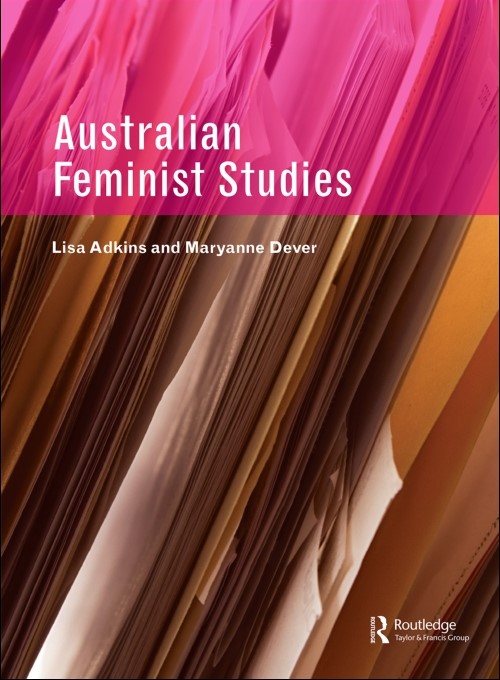
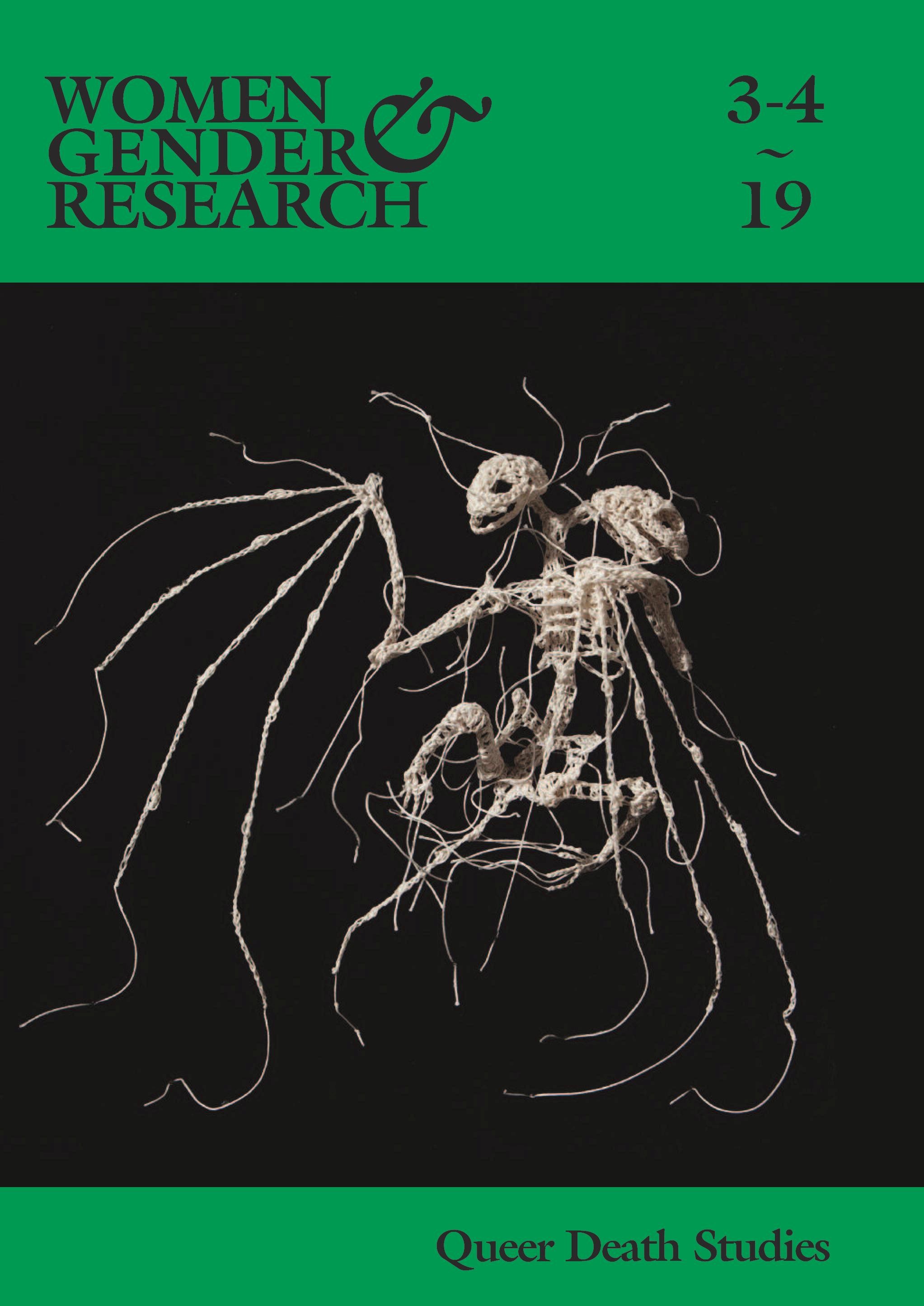
We have earlier published two special journal issues of Australian Feminist Studies (2020, Vol 35 (104)), and Women, Gender and Research (2019: Issue 3-4).

References

Anzaldua, G. E. (2015), Light in the Dark/Luz en Lo Oscuro: Rewriting Identity, Reality, Spirituality, Durham, NC: Duke University Press.

Braidotti, R. (2013), The Posthuman, Cambridge, UK: Polity Press.

Butler, J. (1990), Gender Trouble. Feminism and the Subversion of Identity, London, New York: Routledge.

Butler, J. (2004), Precarious Life: The Powers of Mourning and Violence, New York, NY: Verso.

Chen, M. Y. (2012), Animacies: Biopolitics, Racial Mattering and Queer Affect, Durham, NC: Duke University Press.

Haraway, Donna (2016), Staying with the Trouble: Making Kin in the Chthulucene, Durham, NC and London: Duke University Press.

Lehman, G. (1997), ‘Life’s Quiet Companion’, in G. Carey and R. Sorenson (eds), The Penguin Book of Death, 223–232, Ringwood: Penguin Australia.

Lykke, N. (2019), ‘Making Live and Letting Die: Cancerous Bodies between Anthropocene Necropolitics and Chthulucene Kinship’, Environmental Humanities, 11 (1): 108–36.

Lykke, N (2022), Vibrant Death. A Posthuman Phenomenology of Mourning. London: Bloomsbury Academic.

MacCormack, Patricia (2020a), The Ahuman Manifesto. Activism for the End of the Anthropocene. London: Bloomsbury Academic.

Mbembe, A. (2003), Necropolitics, Public Culture, 15 (1): 11–40.

Minh-ha, T. T. (1989), Woman, Native, Other: Writing Postcoloniality and Feminism, Bloomington and Indianapolis IN: Indiana University Press.

Puar, J. (2007), Terrorist Assemblages: Homonationalism in Queer Times, Durham: Duke UP-

Radomska, M., T. Mehrabi, and N. Lykke (2020), Queer Death Studies: Death, Dying and Mourning From a Queerfeminist Perspective, Australian Feminist Studies, 35(104): 81-100.

Radomska, M. (2017), Non/living Matter, Bioscientific Imaginaries and Feminist Technoecologies of Bioart, Australian Feminist Studies, 32 (94): 377-394.

Rose, D. B. (2012), Multispecies knots of ethical time, Environmental Philosophy, 9(1): 127–140.

Shildrick, M (2020) Queering the Social Imaginaries of the Dead, Australian Feminist Studies, 35(104): 170-185.

Smith, L.T. 1999. Decolonizing Methodologies. Research and Indigenous Peoples. London and New York: Zed books.

Snorton, C.R (2017), Black on Both Sides: A Racial History of Trans Identity. Minneapolis: University of Minnesota Press.

Tlostanova, M. and W. Mignolo (2009), On Pluritopic Hermeneutics, Trans-Modern Thinking, and Decolonial Philosophy, Encounters, 1 (1): 11–27.

New Publication: Special issue of the journal Australian Feminist Studies focused on Queer Death Studies

We are delighted to say that the special issue of the journal Australian Feminist Studies focused on the topic of “Queer Death Studies” and co-edited by Marietta RadomskaTara Mehrabi and Nina Lykke, has finally been published.

The issue contains contributions by QDS scholars: Patricia MacCormack, Marietta Radomska, Tara Mehrabi, Stine Willum Adrian, Margrit Shildrick, Hema’ny Molina Vargas, Camila Marambio and Nina Lykke.

The collection strives to advance queerfeminist methodologies and ontological, ethical and political understandings that critically and creatively attend to the problem of death, dying and mourning in the current environmental, cultural, and socio-political contexts.

In order to learn more, do check out the introduction “Queer Death Studies: Death, Dying and Mourning From a Queerfeminist Perspective”, co-authored by myself, Tara and Nina, available in OA here.

InterGender course “Queer Death Studies – Analyzing and Resisting Necropower”

NEWS via InterGender, Consortium and Research School in Interdisciplinary Gender Studies www.Intergender.net

For this course PhD students, but also Master’s students are eligible to apply.
Title of the Course:

Queer Death Studies – Analyzing and Resisting Necropower

The recommended accreditation is: 7,5 + 7,5 credits
 
Time:
December 8, 2020
 
Location: Online
 
Deadline for applications: September 20, 2020
 
Applications should be sent to: InterGender Consortium Coordinator Edyta Just (edyta.just[at]liu.se)
 
Maximum number of participants: 20 participants
 
Organized by: InterGender, Consortium and Research School in Interdisciplinary Gender Studies and Linköping University, Sweden
 
Course coordinator:
InterGender Consortium Coordinator Edyta Just (edyta.just[at]liu.se)
 
Teachers:
Professor Em Nina Lykke, Linköping University, Sweden
Senior lecturer Tara Mehrabi, Karlstad University, Sweden
Postdoc Marietta Radomska, Linköping University, Sweden
 
Course description:
The course gives an introduction to the emerging field of Queer Death Studies, its critiques of necropowers, and its framings of resistances to current necropolitics, moulded by neoliberal and extractivist capitalism and post/colonialism. It raises the question: What does it mean to bring the notion of queering to bear on the analysis of death, dying, mourning and afterlife in current political climates and contexts of crises? In response, the course takes a point of departure in a broad conceptualization of queering. This means that queer will be understood in its verbform, queering, which refers to processes of undoing and unmaking of norms and structurally oppressive societal normativities in a broad sense, which in the case of death, dying, mourning and afterlife is related to clusters of intersecting necropowers. But it will also be emphasized how such an understanding opens horizons towards politically much needed reflections on resistance and reontologizations, based on entanglements of queering methodologies with posthumanizing and decolonizing ones. The lectures will draw on different analytical examples, focusing 1) on the issue of killability and disposable bodies related to lab animals; 2) on bioart practices and the ways in which they call for reflections on the non/living; 3) on viral ontologies and necropowers, related to the CoVid19 pandemic.


Online format:

The course will be organized as a one-day online event in real time (Dec 8, 10.00-12.30 + 13.00-17.45), see time schedule below.
Lectures by each of the three teachers will be prerecorded and made digitally accessible to registered participants 2 weeks before the online event in real time. Preparation for the online event will entail listening to the lectures, submitting a paper (2–5 pages describing research problem related to the participant’s PhD thesis project (or master thesis project)), and read the papers of 5-6 fellow participants. A reading list, also to be prepared before the online event, will be sent to participants when admitted to the course. (See also general remarks on course preparation below).
The one-day online event in real time will be divided into plenary and group sessions, shifting between discussions of lectures and readings, and students’ presentations. Body exercises and creative moments will be included – in order to make the online event more lively.
 
Schedule:
Time schedule:
10.00-10.30 – Welcome and round of short presentations.
10.30-10.45 – Shared creative exercise
10.45-11.30 – Discussion of lecture 1 and related readings from the reading list.
11.30-11.45 – Shared creative exercise
11.45-12.30 – Discussion of lecture 2 and related readings from the reading list.
12.30-13.00 – Lunch break
13.00-13.45 – Discussion of lecture 3 and related readings from the reading list.
13.45-14.00 – Shared creative exercise
14.00-17.00 – Group work on students’ projects (3 groups, each chaired by one of the teachers – creative moments and breaks will be decided in the group)
17.00-17.45 – Wrap up, evaluations, and creative farewell moment.
 
 Preparation (after the acceptance to the course):
• Course readings: will be sent to participants, when admitted to the course.
• Paper (2–5 pages describing research problem related to the participant’s PhD thesis project (or master thesis project) to be sent to the Local InterGender Course and the InterGender Consortium Coordinator Edyta Just (edyta.just[at]liu.se) Remember to mark it with your name and the course name.
• All participants are expected to read the paper of their fellow group members before the course and be prepared to offer constructive comments in the group sessions and workshops. The papers will be made available online.
 
Essay:
• 10-15 pages to be handed in no later than 3 months after the course. One copy should be sent to the teacher, who chaired the group in which the student presented their paper at the course and who is going to evaluate it, and one to the InterGender Consortium Coordinator Edyta Just (edyta.just[at]liu.se). The teacher has 3 months to evaluate the essay.
• The essay should strike a balance between addressing a theme that has been part of course (lectures, discussions, reading material), and be relevant for participant’s own research.
• The essay should, moreover, be considered as an exercise in doing a written presentation aimed at an academic readership not familiar with the author’s PhD research. The essay should constitute a whole and explain relevant contexts.
 
Accreditation and examination:
1. 7,5 ECTS credits are recommended for active participation and a short paper, 2-5 pages describing research problem related to the participant’s PhD thesis project (or master thesis project).
2. 15 ECTS credits are recommended for active participation plus an essay (graded pass/fail).
3. The essay should be 10-15 pages. The selected topic shall be related to the course content and readings, and relate to the student’s own research area. The essay is to be sent to the teacher as well as to the InterGender Consortium Coordinator no later than 3 months after the final day of the course. The teacher has 3 months to evaluate the essay.
 
It is the students’ own responsibility to ask their institution about its accreditation rules and get the credit points registered at their respective higher education establishment.


Course Certificate:

In order to request the certificate, please send an e-mail to Edyta Just (edyta.just[at]liu.se).

The Consortium Coordinator issues, upon request, a certificate indicating to how many ECTS credits course participation is considered equal. It is the students’ own responsibility to ask their institution about its accreditation rules and get the credit points registered at their respective higher education establishment.

InterGender cannot issue a regular InterGender Certificate to MA students but a Certificate of Attendance. For MA students, the coordinator can state what the course was about content and format wise, what the requirements were for all in terms of readings and participation and the number of the credits it was equivalent to.
 
Applications should be written in English and include:
* name, affiliation, full address, e-mail, phone
* name and affiliation of PhD supervisor (MA supervisor)
* brief CV
* description of PhD project (MA project) (1-2 pages)
* motivation: why do you want to participate in the course (1-2 pages)
* please, indicate if you are in the first/middle/last phase of your PhD research or if you are a MA student
 
MA students will be selected on the basis of an evaluation of their CV, project description and a letter of motivation.
 
Information on Admission for PhD students:
 
1. Participants have to be registered as PhD students.
 
2. PhD students from all disciplines and countries are eligible.
 
3. Participants will be selected on the basis of an evaluation of their CV, project description and a letter of motivation.
 
4. If there are more applicants who qualify for participation, than there are places, the places will be distributed along the following criteria:
 
a) Students registered as PhD students at Partner Units will be prioritized for a maximum 80% of places. When the places are distributed among the Partner Unites, a good spread between these units will also be ensured.
 
b) Students registered as PhD students in other units at the Partner Higher Education Establishments will be prioritized for 20 % of the places. When the places are distributed among the Partner Higher Education Establishments, a good spread between these establishments will also be ensured. If places remain of the 80 % prioritized for PhD students registered at the Partner Units, these places will instead be prioritized for PhD students registered at the Partner Higher Education Establishments.
 
c) If the students according to a) and b) do not fill all the places, remaining places will be open for competition between all eligible and qualifying applicants from any higher education establishment.
 
5. If there are more eligible and qualified applicants for the a selection process will take place, which, in addition to academic quality and motivation/relevance, will use non-discriminatory selection criteria, which will ensure a spread of nationalities, regions, institutions and disciplines.
 
6. An additional lot drawing procedure will be used, if several eligible and in all respects
equally qualified applicants are competing for the limited number of places in the different categories
 
7. In case of too many eligible and qualifying applicants, a waiting list will also be organized, and places will be offered to applicants on this list, should some of the selected participants have to cancel.
 
8. The consortium coordinator selects participants under the auspice of the board, and is required to report to the board how selection is distributed between the consortium partners. If the board finds that the distribution is uneven, the consortium coordinator shall compensate for this in future selections.
 
There is no tuition fee for the course.

‘Queering Ecologies of Death’ panel at the SLSAeu GREEN conference in Copenhagen, 13-16 June 2018

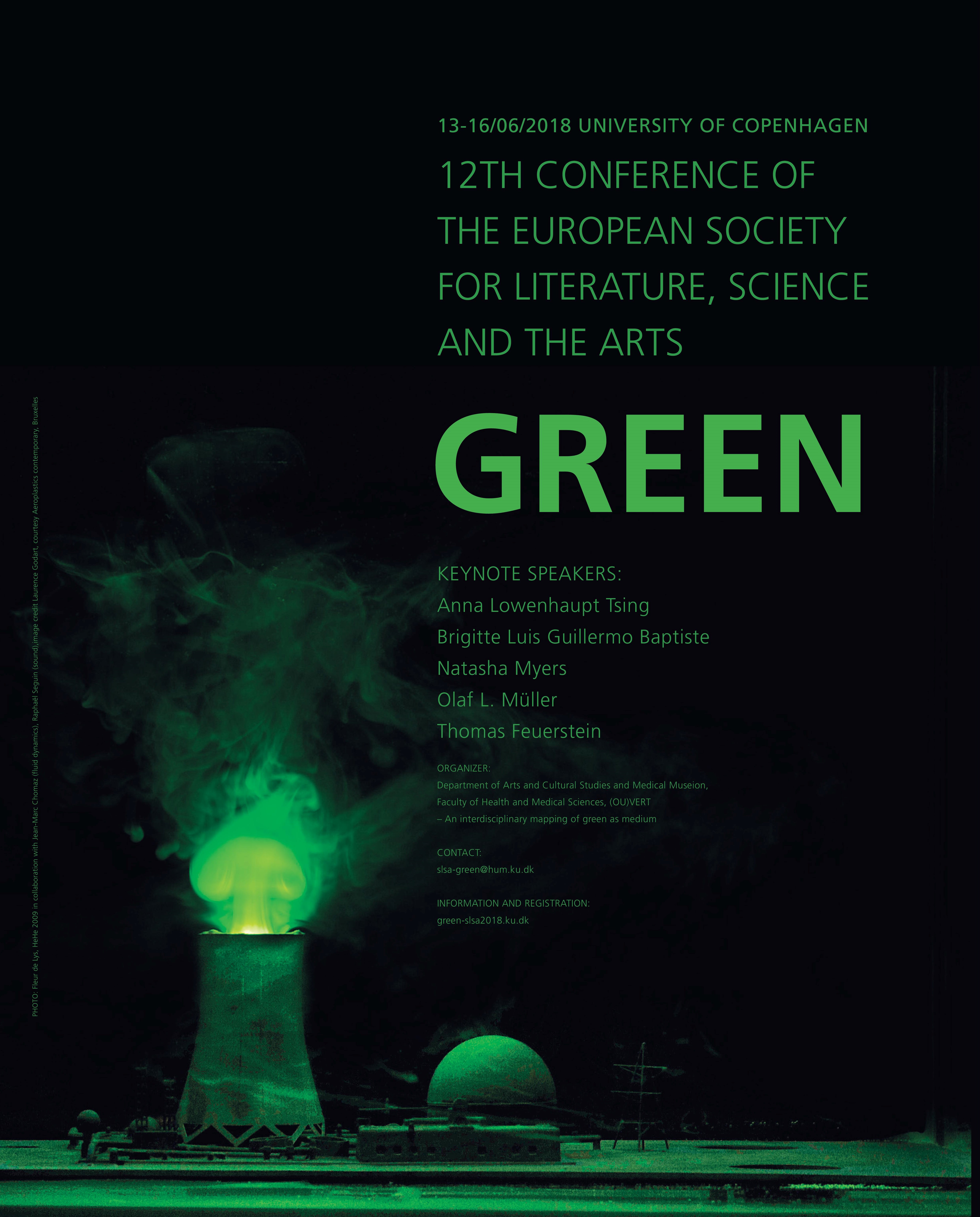
GreenSLSAPoster-page-001 (2)
GREEN SLSAeu poster

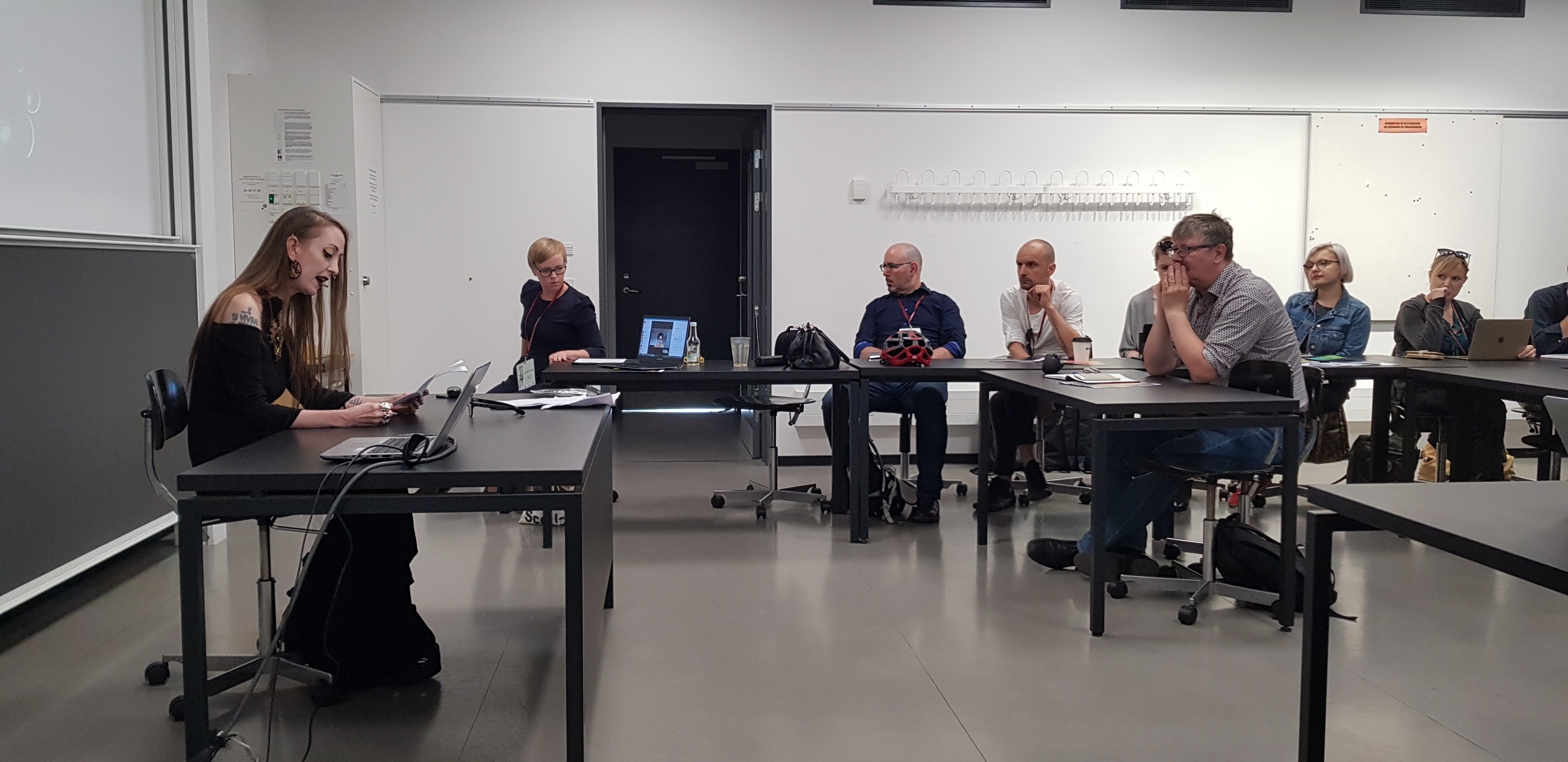
On 14th July some of the QDS Network researchers had a pleasure to present their work in the two-session panel ‘Queering Ecologies of Death’, proposed by Prof. Patricia MacCormack (Anglia Ruskin University, UK) and Dr. Marietta Radomska (Linköping University, SE), at the SLSAeu GREEN conference that took place on 13-16 June 2018 in Copenhagen, Denmark.

Link to the full programme.

Link to the panel schedule.

Below you may find the summary of the panel which consisted of the speakers: Dr. Marietta Radomska, Prof. Patricia MacCormack, Dr. Line Henriksen (University of Copenhagen, DK), Dr. Tara Mehrabi (University of Turku, FI), Prof. Margrit Shildrick (Stockholm University, SE) and Prof. Nina Lykke (Linköping University, SE).

RADOMSKA & MacCormack
& Henriksen & Mehrabi & Shildrick & Lykke

PANEL: Queering Ecologies of Death

‘Green’ as a concept has become a shorthand for ‘ecology’, understood as that which refers to ‘home’ or ‘environment’ with all their constituting relationalities. It not only evokes a reflection on or concern with human and nonhuman entities and their milieus, but also implies a set of discourses (public, political, scientific, philosophical) that focus on the climate change and contemporary ecological crises. The latter, more often than not, entail the degradation and diminution of food and water resources, which make certain habitats unlivable.
Along with ‘climate migration’, these processes lead to the death of individual organisms, populations and species extinction, prompting us to reconsider our ways of understanding and relating to death, dying, extinction and annihilation.
While bioscience and biotechnologies underline and expose interdependency, commonality and relationality as key characteristics of life shared by all organisms, Western thought and cultural imaginaries tend to draw a thick dividing line between human and nonhuman animals and other organisms, notably visible in the context of death. The interdisciplinary field of Death Studies (in its conventional form) gives precedence to the death of human individuals as its main research subject, examined primarily through psychological, anthropological and sociological lens. Western philosophies approach death in a double way: as a process common to all organisms and an event that distinguishes the human from other creatures (e.g. Heidegger [1953] 2010; Calarco 2008).
Yet, in the context of discussions on the so-called Anthropocene – a distinct geological epoch we live in, generated by ‘human activities on earth and atmosphere, and at all, including global, scales’ (Crutzen & Stoermer 2000, 17) – it becomes evident that the stories of species extinction, animal death and annihilation of nonhuman life, broadly speaking, are deeply entangled with the histories of colonial violence, genocide and oppression/elimination of the non-normative human other.
Environmental science and the humanities examine more-than-human death primarily in the form of species extinction, its narratives and imaginaries. Simultaneously, human death is classified, investigated and valued separately: approached through a cultural, social or biomedical lens, it appears as either ‘the end’ of individual’s existence (in religious discourses taken as a step towards an afterlife), or as something to postpone or eliminate by medical means. However, if we look at the human corpse itself, it is an (always already) non/human assemblage of entities, materialities and processes.
Against this background, what strikes is the lack of sufficient theorising of the messy intimacies between materialities of human and nonhuman kind that constitute the processes of death, dying and annihilation. In other words, our cultural understandings require conceptualisations and narratives attentive to multiplicitous relationalities and entanglements of the living and non-living, and human and nonhuman or, what we call, ‘ecologies of death’.
This transdisciplinary panel brings together several different perspectives, encompassing such fields as philosophy, art, cultural studies, monster studies, science and technology studies, gender studies and disability studies, in order to ask what it means to queer ecologies of death. The speakers will not only concentrate on the processes and materialities of death and dying, and living and non-living in a more-than-human world, but also investigate how such enquiries go beyond, unsettle and subvert given norms, normativities and binaries that govern our approaches to and understandings of death, dying, extinction and annihilation. In particular, the
panelists will focus on the following set of questions:
How can ecosophy (a thought informed by entangled intimacies of the living and non-living beyond green) and bio-philosophy (thinking life in its relation to that which takes it beyond itself) attend to multiplicitous difference and relationality constitutive of death and dying as well as its ontology and ethics?

Queering Ecologies of Death: Part 1

While thinking with and through the contemporary practices of eco- and bioart, Marietta Radomska (Linköping University) will ask how such forms of art explore and enact the
relations between the human and the environment in the context of the annihilation of life on Earth resulting from human activity? How can doing biophilosophy through art contribute to a less anthropocentric, non-normative and different understanding of death? And, in return, what kinds of ethics does it mobilise?
Patricia MacCormack (Anglia Ruskin University) will focus on how abolitionism (animal rights at its extreme) can rethink entanglement as grace through a leaving be, while also opening the ecosophical world to freedoms unperceived by anthropocentric apprehension. Furthermore, she will ask how human extinction through a cessation of reproduction or advocation of anti-natalism could further abolition to become
a form of queer death activism that is both vitalistic and caring, creative and jubilant?
Line Henriksen (University of Copenhagen) will look at the ways contemporary ecocritical discourses bring forward the questions of disappearance, absence, annihilation, trace and void. More specifically, if ecology is a home/household
(oikos) – she asks – is it haunted? By bringing together hauntology and ecotheory, she will discuss what it means to think spectrality as part of ecological systems, thereby delving
into the transparency of the apparition as much as the traditional ‘green’ of ecology.

Queering Ecologies of Death: Part 2

Drawing on her ethnographic work in a Drosophila Melanogaster laboratory, Tara Mehrabi (University of Turku/Karlstad University) will explore how, in the context of
contemporary bioscience, life (e.g. of animal models) – no longer scientifically ‘valuable’/’useful’ – becomes ‘waste’. How does this particular ecology of death challenge and queer the boundaries of natural/artificial, inside/outside, nature/laboratory,
safe/hazardous and living/non-living beyond green? How does it problematise human exceptionalism and binary logic?
Margrit Shildrick (Stockholm University/University of Toronto) will enquire about death (organic/cellular/singular/species) in the context of the research on michrochimerism
beyond the human. She will anchor these questions in the problematics around the ‘greening’ of the gut and eradication therapy.
Finally, Nina Lykke (Linköping University) will concentrate on how human death and the human corpse can be rethought from the perspective of inhuman forces, understood
in an immanence philosophical sense, and redefined against the background of its transcorporeal belonging to a queer planetary kinship of vulnerable more-than-human-bodies. What are the eco-ethical implications of such a redefinition?

20180614_091311
Prof. Patricia MacCormack on ‘The Age of Anthropophagus’

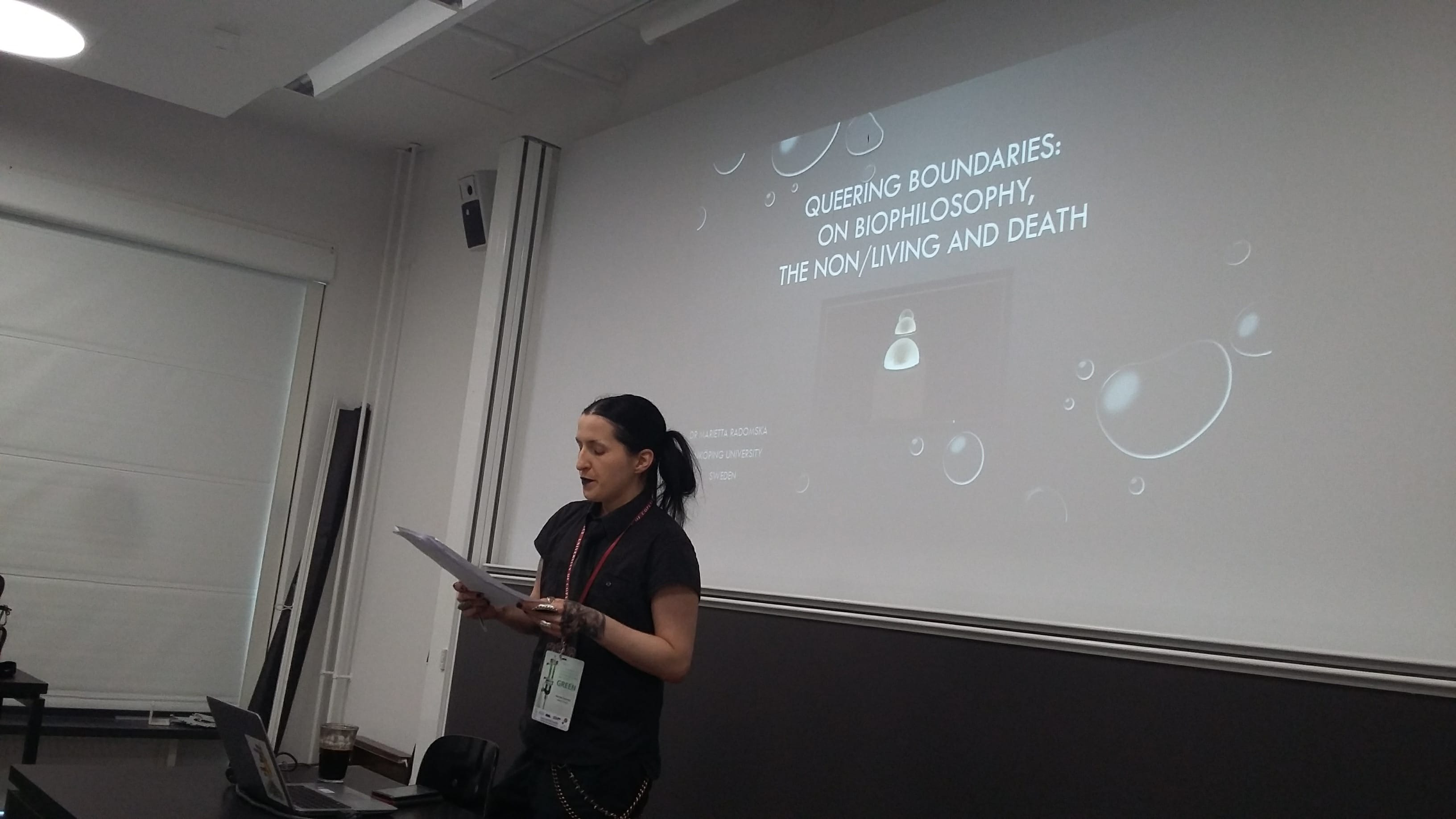
received_10159626006888504
Dr. Marietta Radomska on ‘Queering Boundaries: On Biophilosophy, the Non/Living and Death’

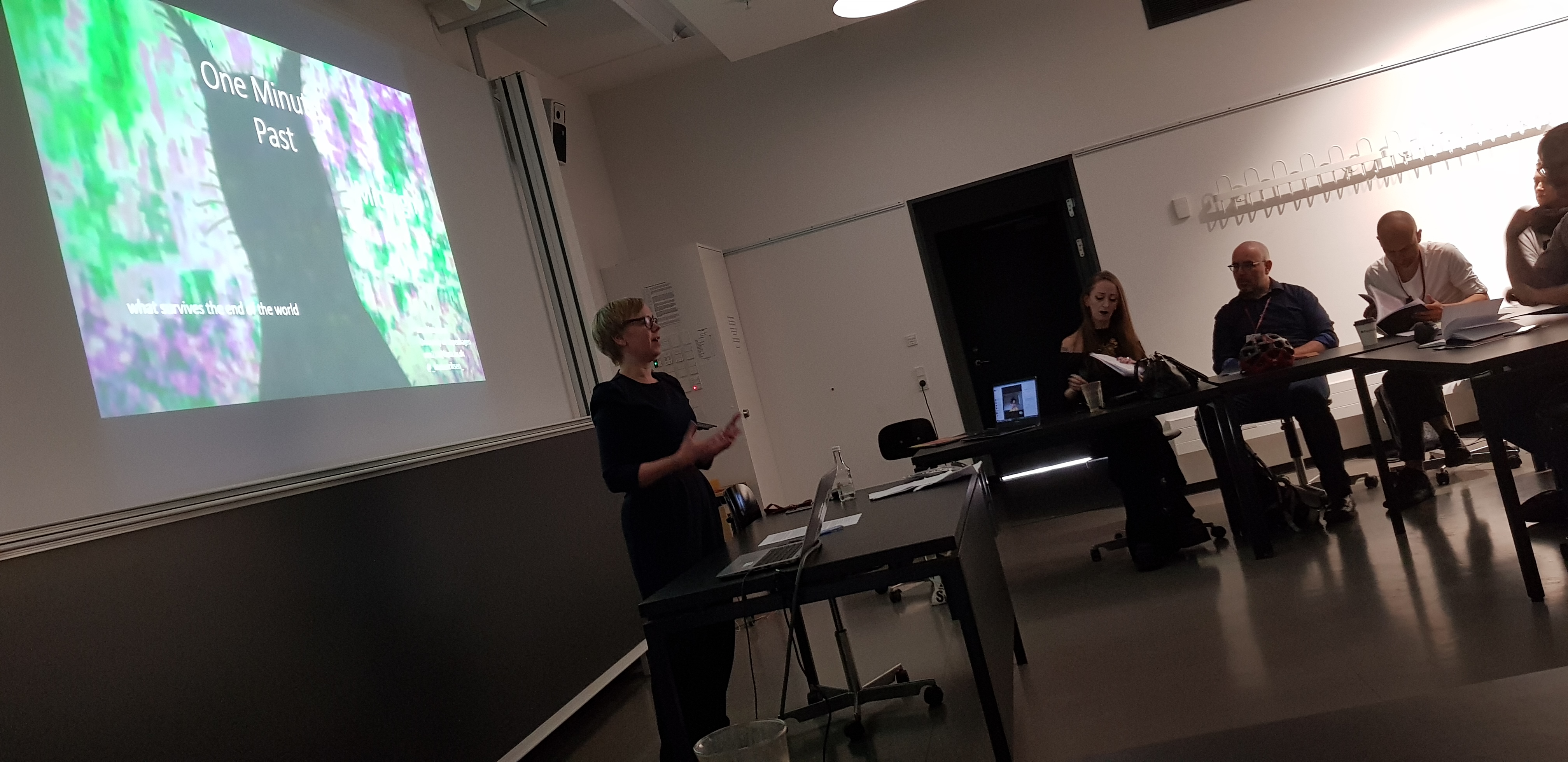
20180614_093603
Dr. Line Henriksen on ‘One Minute Past: What Survives at the End of the World’

IMG_20180614_182728
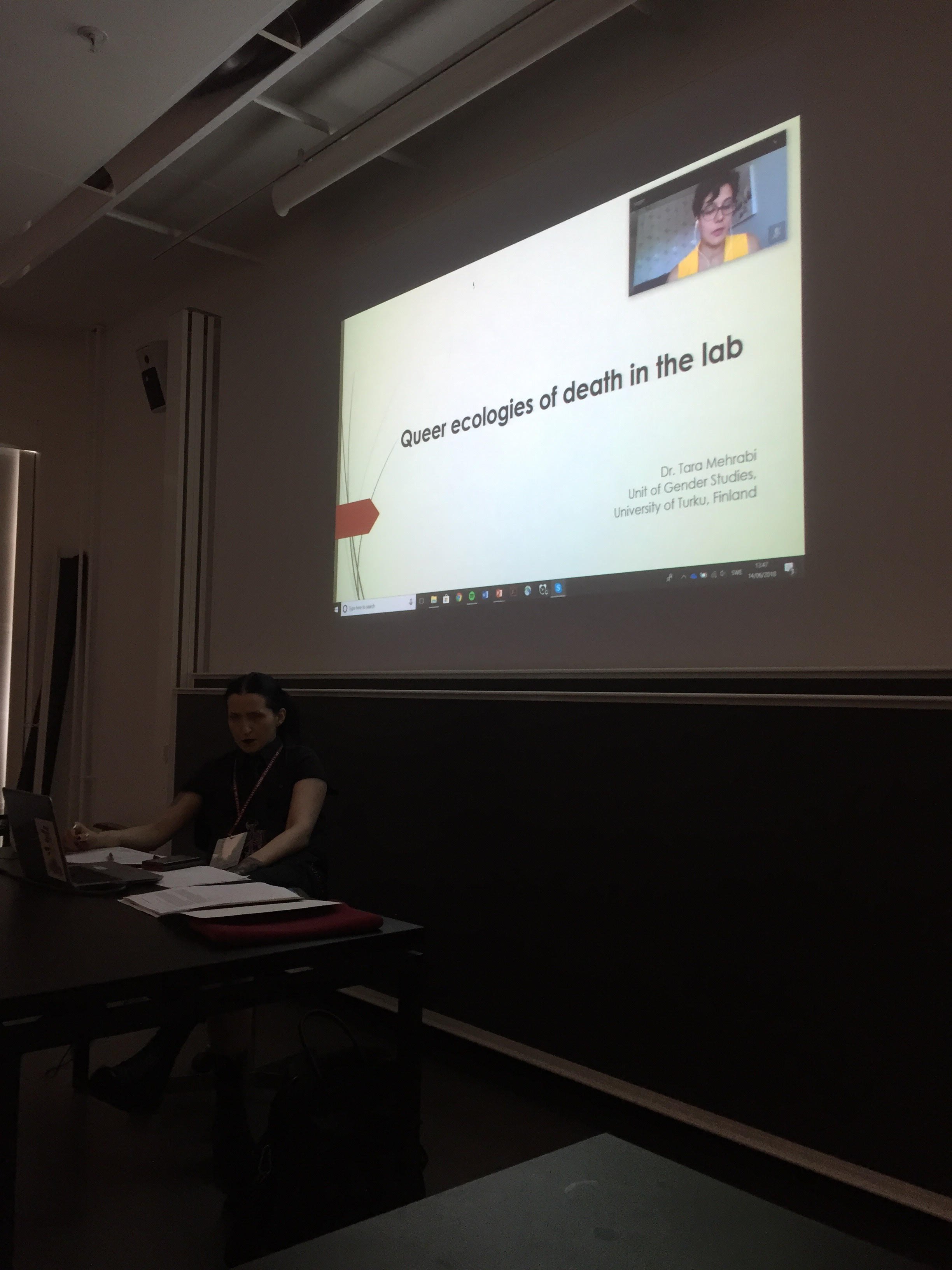
Dr. Tara Mehrabi on ‘Queer Ecologies of Death in the Lab’

20180614_141100
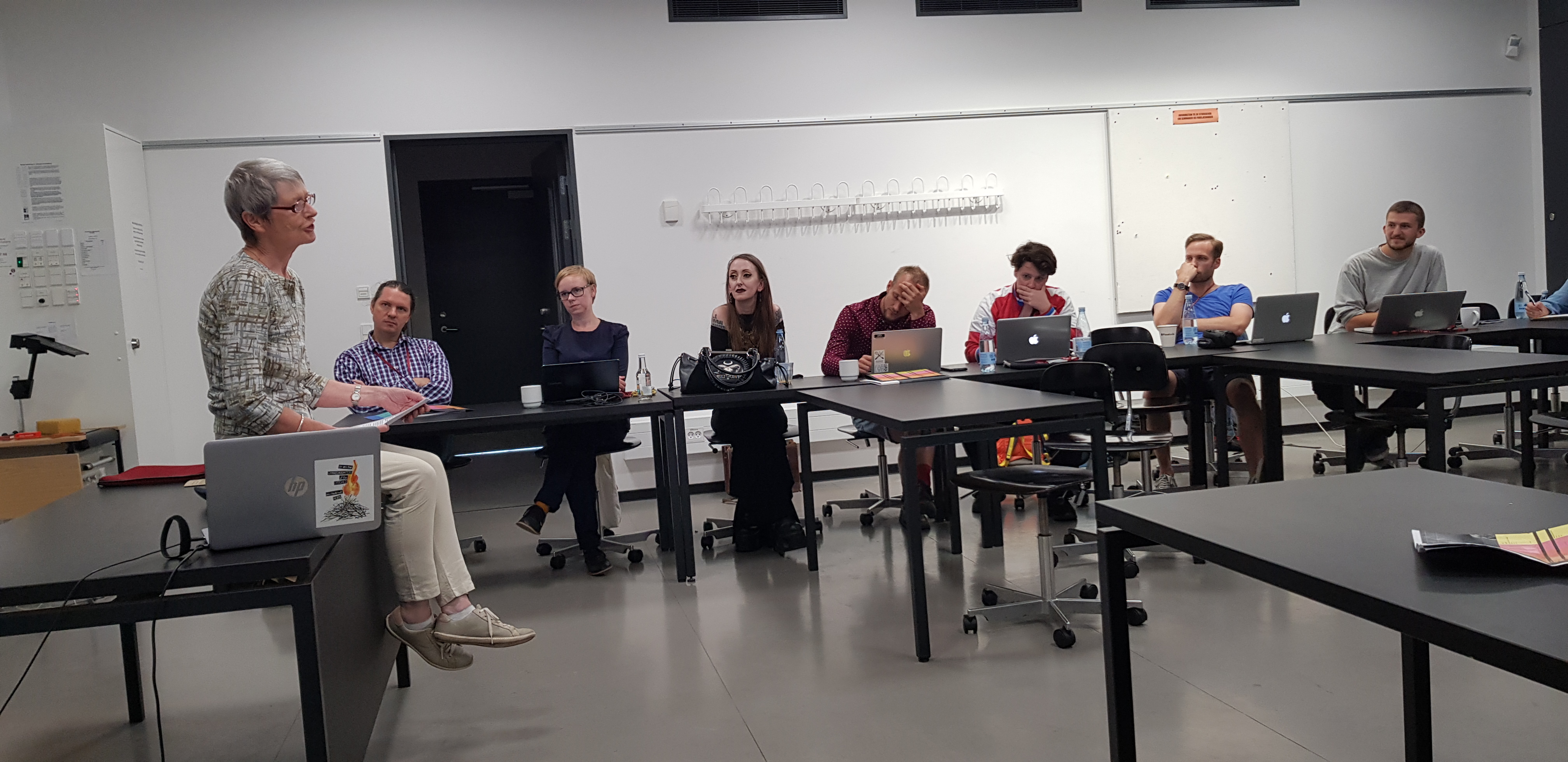
Prof. Margrit Shildrick on microbiome, microchimerism and death

20180614_145318
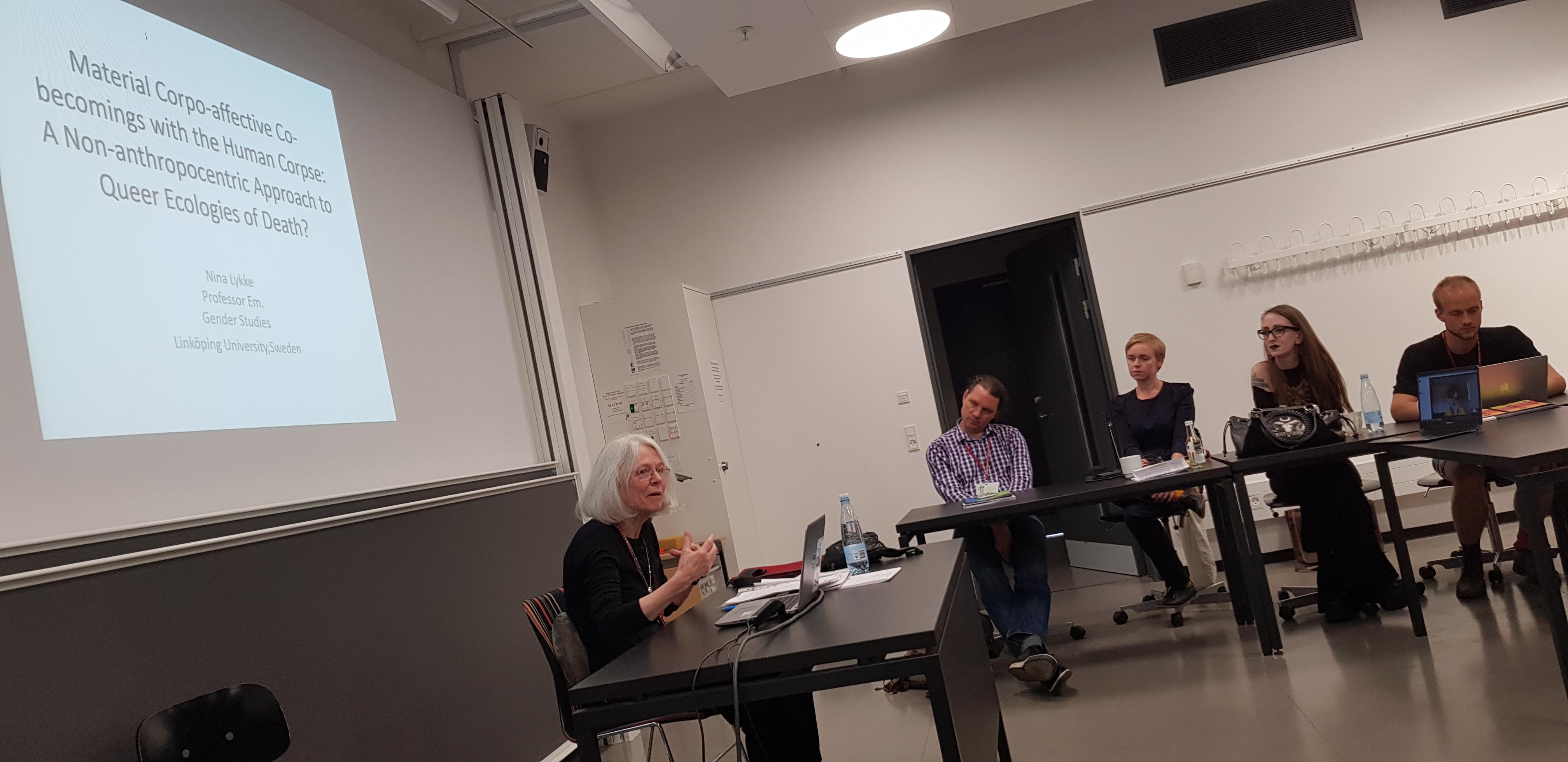
Prof. Nina Lykke on ‘Material Corpo-affective Co-becomings with the Human Corpse’