News from Karlstad University: “Ancestral Conviviality: How I fell in love with queer critters” by Risk Hazekamp and Nina Lykke, 22 March.

We have a pleasure to invite you all to an exciting hybrid event organised by the Centre for Gender Studies at Karlstad University, in collaboration with The Eco-and Bioart Lab and the GEXcel collegium.

Performance Lecture

by Risk Hazekamp and Nina Lykke

Ancestral Conviviality: How I fell in love with queer critters

The performance lecture takes its point of departure in an artistic-philosophic collaboration between Nina Lykke and Risk Hazekamp*), who found each other in their love of micro-organisms, especially Diatoms (a micro-algae with a unique coloured shell) and Cyanobacteria (also called green-blue algae). A warm digital exchange followed, both in words and images, in which the voices of Nina and Risk eventually merged into one shared ‘I’, contemplating co-becomings with the ‘you’ of Diatoms and Cyanobacteria. Speculative, passionate conversations shaped up between these interlocutors, investigating the precarious conditions of in-between-ness, life and death on the planet, and figuring out more-than-human pathways towards joyful, ethical co-existence with the planet body beyond anthropocene extractivism and binary separations of human and non-human bodies. The performance lecture will invite audiences to engage in these conversations.

*) See: Risk Hazekamp & Nina Lykke. 2022. Ancestral Conviviality. How I fell in love with queer critters.
Forum+ Vol 29, Issue 3, p. 30-36
DOI: https://doi.org/10.5117/FORUM2022.3.008.HAZE

Nina Lykke is Professor Emerita of Gender Studies at Linköping University, Sweden, and Adjunct Professor at Aarhus University, Denmark. She* is also a queerfemme-inist philosopher-poet and writer. For many years, she* took part in the building of Feminist Studies in Scandinavia and Europe more broadly. She* has recently co-founded international networks for Queer Death Studies and Ecocritical and Decolonial Research. She* has published numerous books and
articles, most recently the philosophic-poetic monograph Vibrant Death. A Posthuman Phenomenology of Mourning, Bloomsbury, London 2022 (https://www.bloomsbury.com/us/vibrant-death-9781350149731/)

Risk Hazekamp is a Dutch interdependent visual artist, researcher, art educator, and a trans-person. Hazekamp completed the Advanced Master of Research in Art & Design at St. Lucas School of Arts Antwerp in 2020 and attended the 2020 and 2021 edition of the María Lugones Decolonial Summer School. Since 2015 Risk teaches in the Art & Research department and the minor Arts & Humanity at St. Joost School of Art & Design in Breda and Den Bosch, the Netherlands. They are now a researcher at the Biobased Research Group of CARADT (Avans University, the Netherlands), where as of April 2023, Risk will start their Professional Doctorate.

Registration link:
https://kau-se.zoom.us/…/u50kcOuorjwjE9Q…

The event is organised in collaboration with the Eco-and Bioart Lab and the GEXcel collegium.

For further information on the Eco- and Bioart Lab please follow the link: https://liu.se/en/research/the-eco-and-bioart-lab

Image: Cyanobacteria interacting with analogue photographic material © Risk Hazekamp 2021

Ecologies of Death, Ecologies of Mourning vol. II: A Roundtable. 30th March 2023 on Zoom

In case you cannot make it for our symposium on 23rd March in Norrköping, or if you are still thirsty and wish to explore the theme further, you are warmly invited to join us – in a bit altered line-up – for this online event:

Welcome to The Posthumanities Hub & The Eco- and Bioart Lab Webinar

“Ecologies of Death, Ecologies of Mourning vol. II: A Roundtable”

30th March 2023, 13:15 – 15:00 CEST

Where: on Zoom

Our starting point for the international symposium “Ecologies of Death, Ecologies of Mourning: vol. I” (taking place on 23rd March 2023 in Norrköping, SE) is the context of planetary environmental disruption, slow and abrupt environmental violence, and the ways in which ecological, more-than-human dimensions of death have traditionally been underplayed in public debates.  During the symposium, we emphasise that what is urgently needed – now more than ever – is the systematic problematisation of the planetary-scale mechanisms of annihilation of the more-than-human worlds in their philosophical, socio-cultural, ethico-political and very material dimensions.

In this follow-up roundtable, or volume II of “Ecologies of Death, Ecologies of Mourning”, the panellists: Prof. Patricia MacCormack (Anglia Ruskin University, UK), Dr Margherita Pevere (independent artist, DE/IT) and Dr Marietta Radomska (Linköping University, SE) will zoom in on the potential, role, (im)possibilities, urgencies and frictions of artistic and philosophical practices and praxes linked to ecologies of death, care, grief and mourning.

The event is curated by Dr Marietta Radomska.

REGISTER: https://bit.ly/3Ll1J1i

Speakers:

Prof. Patricia MacCormack (Anglia Ruskin University, UK)

Dr Margherita Pevere (independent artist, DE/IT)

Dr Marietta Radomska (Linköping University, SE)

BIOGRAPHICAL NOTES:

Patricia MacCormack, PhD, is Professor of Continental Philosophy at Anglia Ruskin University Cambridge. She has published extensively on philosophy, feminism, queer and monster theory, animal abolitionist activism, ethics, art and horror cinema. She is the author of Cinesexuality (Routledge 2008) and Posthuman Ethics (Routledge 2012) and the editor of The Animal Catalyst (Bloomsbury 2014), Deleuze and the Animal (EUP 2017), Deleuze and the Schizoanalysis of Cinema (Continuum 2008) and Ecosophical Aesthetics (Bloomsbury 2018). Her new book is The Ahuman Manifesto: Activisms for the End of the Anthropocene. She is currently a Leverhulme Research Fellow researching death activism.

Dr Margherita Pevere is an artist and researcher working across biological arts and performance with a distinctive visceral signature. Her inquiry hybridizes biotechnology, ecology, queer and death studies to create artworks that trail today’s ecological complexity. Her body of work is a blooming garden crawling with genetically edited bacteria, cells, sex hormones, microbial biofilm, blood, slugs, growing plants and decomposing remains. She is affiliated to the Eco- and Bioart Lab and co-founded the artists’ group Fronte Vacuo. Web: Www.margheritapevere.com and  https://frontevacuo.com  

Marietta Radomska, PhD, is an Assistant Professor of Environmental Humanities at Linköping University; director of The Eco- and Bioart Lab; co-founder of Queer Death Studies Network; member of The Posthumanities Hub; co-editor of the book series ‘Focus on More-than-human Humanities’ at Routledge (with C. Åsberg); and the PI of ‘Ecological Grief, Crisis Imaginaries and Resilience in Nordic Lights’ (2022-26; funded by FORMAS). She works at the intersection of posthumanities, environmental humanities, continental philosophy, queer death studies, visual culture and contemporary art; and has published in Australian Feminist Studies; Somatechnics; Environment and Planning E and Artnodes, among others. Web: www.mariettaradomska.com

Artwork included in the poster: Margherita Pevere, Semina Aeternitatis (2018)

The Posthumanities Hub Seminar on ‘Queer Death Aesthetics’ (online)

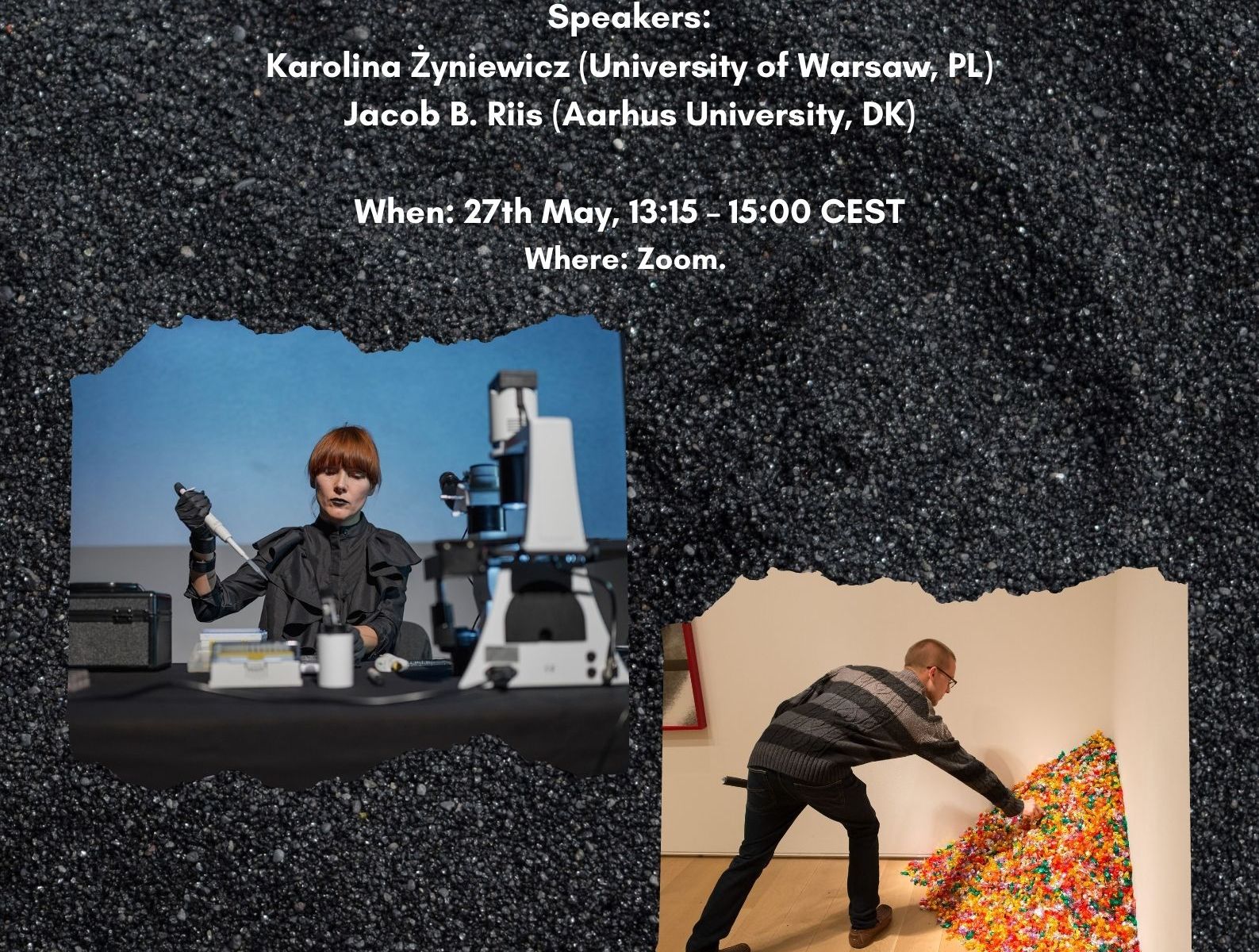
Join us for The Posthumanities Hub Seminar on Queer Death Aesthetics, which takes place on 27th May at 13:15 – 15:00 CEST and is organised in collaboration with The Eco- and Bioart Lab.

The speakers are: Karolina Żyniewicz (University of Warsaw, PL) and Jacob B. Riis (Aarhus University, DK).

For more details, also on how to REGISTER for the event, see below.

Welcome to the Posthumanities Hub Seminar on Queer Death Aesthetics with speakers: Karolina Żyniewicz (University of Warsaw) and Jacob B. Riis (Aarhus University)!

Queer Death Studies (QDS) is an emerging transdisciplinary field that critically investigates and challenges conventional normativities, assumptions and expectations surrounding the issues of death, dying and mourning in the contemporary world. In particular, QDS pays attention to the ways planetary-scale necropolitics render some lives and deaths more recognised, understood or grievable than others.  If ‘queering’ in QDS is understood in a broad, open-ended sense as strange-making, defamiliarising, where the critical defamiliarisation implied may lead to an opening of other, more affirmative horizons, what would then ‘queer death aesthetics’ mean? During the seminar we will try to tackle this question in depth…

The event is curated by Dr Marietta Radomska and is organised in collaboration with The Eco- and Bioart Lab.

When: 27th May 2021, 13:15 – 15:00 CEST

Where: On Zoom

REGISTRATION: In order to take part in the seminar, please register by sending an email to the.posthumanities.hub@gmail.com by 25th May 2021 at noon (CEST) the latest.

The Zoom link will be sent to you on 26th May.

Speakers:

Safe suicide – becoming immortal and dying anyway.

By Karolina Żyniewicz

How to experience immortal life and death at the same time? How to do it safely, without a risk? Are cells isolated from my body still part of me? These were the main questions which I asked to myself and to my scientific collaborators in the beginning of working on safe suicide project. The project was transmattering on many different levels, a transformation of the body and its notion, understanding of life and death coalition, cognitive production, artistic expression. In the frame of the project I immortalised my cells, B lymphocytes just in order to decide about their death. Technically speaking, it was giving to them/myself immortality to take it back in many different experiments. It was being a donor, an observer, a caretaker and a killer at the same time. The project does not give precise answers for the posted questions but it allows to envision what means being liminal, being many and being constantly reconfigured.

Bio

Karolina Żyniewicz is an artist (2009 graduated from the Academy of Fine Arts in Łódź, Department of Visual Arts) and researcher, PhD student (Nature-Culture Transdisciplinary PhD Program at Artes Liberales Faculty, University of Warsaw). Working in a laboratory (mostly at the Institute of Genetics and Biotechnology, Faculty of Biology, University of Warsaw) locates her works in the field of bio art, although she tries to avoid using this term.

Are we dead yet?

By Jacob B. Riis

One of the defining characteristics in human behavioural modernity is burial of the dead in conjunction with ritual and art – art’s primordial love affair is with putrefying corpses. This project outlines a genre that utilises material corpses to produce contemporary art pieces. I currently conceptualise this art form as Necro Art, which serves to connect it to Mbembian inspired Necro Aesthetics and simultaneously establish it as its own field or genre within Art History. While perhaps being a version of Body Art originating in Viennese Actionism, Necro Art simultaneously aligns along different trajectories. It samples and shuffles in early human ritual, folkloric, pagan and rural art forms usually not present in realms of High/Academic Art, and brings the overlooked, the spectral, the magical, and the illiterate too Art History. Through focus on materiality, agency and constellations of subjectivities, each artwork conjures ghosts, reveals life where there is none, and allows its experiencer to connect with the dead, forcing us to reconsider the boundaries of life.

Bio

Jacob B. Riis, Art historian (graduated from Copenhagen University in 2014), 2009-2014 Curator Assistant at The Danish Museum of National History, Hillerød, 2014-2018 Head of Teaching and Curator at Ordrupgaard in Copenhagen, currently PhD student at Art History, Aarhus University.

Photos included in the poster:
(1) Portrait of Karolina Żyniewicz by Pawel Jozwiak (CSW Laznia, Gdansk; LEFT) and 
(2) Untitled (Portrait of Ross in L.A.), 1991, by Felix Gonzalez-Torres (RIGHT).