New special issue of Research in Arts & Education focused on Death is OUT now!

We have a pleasure to share with you the latest update from the editors of the OPEN ACCESS journal Research in Arts & Education, namely, that the special issue focused on topic of death and guest-edited by Helena Sederholm has now been published! Below we include a brief summary from the editors of the journal and the table of contents.

Check it out!

Research in Arts and Education Thematic issue on Death is now published. 

Guest Editor: Helena Sederholm

In this thematic issue, we have a compilation of articles, visual essays, and a commentary dealing with death from diverse viewpoints. In many texts, posthuman and more-than-human-aspect, that is, the relation to other species, has been emphasized. Nevertheless, it is impossible to avoid the perspective of humans, especially when dealing with art, philosophy, and education.

TABLE OF CONTENTS

Thematic issue: 

1–6
Editorial 
We are all necronauts
Helena Sederholm

7–20
Ecologies of Death, Ecologies of Mourning: A Biophilosophy of Non/Living Arts
Marietta Radomska

21–31
Reimagining Death in an All-Too-Human World: A Pedagogical Exploration of Pinar Yoldas’ Ecosystem of Excess
Juliette Clara Bertoldo

32–44
The Spores of Life and Death
Tiina Pusa

45–52
The Bouquet of Death and Decay
Eeva-Liisa Puhakka
                        

53–61
Corpses in Training: Blanchot and The International Necronautical Society’s Experimental Expeditions Beyond Life
Sami Sjöberg

62–75
To the Other Side with Bees
Ulla Taipale

76–84
Unravelling Haptic Visuality and Notions of Care Through Two Videos About Death
Anna Walker and Jo Milne

General Articles          

85–98
Arctic Wool
Fabiola Hernández Cervantes

99–110
Children of Drama: An Arts-Based Educational Action Research Project Applied to a Group of In-Service Educators
Theodora Salti

Call for short contributions (500-2000 words): What do we talk about when we talk about queer death? (Whatever Journal)

Whatever. A Transdisciplinary Journal of Queer Theories and Studies (https://whatever.cirque.unipi.it/) is inviting submissions for short contributions (500-2000 words) to be collected in a multi-authored article entitled “What do we talk about when we talk about queer death?”. The article will introduce the themed section Queer thanatologies (edited by A.C. Corradino, C. Dell’Aversano, R. Langhi and M. Petricola) that will appear in Whatever’s next issue in summer 2021.

Queer death studies has recently emerged as a transdisciplinary field of inquiry investigating the cultural performances related to death, dying, grief, and disposal from the perspective of queer theory, defined as a hermeneutical stance whose premises could be summed up as follows: «queer states that any construction of identity (including LGBT ones) is a performance constituting a subject which does not “exist” prior to it, and encourages to bring into being (both as objects of desire, of fantasy and of theoretical reflection and as concrete existential and political possibilities) alternative modes of performance» (Dell’Aversano 2010: 74-75). Driven by the will to «reconceptualis[e] death, dying and mourning in relentlessly norm-critical ways» (Radomska, Mehrabi, and Lykke 2020: 82), the field of queer death studies is developing and expanding in a number of directions. Some center on an «overall attention to necropolitics and necropowers» (ibidem: 85); some focus on peripheral, non-normative, and anti-normative identities, among which are those falling within the LGBT+ spectrum; some devote to non-humans as both subjects and objects of grief; some explore the construction of corpses as objects of desire in literature and the arts, as well as their position in spiritual and other kinds of political activism; some are grounded in category theory and the social sciences and aimed at the theoretical deconstruction of the life/death polarity itself, considered as one of the most fundamental constructs for the development of every human culture; some critically-affirmatively take a posthuman and/or decolonial point of departure in life/death, considered as a spiritual-material continuum, encouraging an ecophilosophical focus on the vibrancies of all non/living matter beyond the dualisms (mind-soul/body, culture/nature, human/non-human), cherished by Western modernity.

We encourage scholars, activists, thanatologists, and other queer death friends working in any field to contribute to the ongoing development of queer death studies by answering the question “what do we talk about when we talk about queer death?” in a bite-sized format. Your theoretical reflections, case studies, notes, and thoughts are invaluable for mapping this ever-expanding field.

Short contributions should be sent to Mattia Petricola (mattia.petricola[at]gmail.com) by January 27, 2021. For any question or information, for expressing your interest in this publication or discussing your contribution, do not hesitate to get in touch.

References

Dell’Aversano, Carmen. 2010. ‘The Love Whose Name Cannot Be Spoken: Queering the Human-Animal Bond’. Journal for Critical Animal Studies VIII (1/2): 73–125.

http://www.criticalanimalstudies.org/wp-content/uploads/2009/09/JCAS-Vol-VIII-Issue-I-and-II-2010-Full-Issue1.pdf.

Radomska, Marietta, Tara Mehrabi, and Nina Lykke. 2020. ‘Queer Death Studies: Death, Dying and Mourning from a Queerfeminist Perspective’. Australian Feminist Studies 35 (104): 81–100.

https://doi.org/10.1080/08164649.2020.1811952.

You can also download the CfP as a pdf file below:

New Publication: Special issue of the journal Australian Feminist Studies focused on Queer Death Studies

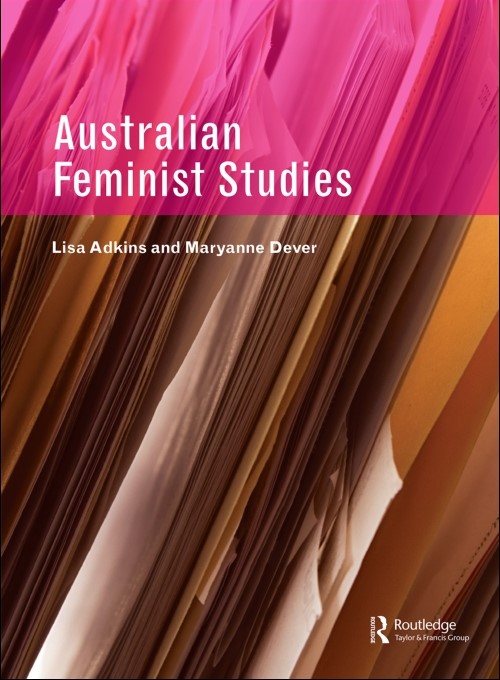
We are delighted to say that the special issue of the journal Australian Feminist Studies focused on the topic of “Queer Death Studies” and co-edited by Marietta RadomskaTara Mehrabi and Nina Lykke, has finally been published.

The issue contains contributions by QDS scholars: Patricia MacCormack, Marietta Radomska, Tara Mehrabi, Stine Willum Adrian, Margrit Shildrick, Hema’ny Molina Vargas, Camila Marambio and Nina Lykke.

The collection strives to advance queerfeminist methodologies and ontological, ethical and political understandings that critically and creatively attend to the problem of death, dying and mourning in the current environmental, cultural, and socio-political contexts.

In order to learn more, do check out the introduction “Queer Death Studies: Death, Dying and Mourning From a Queerfeminist Perspective”, co-authored by myself, Tara and Nina, available in OA here.

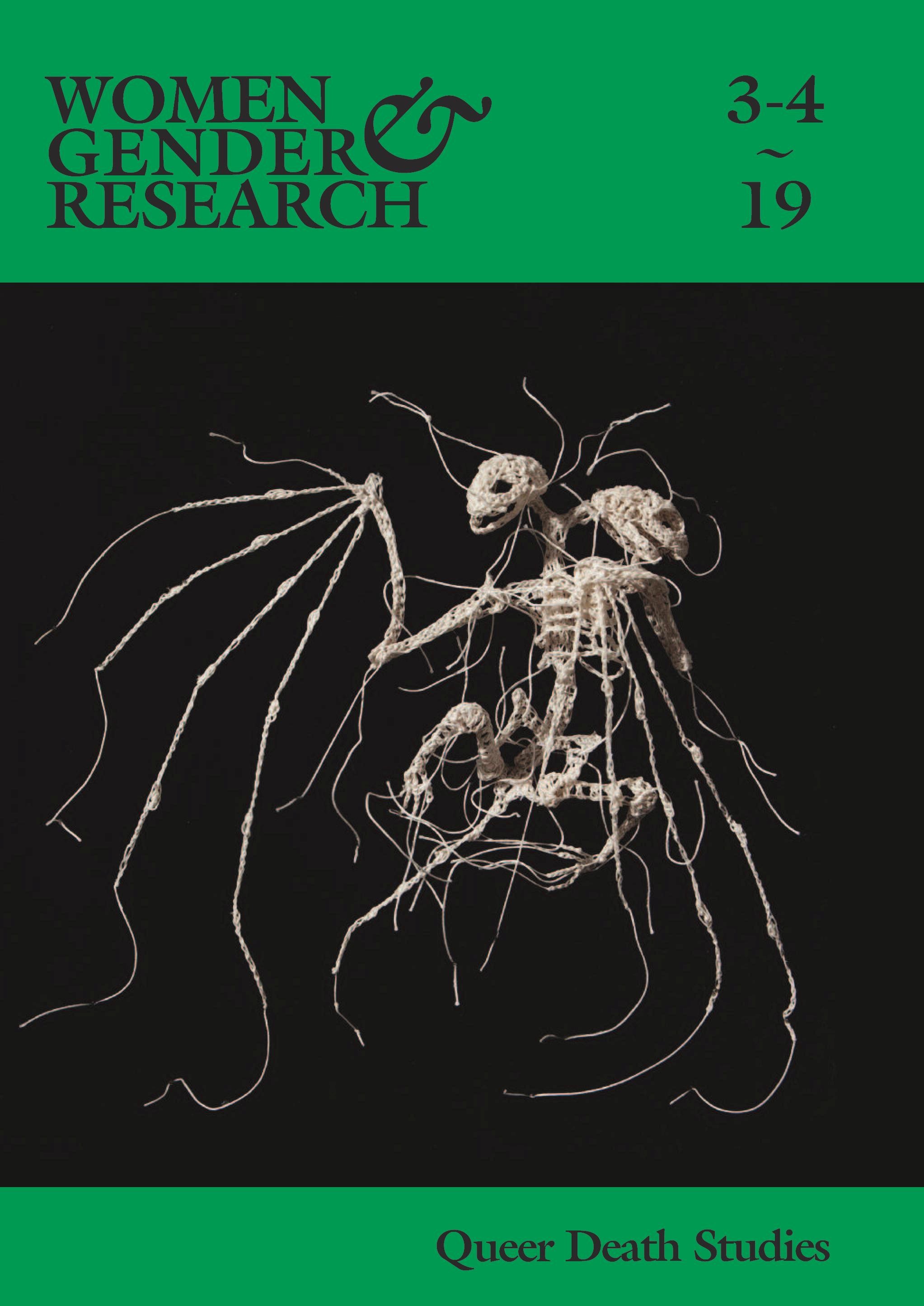
CfP for a special issue of Women, Gender & Research on Queer Death Studies

Cfp: KKF 2019/2-3: Queer Death Studies

Call for Papers:
Queer Death Studies: Coming to Terms with Death, Dying and Mourning Differently

Special issue
Women, Gender & Research, 2019/2-3

Queer Death Studies (QDS) refers to an emerging transdisciplinary field of research that critically and (self) reflexively investigates and challenges conventional normativities, assumptions, expectations, and regimes of truths that are brought to life and made evident by death, dying, and mourning.

Since its establishment as a research field in the 1970s, Death Studies has drawn attention to the questions of death, dying, and mourning as complex and multifaceted phenomena that require inter- or multi-disciplinary approaches and perspectives. Yet, the engagements with death, dying and mourning, constitutive of conventional Death Studies’ investigations, tend to remain insufficient and reductive. They are often governed by the normative notions of: the subject; bonds between humans, as well as between humans and (their) animals; family relations and communities; rituals; and finally, experiences of grief, mourning, and bereavement. Moreover, these engagements are frequently embedded in constraining beliefs in life/death divides, constructed along the lines of conventional religious and/or scientific mind/body dualisms, characteristic of the Western cultural imaginaries.

Against this background, QDS offers a site for ‘queering’ traditional ways of approaching death both as a subject of study and philosophical reflection, and as a phenomenon to articulate in artistic work or practices of mourning. Here, the notion of ‘queer’ conveys many meanings. It refers to researching and narrating death, dying, and mourning in the context of queer bonds and communities, where the subjects involved/studied/interviewed and the relations they are involved in are recognised as ‘queer’. Simultaneously, the term ‘queer’ can also function as an adverb and a verb, referring thus to the processes of going beyond and unsettling (subverting, exceeding) binaries and given norms, normativities, and constraining conventions. In other words, ‘queer’ becomes both a process and a methodology that is applicable and exceeds the focus on gender and sexuality as its exclusive concerns.

This special issue invites academic as well as artistic contributions that focus on and explore the ways queer theory and queer perspectives can help us rethink death, dying, remains, afterlife, mourning and the life-death dichotomy.

The topics may include, but are not limited to:
– Queer methodologies of researching death, dying and mourning
– Queer practices of mourning and bereavement
– Materiality of death and corpses
– Death/life ecologies
– Necropolitics and borders
– Un/grievable lives and deaths
– Death and biotechnology/biomedicine
– Queering cancer and other life-threatening diseases
– Suicide
– Technologies of life/death
– Queer widowhood
– Decolonialising death
– Illness narratives and death
– Ethico-politics and practices of killability
– Nonhuman death and dying
– Extinction and annihilation
– Death and acts of resistance
– ‘Slow death’
– Queering temporalities of death
– Queer spiritualities

Editors:
Marietta Radomska, postdoc, Linköping University, Sweden
Tara Mehrabi, postdoc, University of Turku, Finland
Nina Lykke, professor emerita, Linköping University, Sweden

Deadline for abstracts (max 300-word + up to 100 word author bio): June 25, 2018
Deadline for articles: December 1, 2018

All contributions must be in English and should be submitted to: redsek@soc.ku.dk

Guidelines for contributors: http://koensforskning.soc.ku.dk/english/kkof/guidelines/

Download the call as pdf.

For more information about the journal Women, Gender & Research / Kvinder, Køn & Forskning, see:
http://koensforskning.soc.ku.dk/kkf or http://koensforskning.soc.ku.dk/english/kkof

See also: http://koensforskning.soc.ku.dk/english/kkof/call-for-papers/cfp-kkf-20192-3-queer-death-studies/