Routledge International Handbook of Queer Death Studies is OUT!

At the end of October 2025 – which means already five months ago – the long awaited major publication came out!

The 758-page volume: Routledge International Hanbook of Queer Death Studies, edited by Nina Lykke, Tara Mehrabi, and Marietta Radomska encompasses 63 chapters, written by 75 authors. The book consists of seven thematic sections: I. Rethinking  Life/Death Ecologies and Temporalities; II. Anthropocene Necropolitics and Extinction; III. Caring Death Activism; IV. Aesthetics and Mediated Imaginaries of Death; V. Politics and Ethics of Grieving Practices and Remembrance; VI. Co-Becoming with the Dead and Spectral Mourning; and VII. Imagining Life/Death Entanglements Differently.

Broadly speaking, the Handbook aims to provide a comprehensive, international cartography of Queer Death Studies, offering broad, in-depth insights into the field and its emergence through tentacular transdisciplinary networking. Taking research and art-making on death, dying, mourning, and afterlife into new directions, it explores the multiple effects of contemporary necropolitics and the proliferation of death-worlds during the current period of Earth’s history, ‘The Anthropocene’ or ‘the Age of Man’.

Informed by queer, critical posthumanist, decolonial, and feminist approaches, the Handbook presents a unique variety of both critical and affirmative reflections upon the world’s intersecting necropowers, and ethico-political potentials for social and environmental change. Contributors speculate on ways to reimagine life/ death-relations as vibrant entanglements. They also investigate modes of mourning differently, resisting necropolitical regimes that deem human and non-human individuals and populations to be disposable and non-grievable when they differ too much from the normative modern subject, Universal Man, in terms of intersections of gender, racialisation, class, sexuality, embodiment, embrainment, geopolitical positioning, or species.

A thought provoking read, this Handbook is intended for broad global audiences of researchers, artists, teachers, students, death-professionals, (health)careworkers, activists, and NGOs interested in tools to rethink and reimagine death, dying, mourning, and afterlife from intersections of queering, decolonising, posthumanising, and feminist perspectives.

The volume includes two chapters that are available in OPEN ACCESS.
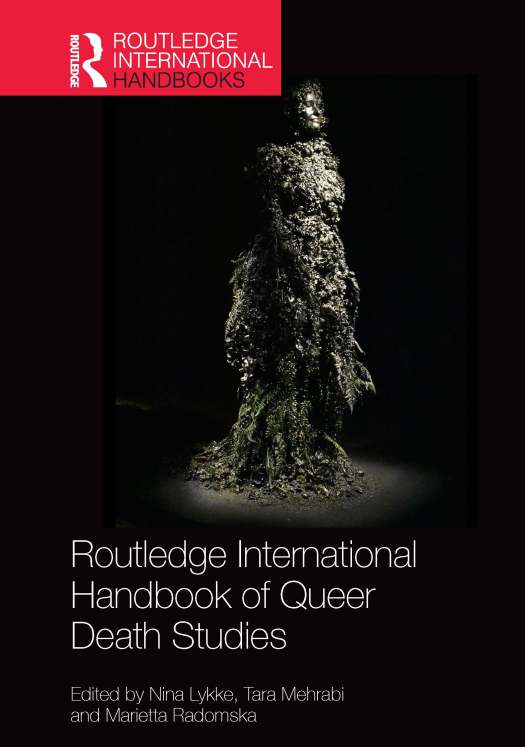
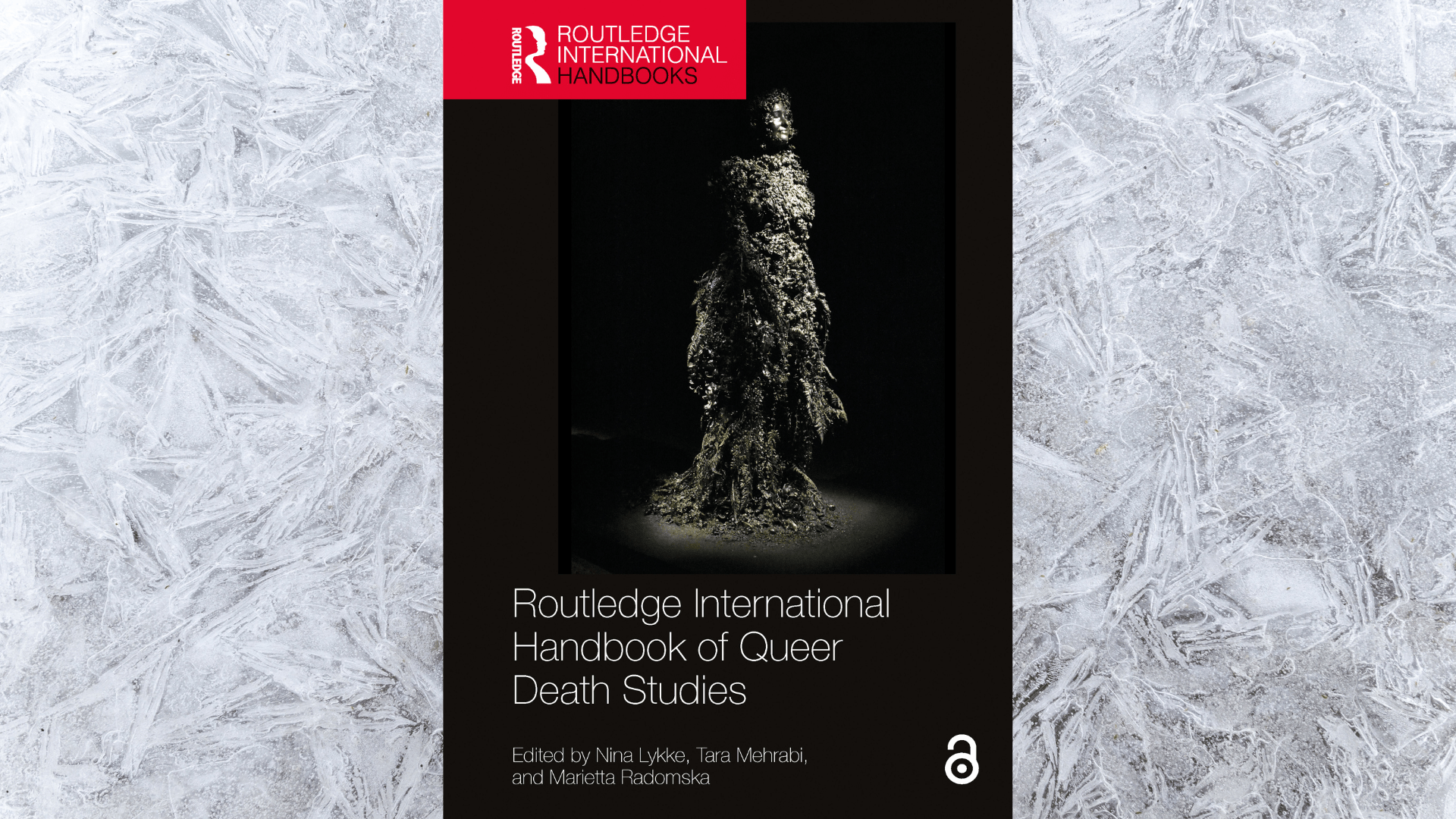
The cover of the Routledge International Handbook of Queer Death Studies

The Posthumanities Hub Seminar on ‘Queer Death Aesthetics’ (online)

Join us for The Posthumanities Hub Seminar on Queer Death Aesthetics, which takes place on 27th May at 13:15 – 15:00 CEST and is organised in collaboration with The Eco- and Bioart Lab.

The speakers are: Karolina Żyniewicz (University of Warsaw, PL) and Jacob B. Riis (Aarhus University, DK).

For more details, also on how to REGISTER for the event, see below.

Welcome to the Posthumanities Hub Seminar on Queer Death Aesthetics with speakers: Karolina Żyniewicz (University of Warsaw) and Jacob B. Riis (Aarhus University)!

Queer Death Studies (QDS) is an emerging transdisciplinary field that critically investigates and challenges conventional normativities, assumptions and expectations surrounding the issues of death, dying and mourning in the contemporary world. In particular, QDS pays attention to the ways planetary-scale necropolitics render some lives and deaths more recognised, understood or grievable than others.  If ‘queering’ in QDS is understood in a broad, open-ended sense as strange-making, defamiliarising, where the critical defamiliarisation implied may lead to an opening of other, more affirmative horizons, what would then ‘queer death aesthetics’ mean? During the seminar we will try to tackle this question in depth…

The event is curated by Dr Marietta Radomska and is organised in collaboration with The Eco- and Bioart Lab.

When: 27th May 2021, 13:15 – 15:00 CEST

Where: On Zoom

REGISTRATION: In order to take part in the seminar, please register by sending an email to the.posthumanities.hub@gmail.com by 25th May 2021 at noon (CEST) the latest.

The Zoom link will be sent to you on 26th May.

Speakers:

Safe suicide – becoming immortal and dying anyway.

By Karolina Żyniewicz

How to experience immortal life and death at the same time? How to do it safely, without a risk? Are cells isolated from my body still part of me? These were the main questions which I asked to myself and to my scientific collaborators in the beginning of working on safe suicide project. The project was transmattering on many different levels, a transformation of the body and its notion, understanding of life and death coalition, cognitive production, artistic expression. In the frame of the project I immortalised my cells, B lymphocytes just in order to decide about their death. Technically speaking, it was giving to them/myself immortality to take it back in many different experiments. It was being a donor, an observer, a caretaker and a killer at the same time. The project does not give precise answers for the posted questions but it allows to envision what means being liminal, being many and being constantly reconfigured.

Bio

Karolina Żyniewicz is an artist (2009 graduated from the Academy of Fine Arts in Łódź, Department of Visual Arts) and researcher, PhD student (Nature-Culture Transdisciplinary PhD Program at Artes Liberales Faculty, University of Warsaw). Working in a laboratory (mostly at the Institute of Genetics and Biotechnology, Faculty of Biology, University of Warsaw) locates her works in the field of bio art, although she tries to avoid using this term.

Are we dead yet?

By Jacob B. Riis

One of the defining characteristics in human behavioural modernity is burial of the dead in conjunction with ritual and art – art’s primordial love affair is with putrefying corpses. This project outlines a genre that utilises material corpses to produce contemporary art pieces. I currently conceptualise this art form as Necro Art, which serves to connect it to Mbembian inspired Necro Aesthetics and simultaneously establish it as its own field or genre within Art History. While perhaps being a version of Body Art originating in Viennese Actionism, Necro Art simultaneously aligns along different trajectories. It samples and shuffles in early human ritual, folkloric, pagan and rural art forms usually not present in realms of High/Academic Art, and brings the overlooked, the spectral, the magical, and the illiterate too Art History. Through focus on materiality, agency and constellations of subjectivities, each artwork conjures ghosts, reveals life where there is none, and allows its experiencer to connect with the dead, forcing us to reconsider the boundaries of life.

Bio

Jacob B. Riis, Art historian (graduated from Copenhagen University in 2014), 2009-2014 Curator Assistant at The Danish Museum of National History, Hillerød, 2014-2018 Head of Teaching and Curator at Ordrupgaard in Copenhagen, currently PhD student at Art History, Aarhus University.

Photos included in the poster:
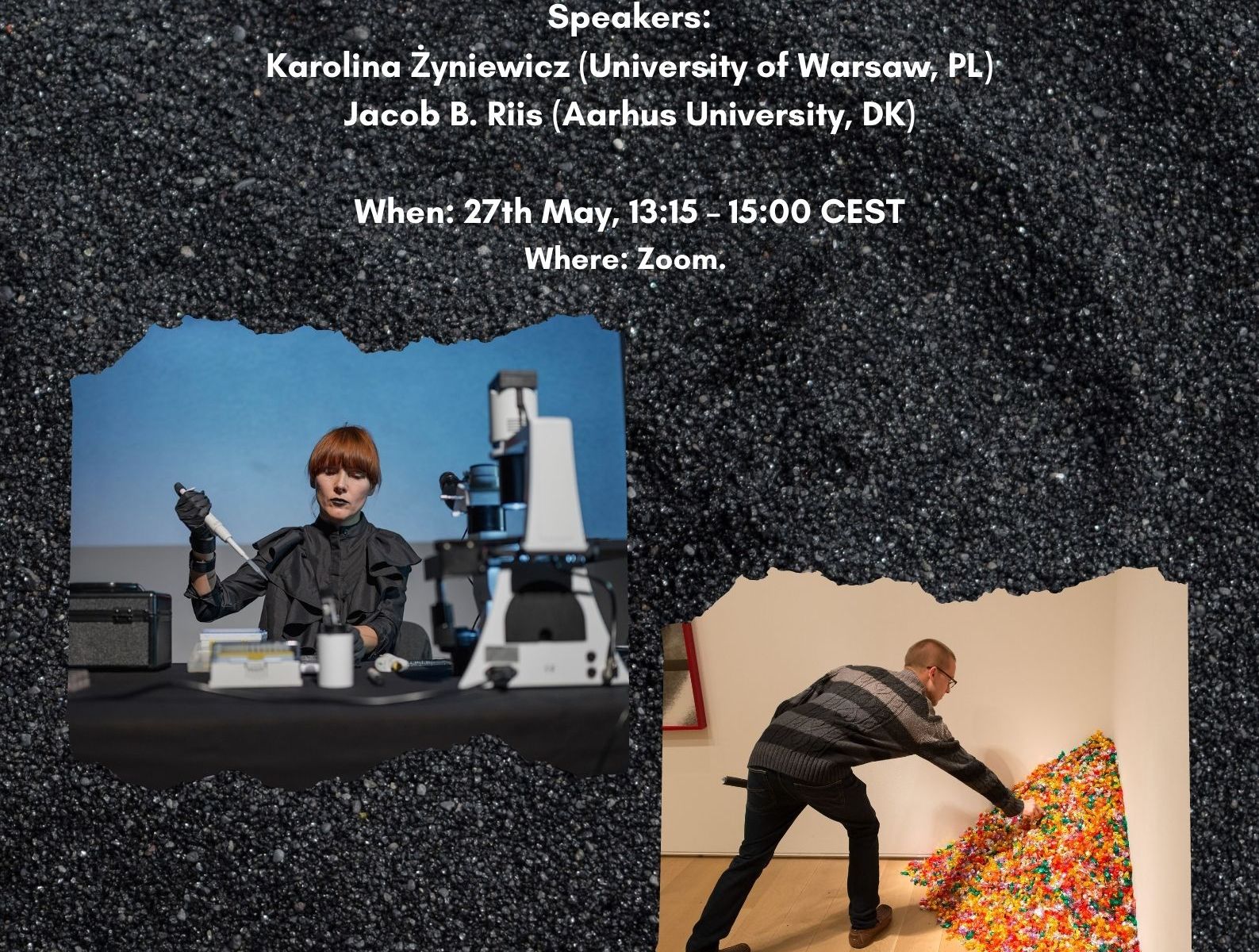
(1) Portrait of Karolina Żyniewicz by Pawel Jozwiak (CSW Laznia, Gdansk; LEFT) and 
(2) Untitled (Portrait of Ross in L.A.), 1991, by Felix Gonzalez-Torres (RIGHT).