Ecologies of Death, Ecologies of Mourning vol. II: A Roundtable. 30th March 2023 on Zoom

In case you cannot make it for our symposium on 23rd March in Norrköping, or if you are still thirsty and wish to explore the theme further, you are warmly invited to join us – in a bit altered line-up – for this online event:

Welcome to The Posthumanities Hub & The Eco- and Bioart Lab Webinar

“Ecologies of Death, Ecologies of Mourning vol. II: A Roundtable”

30th March 2023, 13:15 – 15:00 CEST

Where: on Zoom

Our starting point for the international symposium “Ecologies of Death, Ecologies of Mourning: vol. I” (taking place on 23rd March 2023 in Norrköping, SE) is the context of planetary environmental disruption, slow and abrupt environmental violence, and the ways in which ecological, more-than-human dimensions of death have traditionally been underplayed in public debates.  During the symposium, we emphasise that what is urgently needed – now more than ever – is the systematic problematisation of the planetary-scale mechanisms of annihilation of the more-than-human worlds in their philosophical, socio-cultural, ethico-political and very material dimensions.

In this follow-up roundtable, or volume II of “Ecologies of Death, Ecologies of Mourning”, the panellists: Prof. Patricia MacCormack (Anglia Ruskin University, UK), Dr Margherita Pevere (independent artist, DE/IT) and Dr Marietta Radomska (Linköping University, SE) will zoom in on the potential, role, (im)possibilities, urgencies and frictions of artistic and philosophical practices and praxes linked to ecologies of death, care, grief and mourning.

The event is curated by Dr Marietta Radomska.

REGISTER: https://bit.ly/3Ll1J1i

Speakers:

Prof. Patricia MacCormack (Anglia Ruskin University, UK)

Dr Margherita Pevere (independent artist, DE/IT)

Dr Marietta Radomska (Linköping University, SE)

BIOGRAPHICAL NOTES:

Patricia MacCormack, PhD, is Professor of Continental Philosophy at Anglia Ruskin University Cambridge. She has published extensively on philosophy, feminism, queer and monster theory, animal abolitionist activism, ethics, art and horror cinema. She is the author of Cinesexuality (Routledge 2008) and Posthuman Ethics (Routledge 2012) and the editor of The Animal Catalyst (Bloomsbury 2014), Deleuze and the Animal (EUP 2017), Deleuze and the Schizoanalysis of Cinema (Continuum 2008) and Ecosophical Aesthetics (Bloomsbury 2018). Her new book is The Ahuman Manifesto: Activisms for the End of the Anthropocene. She is currently a Leverhulme Research Fellow researching death activism.

Dr Margherita Pevere is an artist and researcher working across biological arts and performance with a distinctive visceral signature. Her inquiry hybridizes biotechnology, ecology, queer and death studies to create artworks that trail today’s ecological complexity. Her body of work is a blooming garden crawling with genetically edited bacteria, cells, sex hormones, microbial biofilm, blood, slugs, growing plants and decomposing remains. She is affiliated to the Eco- and Bioart Lab and co-founded the artists’ group Fronte Vacuo. Web: Www.margheritapevere.com and  https://frontevacuo.com  

Marietta Radomska, PhD, is an Assistant Professor of Environmental Humanities at Linköping University; director of The Eco- and Bioart Lab; co-founder of Queer Death Studies Network; member of The Posthumanities Hub; co-editor of the book series ‘Focus on More-than-human Humanities’ at Routledge (with C. Åsberg); and the PI of ‘Ecological Grief, Crisis Imaginaries and Resilience in Nordic Lights’ (2022-26; funded by FORMAS). She works at the intersection of posthumanities, environmental humanities, continental philosophy, queer death studies, visual culture and contemporary art; and has published in Australian Feminist Studies; Somatechnics; Environment and Planning E and Artnodes, among others. Web: www.mariettaradomska.com

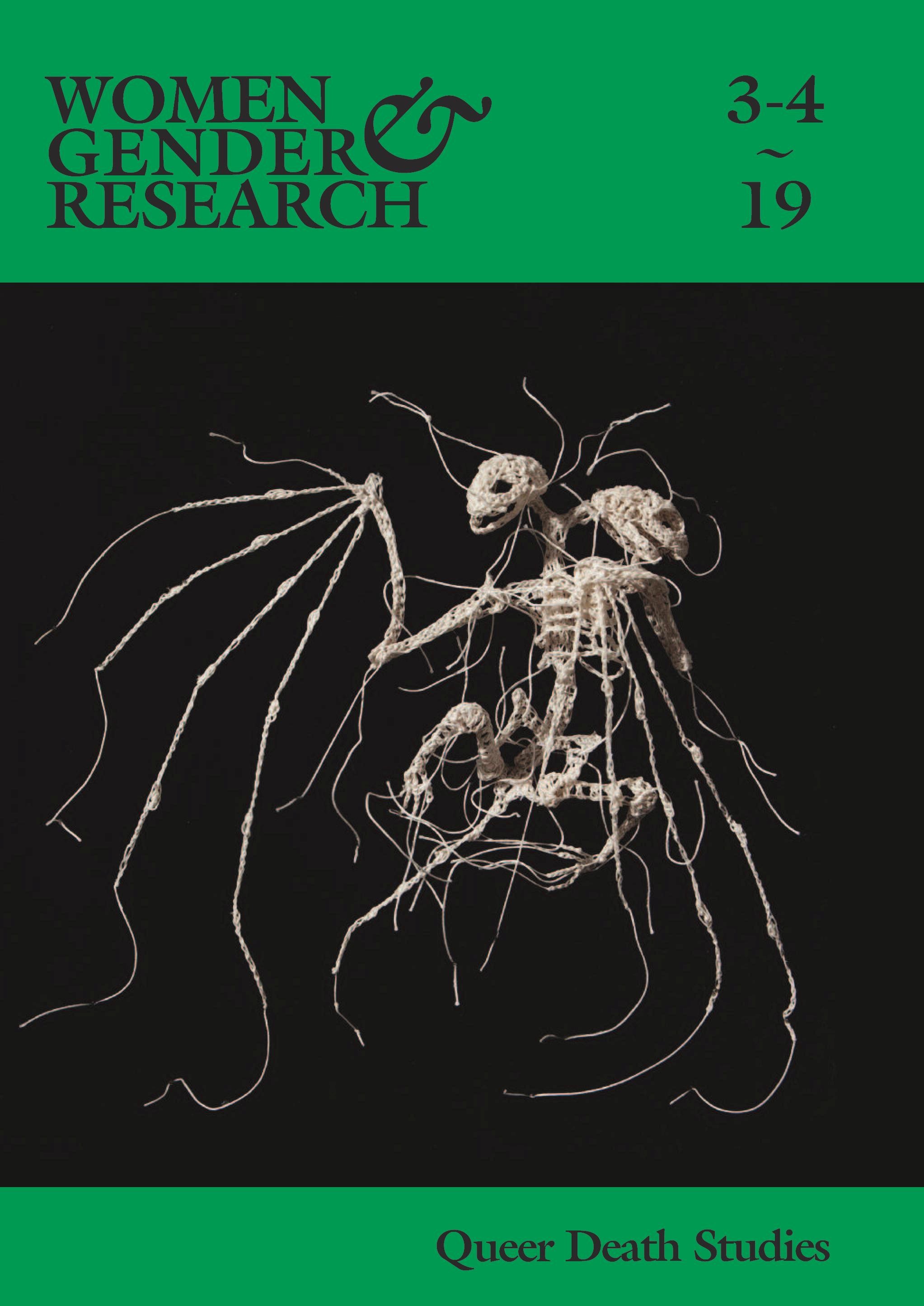
Artwork included in the poster: Margherita Pevere, Semina Aeternitatis (2018)

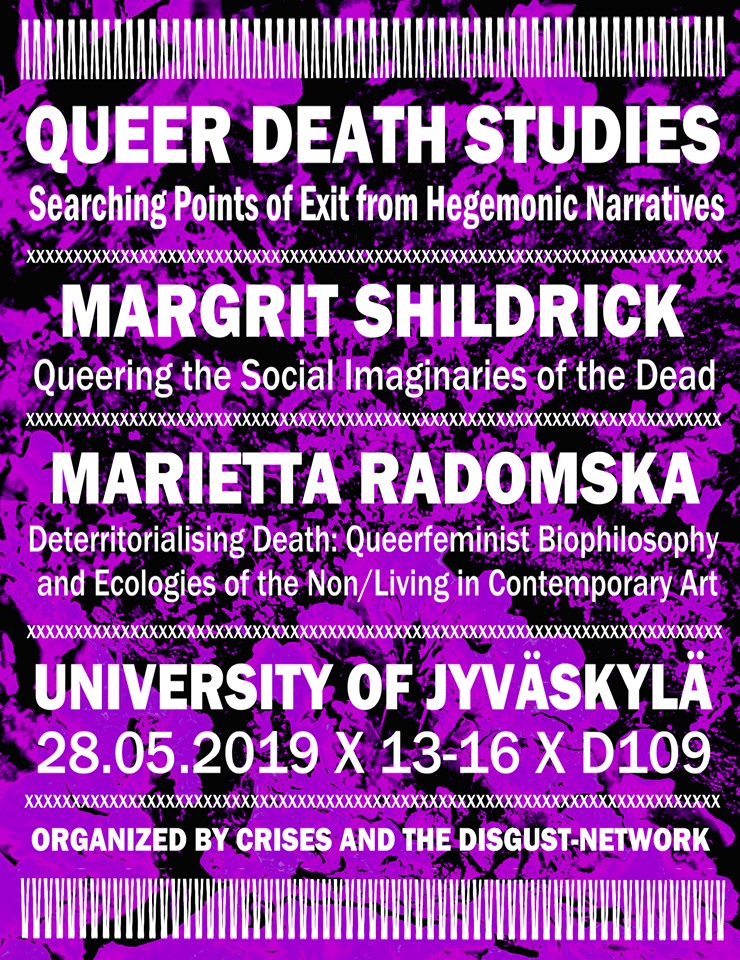
Seminar “Queer Death Studies: Searching Points of Exit from Hegemonic Narratives” with Professor Margrit Schildrick and Dr. Marietta Radomska (at University of Jyväskylä, FI)

qds seminar jyväskylä

Welcome to the seminar “Queer Death Studies: Searching Points of Exit from Hegemonic Narratives” with Professor Margrit Schildrick and Dr. Marietta Radomska.

The seminar, held on the 28 of May (D 109) at 13-16, is organised by the Disgust Network in collaboration with Crises Redefined: Historical Continuity and Societal Change. Further details below.

Seminar “Queer Death Studies: Searching Points of Exit from Hegemonic Narratives”

Queer Death Studies Network, established in 2016, constitutes a space for researchers, students, artists, activists, and other practitioners who critically and (self) reflexively investigate and challenge conventional normativities, assumptions, expectations, and regimes of truths that are brought to life and made evident by death, dying, and mourning.

The conventional engagements with the questions of death, dying and mourning are insufficient and reductive: they are often governed by the normative notions of the subject; interhuman and human/nonhuman bonds; family relations and communities; rituals; and finally, experiences of grief, mourning, and bereavement. Moreover, these engagements are often embedded in constraining beliefs in life/death divides, constructed along the lines of conventional religious and/or scientific mind/body dualisms.

Against this background, Queer Death Studies serves as a site for ‘queering’ traditional ways of approaching death both as a subject of study and philosophical reflection, and as a phenomenon to articulate in artistic work or practices of mourning. Here, the notion of ‘queer’ conveys many meanings. It refers to researching and narrating death, dying and mourning in the context of queer bonds and communities, where the subjects involved/studied/interviewed and the relations they are involved in are recognised as ‘queer’. Simultaneously, the term ‘queer’ can also function as an adverb and a verb, referring thus to the processes of going beyond and unsettling (subverting, exceeding) binaries and given norms, normativities, and constraining conventions. In other words, ‘queer’ becomes both a process and a methodology that is applicable and exceeds the focus on gender and sexuality as its exclusive concerns.

This seminar brings together papers by two scholars whose work is embedded in the field of Queer Death Studies and who’s been active in the formation and development of QDSN.

Queering the Social Imaginaries of the Dead,
Margrit Shildrick

Abstract:
I offer a philosophical examination and queering of the social imaginaries of the dead – with specific reference to the recent public disclosures about death in Ireland’s Mother and Baby Homes – by looking at the issue of spectrality through the work of Derrida and others. What does it mean to respond to the dead, who, though temporarily forgotten, return to haunt us not as remembered human beings but as remnants or remainders? The normative distinctions between past and present; past, present and future; between living and non-living; absence and presence; and self and other are all made indistinct when displaced by a non-linear temporality. What differential is in play with respect to those who are grievable (as Butler has it) and the others who constitute bare life (Agamben)? Following the re/discovery of those dead lost to public discourse, the strategy of memorialisation seems inadequate. I will outline instead an alternative hauntological ethics, as suggested by Derrida, and ask if there are queer social imaginaries that allow us to live well with the dead not because we give them respect, but because death itself has been rethought? I will close with some speculations arising from Deleuze’s understanding of vitalism and Braidotti’s optimistic claim that ‘death frees us into life’.

Bio:
Margrit Shildrick, PhD is Guest Professor of Gender and Knowledge Production at Stockholm University. Her research covers postmodern feminist and cultural theory, bioethics, critical disability studies and body theory. Books include Leaky Bodies and Boundaries (1997), Embodying the Monster (2002) and Dangerous Discourses of Disability, Sexuality and Subjectivity (2009), as well as several edited collections and many journal articles. Most recently, she has been addressing the socio-political and embodied conjunction of microchimerism, immunology, corporeal anomaly and death.

Deterritorialising Death: Queerfeminist Biophilosophy and Ecologies of the Non/Living in Contemporary Art,
Marietta Radomska

Abstract:

In the contemporary context of environmental crises and the degradation of food and water resources, certain habitats become unliveable, leading to the death of individuals, populations and species extinction. Whilst bioscience emphasises interdependency and relationality as crucial characteristics of life shared by all organisms, Western cultural imaginaries tend to draw a thick dividing line between humans and nonhumans, particularly evident in the context of death. On the one hand, death appears as a process common to all forms of life; on the other, as an event that distinguishes human from other organisms (e.g. Heidegger 2010 (1953)).

Against this background, this paper explores how contemporary art – in particular, the series of works The Absence of Alice (2008-2011) by Australian new-media and bioartist Svenja Kratz – challenges the normative and human-exceptionalist concept of death. By employing queerfeminist biophilosophy (Thacker 2008; Radomska 2016) as a strategy that focuses on relations, processes and transformations instead of ‘essences’, the paper examines the ways Kratz’s works – read through feminist-materialist theorising – deterritorialise (Deleuze & Guattari 2004) the conventional concept of death. In this way, it hopes to attend to the intimacies between materialities of a human and nonhuman kind that form part of the processes of death and dying, and what follows, to reframe ethico-ontology of death as material and processual ecologies of the non/living.

Bio:
Marietta Radomska, PhD, is a Postdoc at the Department of Thematic Studies (Gender Studies), Linköping University, SE, and a Visiting Postdoctoral Researcher at the Department of Cultures (Art History), University of Helsinki, FI. She is the co-director of The Posthumanities Hub; founder of The Eco- and Bioart Research Network, co-founder of International Network for ECOcritical and DECOlonial Studies and a founding member of Queer Death Studies Network. Radomska is a philosopher and transdisciplinary gender studies and posthumanities scholar. Her current research project focuses on ecologies of death in the context of contemporary art. She is the author of the monograph Uncontainable Life: A Biophilosophy of Bioart (2016), and has published in Australian Feminist Studies, Somatechnics, and Angelaki, among others.

The Third International Queer Death Studies Workshop “Death Matters: Death and Dying in a Queer Context”: the programme & registration!

Dear all,

It is our great pleasure to announce the programme of the upcoming Third International Queer Death Studies Workshop: Death Matters: Death and Dying in a Queer Context that takes place on 30th and 31st May 2018 at Linköping University. The workshop starts at 10:15 on 30th May and finishes at 16:00 on 31st May.

In order to register, please send an email to: tara.mehrabi [at] liu.se.

Registration DEADLINE: 23rd May 2018.


Programme:

30th May (Wednesday)

10:15 – 11:00 Introduction

11:00 – 12:30 Session I:

Margrit Shildrick (Stockholm University, SE/York University, Toronto, CA), Temporalities and Onto-epistemologies of Death and Dying

Natashe Lemos Dekker (University of Amsterdam/Leiden University, NL), Valuing Life: Normative and Moral Frames at the End of Life with Dementia

12:30 – 13:45 Lunch (on a self-paid basis)

13:45 – 15:55 Session II

Andria Nyberg Forshage & Eliot Eklöw (Södertörn University/Stockholm University, SE), Lilies of Sterile Pleasure. On Indolence, Deathliness, Deproduction, and Double Affirmation

ida Hillerup Hansen (Central European University, HU), ‘Falling Apart’: Prisms of Living with Loss

Magdalena Górska (Utrecht University, NL), Suffocations

15:55 – 16:10 Break (fika)

16:10 – 18:10 Session III

Órla O’Donovan (University College Cork, IE), Death, Dying and the ‘Commons’

Anne Bettina Pedersen (Aarhus University, DK), (Un)Making Sylvia Likens: Towards a Theory of Femicide Narratives

Saad Khan (independent researcher, BD), Dying Inside Black Mirror’s Posthumanist World

18:10 – 18:30 Discussion

19:30 – … Dinner downtown (on a self-paid basis)


31st May (Thursday)

10:15 – 11:45 Session IV

Agnieszka Kotwasińska (University of Warsaw, PL), Self/Haunted: Death and Mourning in Recent Horror Cinema

Line Henriksen (University of Copenhagen, DK) & Tara Mehrabi (Linköping University, SE), Hosts, Ghosts and Flies: Thinking Life, Death and Ethics through HBO’s West World

11:45 – 13:15 Lunch (on a a self-paid basis)

13:15 – 14:45 Session V

Alexandra Løvås Kristinnsdottir (University of Oslo, NO), Death Positivity and Its Potentials

Kristin Gupta (Rice University, US), Death (Feminist) Futures

14:45 – 15:00 Break (fika)

15:00 – 16:00 Final discussion

Deadline EXTENDED

Dear all,

Due to many requests we received, we have decided to extend the abstract deadline for The Third International Queer Death Studies Workshop until 18th March 2018. You can find more information on the workshop, including the CfP here, or in the pdf version here.

We hope that in this way those of you who would like to take active part in the workshop and haven’t managed to get in touch with us will now have a few more days to do so!

We are so much looking forward to hearing from you and to the workshop itself!

Official launch of Queer Death Studies Network

Queer Death Studies Network (QDSN) was officially launched in November 2016 at the G16: Swedish National Gender Research Conference in Linköping and has been vividly developing since then. The network constitutes a space for researchers, students, artists, activists, and other practitioners who critically and (self) reflexively investigate and challenge conventional normativities, assumptions, expectations, and regimes of truths that are brought to life and made evident by death, dying, and mourning.