Exciting NEW PUBLICATION: Death’s Social and Material Meaning Beyond the Human

It is our great pleasure to feature here on our blog the latest publication coming out via Bristol University Press and edited by Jesse D. Peterson, Natashe Lemos Dekker and Philip R. Olson – a collection entitled Death’s Social and Material Meaning Beyond the Human (out on 9th January 2024).

The Bristol University Press website includes the following book description:

Death studies typically focus on the death of humans, overlooking the wider factors involved in social and natural processes around death.

This edited volume provides an alternative focus for death studies by looking beyond human death, to reveal the complex interconnections among human and more than human creatures, entities and environments.

Bringing together a diverse range of international scholars, the book sheds light on topics which have previously remained at the margins of contemporary death studies and death care cultures.

Organised around three themes – Knowledge and Mediation, Care and Remembrance, and Agency and Power – this book pushes the boundaries of death studies to explore death and dying from beyond the perspective of a nature/culture binary.

Check out this exciting book once it’s out and make sure your local/university library includes it in its collection!

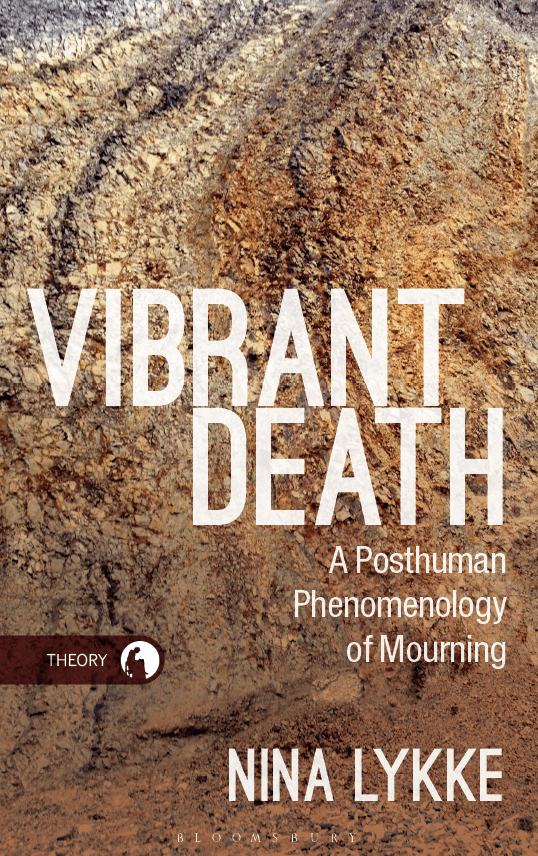
New Book Coming Out Soon!

Nina Lykke:

Vibrant Death. A Posthuman Phenomenology of Mourning.

Bloomsbury Academic, London.

WILL BE AVAILABLE FROM DECEMBER 2021, MORE INFO:

https://www.bloomsbury.com/uk/vibrant-death-9781350149731/


Vibrant Death links philosophy and poetry-based, corpo-affectively grounded knowledge seeking. It offers a radically new materialist theory of death, critically moving the philosophical argument beyond Christian and secular-mechanistic understandings. The book’s ethico-political figuration of vibrant death is shaped through a pluriversal conversation between Deleuzean philosophy, neo-vitalist materialism and the spiritual materialism of decolonial, queerfeminist poet and scholar Gloria Anzaldua. The book’s posthuman de-exceptionalising of human death unfurls together with a collection of poetry, and autobiographical stories. They are analysed through the lens of a posthuman, queerfeminist revision of the method of autophenomenography (phenomenological analysis of autobiographical material).

Nina Lykke explores the speaking position of a mourning, queerfeminine ”I”, who contemplates the relationship with her dead beloved lesbian life partner. She reflects on her enactment of processes of co-becoming with the phenomenal and material traces of the deceased body, and the new assemblages with which it has merged through death’s material metamorphoses: becoming-ashes through cremation, and becoming-mixed-with-algae-sand when the ashes were scattered across a seabed made of fiftyfive million-year-old, fossilised algae. It is argued that the mourning “I”’s intimate bodily empathising (theorised as symphysising) with her deceased, queermasculine beloved life partner facilitates the processes of vitalist-material and spiritual-material co-becoming, and the rethinking of death from a new and different perspective than that of the sovereign, philosophical subject.