News from Utrecht University: NOISE Summer School on Queer Death Studies

Today we have some exciting updates for you directly from our colleagues at Utrecht University, namely, an invitation to sign up for a PhD and MA student-focused NOISE Summer School on “Queer Death Studies: Loss and Grief in Contemporary Bio- and Necropolitics which takes place on 26-30 August 2024 in Utrecht, NL.

The 2024 edition of the summer school is coordinated by Dr Ida Hansen (Utrecht University) and Prof. Em. Nina Lykke (Linköping University).

Here is a brief description taken from the organisers’ website:

“Embedded in the emerging field of Queer Death Studies, this year’s NOISE summer school focuses on the topics of loss and grief by bringing perspectives from the fields of queer feminist, posthuman and eco-critical, anti-racist and post- and decolonial studies to bear on contemporary questions, practices and politics of life and death.

The interdisciplinary field of Queer Death Studies has, in recent years, taken shape as critical interventions in and reconfigurations of the ontologies, epistemologies and ethics that limit the conventional study of death and dying to the anthropocentric, racist, sexed/gendered and otherwise normatively figured human subject and its similarly imagined relations, with little attention paid to the impacts of contemporary bio- and necropolitics (Radomska, Mehrabi and Lykke 2020). Simultaneously, the topic of grief has received heightened attention with its recent realization as psychiatric diagnosis (i.e., the entries of “Prolonged Grief Disorder” in the DSM-5-TR and the ICD-11). Across expert discourse and popular-societal debate, however, resides a tendency to constrain engagement with experiences of loss to the question of whether to perceive of grief as pathology, rather than asking what else this phenomenon might have to tell us about life and death. […]”

READ MORE ABOUT THE SUMMER SCHOOL AND LEARN HOW TO REGISTER.

New special issue of Research in Arts & Education focused on Death is OUT now!

We have a pleasure to share with you the latest update from the editors of the OPEN ACCESS journal Research in Arts & Education, namely, that the special issue focused on topic of death and guest-edited by Helena Sederholm has now been published! Below we include a brief summary from the editors of the journal and the table of contents.

Check it out!

Research in Arts and Education Thematic issue on Death is now published. 

Guest Editor: Helena Sederholm

In this thematic issue, we have a compilation of articles, visual essays, and a commentary dealing with death from diverse viewpoints. In many texts, posthuman and more-than-human-aspect, that is, the relation to other species, has been emphasized. Nevertheless, it is impossible to avoid the perspective of humans, especially when dealing with art, philosophy, and education.

TABLE OF CONTENTS

Thematic issue: 

1–6
Editorial 
We are all necronauts
Helena Sederholm

7–20
Ecologies of Death, Ecologies of Mourning: A Biophilosophy of Non/Living Arts
Marietta Radomska

21–31
Reimagining Death in an All-Too-Human World: A Pedagogical Exploration of Pinar Yoldas’ Ecosystem of Excess
Juliette Clara Bertoldo

32–44
The Spores of Life and Death
Tiina Pusa

45–52
The Bouquet of Death and Decay
Eeva-Liisa Puhakka
                        

53–61
Corpses in Training: Blanchot and The International Necronautical Society’s Experimental Expeditions Beyond Life
Sami Sjöberg

62–75
To the Other Side with Bees
Ulla Taipale

76–84
Unravelling Haptic Visuality and Notions of Care Through Two Videos About Death
Anna Walker and Jo Milne

General Articles          

85–98
Arctic Wool
Fabiola Hernández Cervantes

99–110
Children of Drama: An Arts-Based Educational Action Research Project Applied to a Group of In-Service Educators
Theodora Salti

Invitation: Tema G Higher Seminar with Prof. Patricia MacCormack on “Occult Ahuman Pedagogy: Death to the Anthropocene by Witchcraft”, 29th March

During the second half of March 2023, The Eco- and Bioart Lab, Queer Death Studies Network and Tema G (the unit of Gender Studies) at Linköping University (LiU) have a pleasure to host our guest and visiting researcher Prof. Patricia MacCormack (Anglia Ruskin University, UK).

We are thrilled to hold several local, hybrid and online events, where you can tune in and engage with the work of Prof. MacCormack. One of these events is the Tema Genus Higher Seminar taking place on 29th March 2023 at 13:15-15:00 CEST.

Pleas, see details below!

Tema Genus Higher Seminar on

“Occult Ahuman Pedagogy: Death to the Anthropocene by Witchcraft”

Speaker: Prof. Patricia MacCormack (Anglia Ruskin University, UK)

Where: Faros, Tema huset, Campus Valla, Linköping University & on Zoom

When: 29th March 2023, 13:15 – 15:00 CEST

BIO:

Patricia MacCormack is Professor of Continental Philosophy at Anglia Ruskin University Cambridge. She has published extensively on philosophy, feminism, queer and monster theory, animal abolitionist activism, ethics, art and horror cinema. She is the author of Cinesexuality (Routledge 2008) and Posthuman Ethics (Routledge 2012) and the editor of The Animal Catalyst (Bloomsbury 2014), Deleuze and the Animal (EUP 2017), Deleuze and the Schizoanalysis of Cinema (Continuum 2008) and Ecosophical Aesthetics (Bloomsbury 2018). Her new book is The Ahuman Manifesto: Activisms for the End of the Anthropocene. She is currently a Leverhulme Research Fellow researching death activism.

The seminar is organised in collaboration with The Eco- and Bioart Lab,

For those of you who are not able to join us on location, we have great news: do tag along via zoom! You may register here: http://bit.ly/3ZRCurg

Ecologies of Death, Ecologies of Mourning vol. II: A Roundtable. 30th March 2023 on Zoom

In case you cannot make it for our symposium on 23rd March in Norrköping, or if you are still thirsty and wish to explore the theme further, you are warmly invited to join us – in a bit altered line-up – for this online event:

Welcome to The Posthumanities Hub & The Eco- and Bioart Lab Webinar

“Ecologies of Death, Ecologies of Mourning vol. II: A Roundtable”

30th March 2023, 13:15 – 15:00 CEST

Where: on Zoom

Our starting point for the international symposium “Ecologies of Death, Ecologies of Mourning: vol. I” (taking place on 23rd March 2023 in Norrköping, SE) is the context of planetary environmental disruption, slow and abrupt environmental violence, and the ways in which ecological, more-than-human dimensions of death have traditionally been underplayed in public debates.  During the symposium, we emphasise that what is urgently needed – now more than ever – is the systematic problematisation of the planetary-scale mechanisms of annihilation of the more-than-human worlds in their philosophical, socio-cultural, ethico-political and very material dimensions.

In this follow-up roundtable, or volume II of “Ecologies of Death, Ecologies of Mourning”, the panellists: Prof. Patricia MacCormack (Anglia Ruskin University, UK), Dr Margherita Pevere (independent artist, DE/IT) and Dr Marietta Radomska (Linköping University, SE) will zoom in on the potential, role, (im)possibilities, urgencies and frictions of artistic and philosophical practices and praxes linked to ecologies of death, care, grief and mourning.

The event is curated by Dr Marietta Radomska.

REGISTER: https://bit.ly/3Ll1J1i

Speakers:

Prof. Patricia MacCormack (Anglia Ruskin University, UK)

Dr Margherita Pevere (independent artist, DE/IT)

Dr Marietta Radomska (Linköping University, SE)

BIOGRAPHICAL NOTES:

Patricia MacCormack, PhD, is Professor of Continental Philosophy at Anglia Ruskin University Cambridge. She has published extensively on philosophy, feminism, queer and monster theory, animal abolitionist activism, ethics, art and horror cinema. She is the author of Cinesexuality (Routledge 2008) and Posthuman Ethics (Routledge 2012) and the editor of The Animal Catalyst (Bloomsbury 2014), Deleuze and the Animal (EUP 2017), Deleuze and the Schizoanalysis of Cinema (Continuum 2008) and Ecosophical Aesthetics (Bloomsbury 2018). Her new book is The Ahuman Manifesto: Activisms for the End of the Anthropocene. She is currently a Leverhulme Research Fellow researching death activism.

Dr Margherita Pevere is an artist and researcher working across biological arts and performance with a distinctive visceral signature. Her inquiry hybridizes biotechnology, ecology, queer and death studies to create artworks that trail today’s ecological complexity. Her body of work is a blooming garden crawling with genetically edited bacteria, cells, sex hormones, microbial biofilm, blood, slugs, growing plants and decomposing remains. She is affiliated to the Eco- and Bioart Lab and co-founded the artists’ group Fronte Vacuo. Web: Www.margheritapevere.com and  https://frontevacuo.com  

Marietta Radomska, PhD, is an Assistant Professor of Environmental Humanities at Linköping University; director of The Eco- and Bioart Lab; co-founder of Queer Death Studies Network; member of The Posthumanities Hub; co-editor of the book series ‘Focus on More-than-human Humanities’ at Routledge (with C. Åsberg); and the PI of ‘Ecological Grief, Crisis Imaginaries and Resilience in Nordic Lights’ (2022-26; funded by FORMAS). She works at the intersection of posthumanities, environmental humanities, continental philosophy, queer death studies, visual culture and contemporary art; and has published in Australian Feminist Studies; Somatechnics; Environment and Planning E and Artnodes, among others. Web: www.mariettaradomska.com

Artwork included in the poster: Margherita Pevere, Semina Aeternitatis (2018)

New Exciting CfP: Special issue on Death

Dear all – it is our pleasure to draw your attention to a new exciting call for papers, which has been announced by the journal Research in Arts & Education.

Abstract submission deadline is soon: 9th November 2022.

In order to learn more, please CLICK HERE.

CALL FOR PAPERS: SPECIAL ISSUE ON DEATH

Death studies have been a discipline since the 1970s. Currently, death is a topical issue not least due to the war in Europe. Also, Covid-19 made the idea of death a little less remote in peoples’ ordinary life. But death does not concern only humans. The ongoing extinction prompts us to ponder if there are deaths we dismiss as not worth enough of our attention.

Death is an aesthetic, ethical, and ecological issue. Graveyards might be historically meaningful places as in Ulla Taipale’s environmental installation The Other Side in Barcelona 2018, but they take up space, and decomposing of bodies needs ecological solutions. Recently, interest in the materiality of death has increased, and many artists have dealt with death and dying. Photographs of Perttu Saksa, bioart works of Svenja Kratz, bronze sculptures of dead animals by Anne Koskinen, decomposed corpses on brass by Toni R. Toivonen, and Terike Haapoja’s Community (2007) serve as examples. From an artistic point of view, the binary of life and death might not be self-evident, but a threshold between life and death can be seen as a matter of varied discourses.

Nevertheless, there are aims to abolish death through technoscientific means. In his book, Karhun nimi [The Name of The Bear] (2006), philosopher Tere Vadén criticises natural sciences for promoting survivalism by developing new medicines and technologies to endure and enhance life. However, biological organisms strive at least as much toward death as toward survival. Deterioration and death are natural parts of life.

There has been a need to reconceptualise death. Queer Death Studies (QDS) is an emerging transdisciplinary field of research “that critically, (self-)reflexively and affirmatively investigates and challenges the conventional normativities, assumptions, expectations and regimes of truths that are brought to life and made evident by death, dying and mourning,” as Marietta Radomska, Tara Mehrabi, and Nina Lykke write in Queer Death Studies: Death, Dying and Mourning from a Queerfeminist Perspective (2020). QDS focuses on necropolitics and asks, who are ignored in dominant stories of death, loss, grief, and mourning?

We invite articles, visual essays, and commentary papers dealing with artistic research, art practice, or theoretical and critical viewpoints on contemporary art of death, dying, and mourning.

Call for abstracts

Please submit a max. 150-word (not including references) abstract by November 9th, 2022, through Research in Arts and Education’s online platform: https://journal.fi/rae/about/submissions. Please note that you must register to the platform to submit your abstract. Make sure you use the submission section “Abstracts” when submitting the file. In “Comments to the editor,” write “CFP Death” and the manuscript format listed below (Practice-based/visual essay; Research-based article; Commentary paper).

The authors will be notified of the status of their abstract by November 15th, 2022, and are expected to send their full manuscripts by January 16th, 2023.

Research in Arts and Education grants open access to all publications and is ranked in the Publication Forum of The Federation of Finnish Learned Societies.

There are three recommended manuscript formats for Research in Arts and Education:

  • Practice-based / visual essay that studies the topic through artistic means. Artistic content must be accompanied by a written component in which the author describes, analyses, and/or reflects their artistic practice. The recommended length for this format is 3,000 words, including references.
  • Research-based article that studies the topic through academic means. The recommended length for this format is 6,000 words, including references.
  • Commentary paper that partakes in a topical discussion on art and/or research. The recommended length for this format is 3,000 words, including references.

Each format can include visual material as well as multimedia content (e.g., performative content, video, internet, or sound work, etc.). Since Research in Arts and Education is published in PDF format, multimedia content must be included as external links. Authors are responsible for hosting all external content as well as ensuring its accessibility, as Research in Arts and Education does not currently provide online hosting services.

Please email Eva Tordera Nuño (eva.torderanuno@aalto.fi) if you have any questions about submission procedures. This special issue is guest edited by Helena Sederholm (helena.sederholm@aalto.fi).

Key dates for authors

Deadline for abstracts: November 9th, 2022

Notification for abstract submissions: November 15th, 2022

Deadline for full contributions: January 16th, 2023

Reviewers’ deadline (1. round): February 15th, 2023

Revised manuscript due date: March 19th, 2023

Reviewers’ deadline (2. round): April 9th, 2023

Final manuscripts due date: May 5th, 2023

Publishing in June 2023

Submission procedure

Prospective authors are invited to submit their papers following the instructions provided on the RAE website: https://journal.fi/rae/about/submissions. The submitted manuscripts should not have been previously published, nor should they be currently under consideration for publication elsewhere.

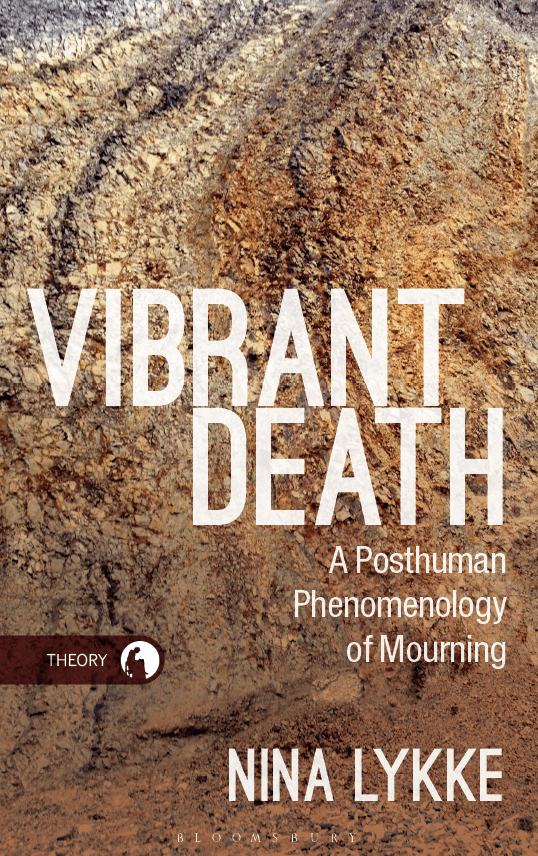
New Book Coming Out Soon!

Nina Lykke:

Vibrant Death. A Posthuman Phenomenology of Mourning.

Bloomsbury Academic, London.

WILL BE AVAILABLE FROM DECEMBER 2021, MORE INFO:

https://www.bloomsbury.com/uk/vibrant-death-9781350149731/


Vibrant Death links philosophy and poetry-based, corpo-affectively grounded knowledge seeking. It offers a radically new materialist theory of death, critically moving the philosophical argument beyond Christian and secular-mechanistic understandings. The book’s ethico-political figuration of vibrant death is shaped through a pluriversal conversation between Deleuzean philosophy, neo-vitalist materialism and the spiritual materialism of decolonial, queerfeminist poet and scholar Gloria Anzaldua. The book’s posthuman de-exceptionalising of human death unfurls together with a collection of poetry, and autobiographical stories. They are analysed through the lens of a posthuman, queerfeminist revision of the method of autophenomenography (phenomenological analysis of autobiographical material).

Nina Lykke explores the speaking position of a mourning, queerfeminine ”I”, who contemplates the relationship with her dead beloved lesbian life partner. She reflects on her enactment of processes of co-becoming with the phenomenal and material traces of the deceased body, and the new assemblages with which it has merged through death’s material metamorphoses: becoming-ashes through cremation, and becoming-mixed-with-algae-sand when the ashes were scattered across a seabed made of fiftyfive million-year-old, fossilised algae. It is argued that the mourning “I”’s intimate bodily empathising (theorised as symphysising) with her deceased, queermasculine beloved life partner facilitates the processes of vitalist-material and spiritual-material co-becoming, and the rethinking of death from a new and different perspective than that of the sovereign, philosophical subject.

CFP: Dying at the Margins: A critical exploration of Material-Discursive Perspectives to Death and Dying

Organizers: Natashe Lemos Dekker (University of Amsterdam and Leiden University Medical Center) and Jesse D Peterson (KTH Royal Institute of Technology)
Place: Environmental Humanities Laboratory, Division of History of Science, Technology, and Environment, KTH Royal Institute of Technology, Stockholm, Sweden
Dates: September 26-27, 2019

Description

Death is often assumed to arrive when heart and lungs stop. Yet, sometimes the borders between life and death are unclear. Death, then, may get interrupted, delayed, or come undone, disrupting the “natural” and “normal” forms of a “good” death. We acknowledge such disruptions as material and discursive; that is, bodies, minds, geographies, stories, and more act to challenge human perspectives on how people, animals, plants, or things ought to die and where and how the dead ought to be laid to rest. Suddenly, what seemed coherent no longer is, in the breakdown or dissolution of that which is dying but also in the way one orders worlds and afterworlds.

This workshop, thus, seeks to explore socio-ecological networks of the dying and dead that exist at the margins. We see tantalizing glimpses of this endeavor in the work of Achille Mbembe’s notion of “necro-politics” that explores the instrumentalization and material destruction of the human, Philip R. Olson’s “necro-waste” that looks at the human body as a form of material waste, and Joshua Reno’s work on the biosemiotics of shit as a “sign of life.” Such work invites us to pursue and further identify ways to explore and establish connections between dying and death from perspectives that refute a nature/culture binary—to ask questions such as:

·       What boundary work takes place to construct and maintain the categories of alive, not-alive, dead, dying, and undead for places, objects, and beings?

·       How do states and processes of acquiescing to, existing in between, manipulating, or overcoming life and/or death affect normative assumptions about dying and death?

·       What might it mean to reconfigure human understanding of death to a more ecological frame that accommodates more-than-human lives and/or deep time?

·       How might the memories, spirits, or spiritualities related to the dead and dying limit, expand, or explode a material-discursive frame?

·       How do such challenges alter ethical approaches or values attached to dying and death?

Through this workshop, we hope to build a bridge between scholars working in the medical and environmental humanities and the social sciences, providing a venue to put into conversation research that explores how dying “bodies”—animal (including human), plant, thing, place—challenge natural, normative, and notions of a “good” death.  We encourage applications from scholars whose research practices consider feminist and queer studies, new materialism and waste, plant and animal studies, non-western or indigenous studies, and/or death studies.

Deadline for abstracts is June 5, 2019. Please send your abstract (max 250 words) and a short biography (100 words) to Natashe Lemos Dekker (N.LemosDekker@uva.nl) and Jesse Peterson (jessep@kth.se). Notifications of acceptance will be sent on June 11, 2019 or shortly thereafter.

We are happy to announce that Philip R. Olsen and Marietta Radomska will give keynote lectures and participate in the workshop. Participants will be asked to submit their papers by August 31. These will be pre-circulated to all participants and each paper assigned a discussant. Papers do not need to be finished articles, but can take the form of a think piece of up to 6 pages. We ask all participants to read all contributions beforehand to ensure in-depth discussion. During the workshop, each participant will pitch their work, followed by another participant who will act as a discussant, and who will pose remarks and questions. All participants will be allocated a text to discuss.

The workshop will be held at KTH – Royal Institute of Technology in Stockholm on September 26-27, 2019. A workshop dinner will take place on the night of the 26th. Lunch and coffee will also be provided free of charge during the workshop. We may be able to offer partial travel reimbursement for some applicants.

See the original post here