Call for abstracts: Queer Death Studies Reader. Edited by Nina Lykke, Marietta Radomska and Tara Mehrabi

The field of Queer Death Studies

The planned reader will gather a wide range of contributions to the field of Queer Death Studies (QDS). This is an emerging, transdisciplinary field of study which takes research on death, dying, and mourning in new directions, inspired by feminist, posthumanist, decolonial, anti-racist, queer, trans, body- and affect-theoretical scholarship, art and activism (Radomska, Mehrabi and Lykke 2020). What distinguishes QDS from conventional Death Studies such as death sociology or anthropology of death is an overall critical focus on the framing of death and extinction in the contemporary world through Anthropocene necropolitics (Mbembe 2003, Lykke 2019) and necropowers of post/colonialism, racial and extractivist capitalism. Death is approached as an ethico-political issue that is embedded in global power structures. QDS pays attention to systematic, necropolitical productions of death, in dialogue with ethico-political critiques emerging from political movements for social, environmental and planetary justice and change. QDS is also based on critiques of the dichotomous divides, characterising Western modernity, and is marked out through a critical focus on normativities and exclusionary notions of the human, casting the death of those who differ from the normative human subject in terms of gender, racialisation, migration status, class, geopolitical situatedness, able-bodiedness, and species as less grievable or disposable and not counting at all (Butler 2004). In short, QDS aligns itself with critiques of the intra-acting multiplicity of hierarchising divides between appropriate and in/appropriate/d others (Minh-ha 1989), articulated by social, environmental and planetary justice movements.

The Call

With this call, we invite abstracts from researchers, students, artists and activists who see their research and activities as aligned with critiques of the necropowers operating in the contemporary world, and who want to contribute to queering, decolonising and posthumanising death and the onto-epistemololgies and politics conventionally framing death.

Queering, Decolonising and Posthumanising

The verbform, queering, which we use here, encompasses a wide range of meanings. It refers to (1) open-ended deconstructing of normativities and processes of normalisation in various forms, as well as (2) undoing of heteropatriarchy, heteronormativity, binary gender and sexualities governed by reproductive biopowers or, in other words, the normative heterosexual matrix. Queering death is thus on the one hand understood as a critical strange-making, and defamiliarising, which may imply affirmative openings of other horizons than Christian and Cartesian dualist approaches to death, for example a focus on the vibrant entanglement of growing and decomposing (Radomska 2017; Lykke 2022). On the other hand, queering means critically focusing on the ways in which misogyny, trans- and queerphobia lead to social as well as physical death, and how violence and hate crimes towards non-normative individuals seek to render their lives and deaths non-grievable (Puar 2007; Chen 2012; Snorton 2017). Together with this broad spectrum of meanings, we also want to emphasise that queering should be understood in its intersections with decolonising and posthumanising efforts

Decolonising death involves critically dismantling the violent necropowers of colonisation, racial and extractivist capitalism, which for centuries have made death become ”life’s quiet companion” (Lehman 1997) for racialised and indigenous people worldwide, as well as confronting the over-arching racisms which continue to produce (physical, social and cultural) death along racialised lines. Moreover, decolonising death signals a turn towards pluritopic hermeneutics (Tlostanova and Mignolo 2009), i.e. hermeneutics which do not universalise Western modern frameworks, and which reevaluate indigenous philosophies, cosm-ontologies and sensibilities. In terms of life/death thresholds, this implies critically-affirmatively shifting the meanings of death, for example, substituting conceptualisations and imaginaries of death as a final endpoint within a chrononormative linear temporality, and instead opting for understandings, situated in geo- and corpo-political frameworks outside of Western modernity (e.g. Smith 1999; Anzaldua 2015).

Posthumanising death refers to the systematic problematisation of the planetary-scale mechanisms of annihilation of the more-than-human world in their ontological, epistemological and ethico-political dimensions. It involves critical analyses of the human/nonhuman divide and power differentials that have allowed for the reduction of the nonhuman to mere resource and instrument for human endeavours. Furthermore, the posthumanising move entails unpacking philosophical and cultural meanings of extinction and the ways in which it fundamentally disrupts life processes in relation to time, death and generations (e.g. Rose 2012); it draws attention to environmental violence, environmental grief, as well as nonhuman death manufactured en masse through anthropocentric habits of consumption and mechanisms of extractivism.

Consequently, posthumanising death takes seriously the issues of responsibility, accountability and care for/in dying more-than-human worlds, while remaining grounded in radical critiques of human exceptionalism, and affirmative embrace of alternatives (eg. Braidotti 2013; Haraway 2016; MacCormack 2020).

Formats and deadlines:

We call for abstracts of approximately 300 words, to be accompanied by a bio-note of approximately 200 words, as well as by a title of the proposed chapter and an indication of how the chapter relates to the below main themes to be covered in the reader.

Please, send your abstract etc to ninly[at]fastmail.fm , cc: <marietta.radomska[at]liu.se> and <tara.mehrabi[at]kau.se>

Abstract DEADLINE: 1st NOVEMBER, 2021

We will respond to your abstract by MID-JANUARY 2022, and foresee submissions of FIRST DRAFT CHAPTERS by August 1, 2022.

We plan a reader with around 50 contributions, including a few reprints of classics. Scholarly as well as creative and artistic contributions are welcome! We hope together with contributors to build a reader which will be significant and agenda-setting for the field

Thematic clusters:

*Queering Death: Rethinking life/death ecologies

*Histories of necropowers and Anthropocene necropolitics

*Decolonising death

*Posthumanising death

*Demedicalising death

*Politics and Ethics of Mourning

*Alternative Spiritual, Aesthetic and Arts Activist Approaches to Death and After-life

The International Network for Queer Death Studies

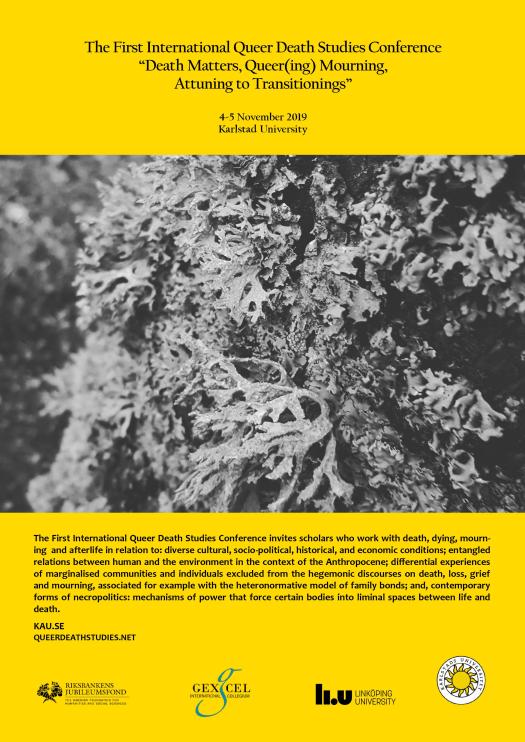
The idea for the reader grew out of the international network for Queer Death Studies, which was founded in 2016, (see https://queerdeathstudies.net/). The network has organised several workshops and an international conference at Karlstad University, Sweden, in 2019.

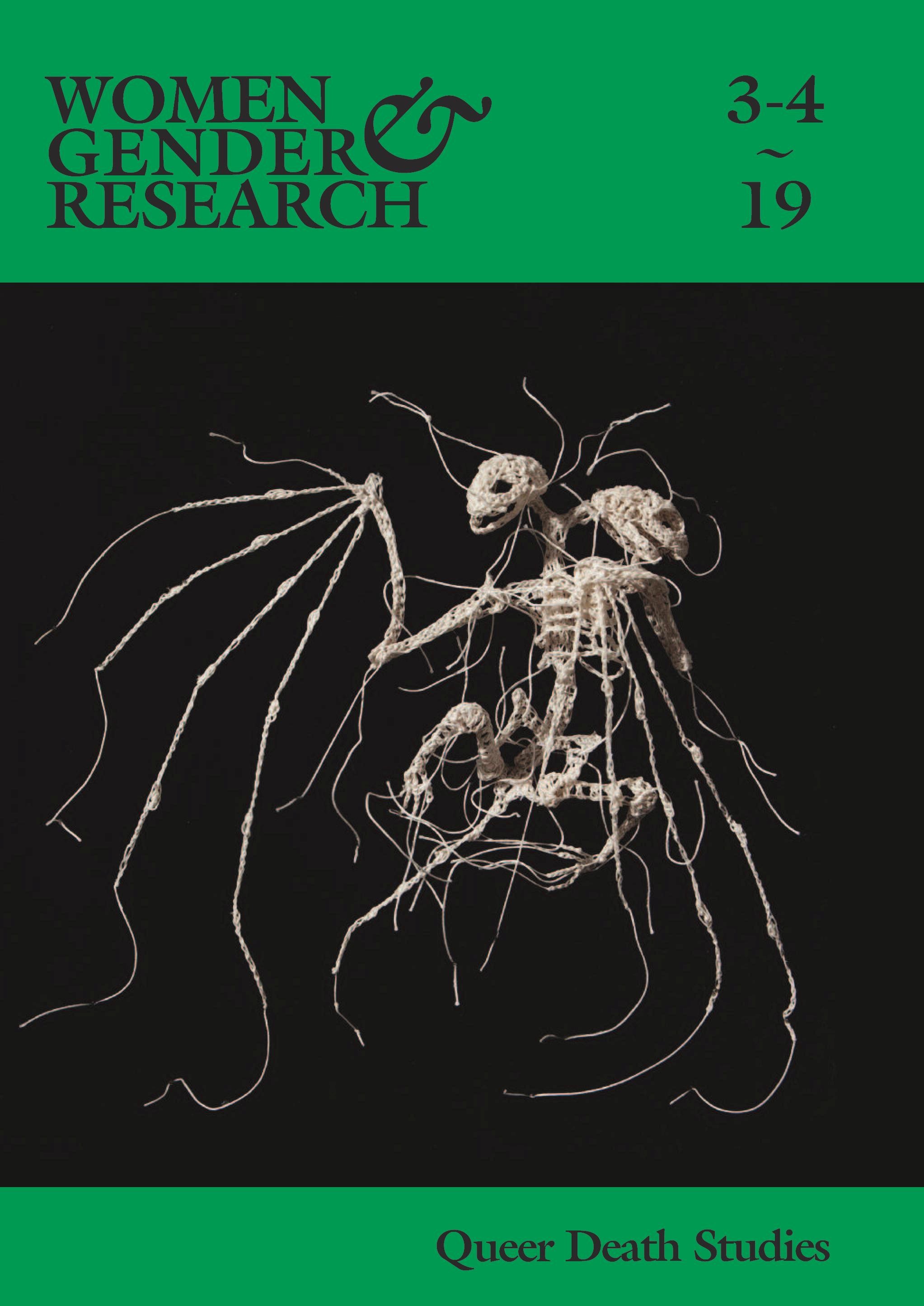
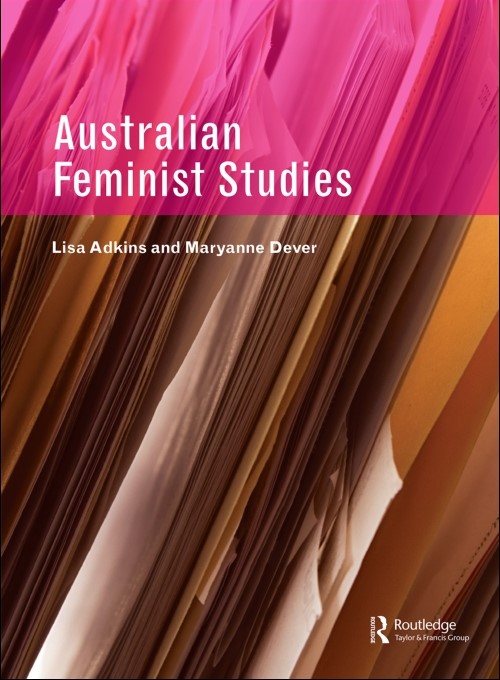
We have earlier published two special journal issues of Australian Feminist Studies (2020, Vol 35 (104)), and Women, Gender and Research (2019: Issue 3-4).

References

Anzaldua, G. E. (2015), Light in the Dark/Luz en Lo Oscuro: Rewriting Identity, Reality, Spirituality, Durham, NC: Duke University Press.

Braidotti, R. (2013), The Posthuman, Cambridge, UK: Polity Press.

Butler, J. (1990), Gender Trouble. Feminism and the Subversion of Identity, London, New York: Routledge.

Butler, J. (2004), Precarious Life: The Powers of Mourning and Violence, New York, NY: Verso.

Chen, M. Y. (2012), Animacies: Biopolitics, Racial Mattering and Queer Affect, Durham, NC: Duke University Press.

Haraway, Donna (2016), Staying with the Trouble: Making Kin in the Chthulucene, Durham, NC and London: Duke University Press.

Lehman, G. (1997), ‘Life’s Quiet Companion’, in G. Carey and R. Sorenson (eds), The Penguin Book of Death, 223–232, Ringwood: Penguin Australia.

Lykke, N. (2019), ‘Making Live and Letting Die: Cancerous Bodies between Anthropocene Necropolitics and Chthulucene Kinship’, Environmental Humanities, 11 (1): 108–36.

Lykke, N (2022), Vibrant Death. A Posthuman Phenomenology of Mourning. London: Bloomsbury Academic.

MacCormack, Patricia (2020a), The Ahuman Manifesto. Activism for the End of the Anthropocene. London: Bloomsbury Academic.

Mbembe, A. (2003), Necropolitics, Public Culture, 15 (1): 11–40.

Minh-ha, T. T. (1989), Woman, Native, Other: Writing Postcoloniality and Feminism, Bloomington and Indianapolis IN: Indiana University Press.

Puar, J. (2007), Terrorist Assemblages: Homonationalism in Queer Times, Durham: Duke UP-

Radomska, M., T. Mehrabi, and N. Lykke (2020), Queer Death Studies: Death, Dying and Mourning From a Queerfeminist Perspective, Australian Feminist Studies, 35(104): 81-100.

Radomska, M. (2017), Non/living Matter, Bioscientific Imaginaries and Feminist Technoecologies of Bioart, Australian Feminist Studies, 32 (94): 377-394.

Rose, D. B. (2012), Multispecies knots of ethical time, Environmental Philosophy, 9(1): 127–140.

Shildrick, M (2020) Queering the Social Imaginaries of the Dead, Australian Feminist Studies, 35(104): 170-185.

Smith, L.T. 1999. Decolonizing Methodologies. Research and Indigenous Peoples. London and New York: Zed books.

Snorton, C.R (2017), Black on Both Sides: A Racial History of Trans Identity. Minneapolis: University of Minnesota Press.

Tlostanova, M. and W. Mignolo (2009), On Pluritopic Hermeneutics, Trans-Modern Thinking, and Decolonial Philosophy, Encounters, 1 (1): 11–27.
New Publication: Special issue of the journal Australian Feminist Studies focused on Queer Death Studies

We are delighted to say that the special issue of the journal Australian Feminist Studies focused on the topic of “Queer Death Studies” and co-edited by Marietta RadomskaTara Mehrabi and Nina Lykke, has finally been published.

The issue contains contributions by QDS scholars: Patricia MacCormack, Marietta Radomska, Tara Mehrabi, Stine Willum Adrian, Margrit Shildrick, Hema’ny Molina Vargas, Camila Marambio and Nina Lykke.

The collection strives to advance queerfeminist methodologies and ontological, ethical and political understandings that critically and creatively attend to the problem of death, dying and mourning in the current environmental, cultural, and socio-political contexts.

In order to learn more, do check out the introduction “Queer Death Studies: Death, Dying and Mourning From a Queerfeminist Perspective”, co-authored by myself, Tara and Nina, available in OA here.

‘Queering Ecologies of Death’ panel at the SLSAeu GREEN conference in Copenhagen, 13-16 June 2018

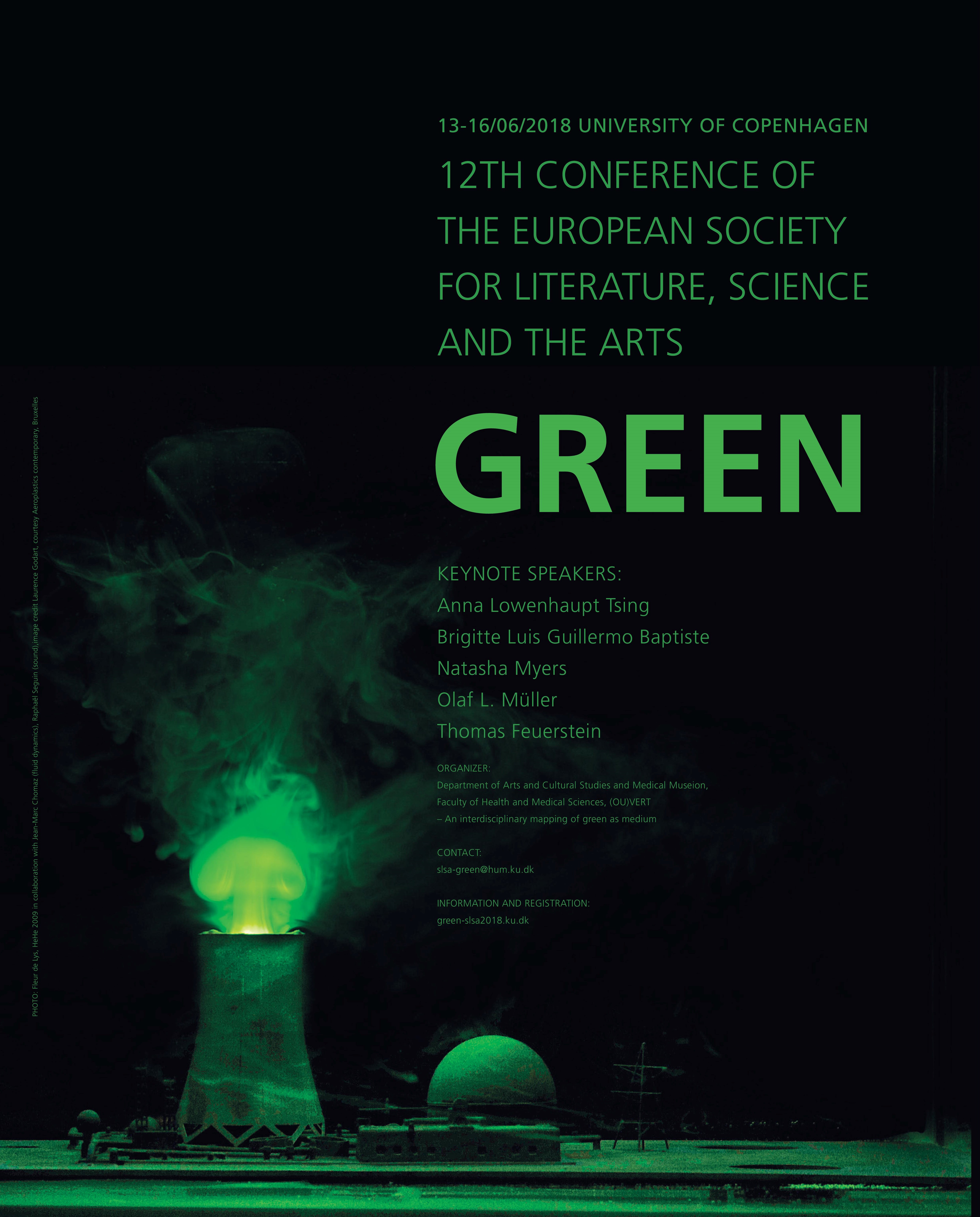
GreenSLSAPoster-page-001 (2)
GREEN SLSAeu poster

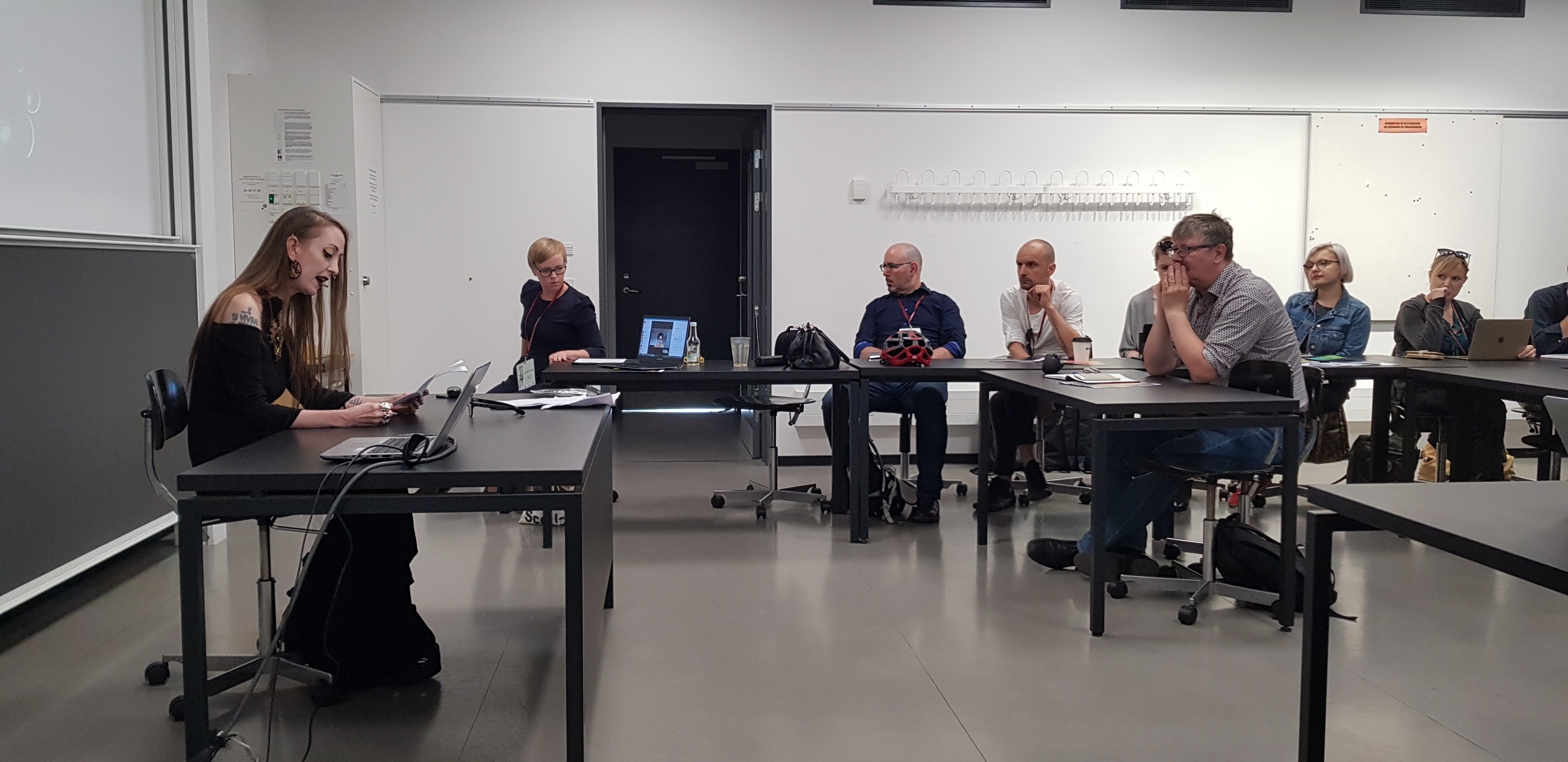
On 14th July some of the QDS Network researchers had a pleasure to present their work in the two-session panel ‘Queering Ecologies of Death’, proposed by Prof. Patricia MacCormack (Anglia Ruskin University, UK) and Dr. Marietta Radomska (Linköping University, SE), at the SLSAeu GREEN conference that took place on 13-16 June 2018 in Copenhagen, Denmark.

Link to the full programme.

Link to the panel schedule.

Below you may find the summary of the panel which consisted of the speakers: Dr. Marietta Radomska, Prof. Patricia MacCormack, Dr. Line Henriksen (University of Copenhagen, DK), Dr. Tara Mehrabi (University of Turku, FI), Prof. Margrit Shildrick (Stockholm University, SE) and Prof. Nina Lykke (Linköping University, SE).

RADOMSKA & MacCormack
& Henriksen & Mehrabi & Shildrick & Lykke

PANEL: Queering Ecologies of Death

‘Green’ as a concept has become a shorthand for ‘ecology’, understood as that which refers to ‘home’ or ‘environment’ with all their constituting relationalities. It not only evokes a reflection on or concern with human and nonhuman entities and their milieus, but also implies a set of discourses (public, political, scientific, philosophical) that focus on the climate change and contemporary ecological crises. The latter, more often than not, entail the degradation and diminution of food and water resources, which make certain habitats unlivable.
Along with ‘climate migration’, these processes lead to the death of individual organisms, populations and species extinction, prompting us to reconsider our ways of understanding and relating to death, dying, extinction and annihilation.
While bioscience and biotechnologies underline and expose interdependency, commonality and relationality as key characteristics of life shared by all organisms, Western thought and cultural imaginaries tend to draw a thick dividing line between human and nonhuman animals and other organisms, notably visible in the context of death. The interdisciplinary field of Death Studies (in its conventional form) gives precedence to the death of human individuals as its main research subject, examined primarily through psychological, anthropological and sociological lens. Western philosophies approach death in a double way: as a process common to all organisms and an event that distinguishes the human from other creatures (e.g. Heidegger [1953] 2010; Calarco 2008).
Yet, in the context of discussions on the so-called Anthropocene – a distinct geological epoch we live in, generated by ‘human activities on earth and atmosphere, and at all, including global, scales’ (Crutzen & Stoermer 2000, 17) – it becomes evident that the stories of species extinction, animal death and annihilation of nonhuman life, broadly speaking, are deeply entangled with the histories of colonial violence, genocide and oppression/elimination of the non-normative human other.
Environmental science and the humanities examine more-than-human death primarily in the form of species extinction, its narratives and imaginaries. Simultaneously, human death is classified, investigated and valued separately: approached through a cultural, social or biomedical lens, it appears as either ‘the end’ of individual’s existence (in religious discourses taken as a step towards an afterlife), or as something to postpone or eliminate by medical means. However, if we look at the human corpse itself, it is an (always already) non/human assemblage of entities, materialities and processes.
Against this background, what strikes is the lack of sufficient theorising of the messy intimacies between materialities of human and nonhuman kind that constitute the processes of death, dying and annihilation. In other words, our cultural understandings require conceptualisations and narratives attentive to multiplicitous relationalities and entanglements of the living and non-living, and human and nonhuman or, what we call, ‘ecologies of death’.
This transdisciplinary panel brings together several different perspectives, encompassing such fields as philosophy, art, cultural studies, monster studies, science and technology studies, gender studies and disability studies, in order to ask what it means to queer ecologies of death. The speakers will not only concentrate on the processes and materialities of death and dying, and living and non-living in a more-than-human world, but also investigate how such enquiries go beyond, unsettle and subvert given norms, normativities and binaries that govern our approaches to and understandings of death, dying, extinction and annihilation. In particular, the
panelists will focus on the following set of questions:
How can ecosophy (a thought informed by entangled intimacies of the living and non-living beyond green) and bio-philosophy (thinking life in its relation to that which takes it beyond itself) attend to multiplicitous difference and relationality constitutive of death and dying as well as its ontology and ethics?

Queering Ecologies of Death: Part 1

While thinking with and through the contemporary practices of eco- and bioart, Marietta Radomska (Linköping University) will ask how such forms of art explore and enact the
relations between the human and the environment in the context of the annihilation of life on Earth resulting from human activity? How can doing biophilosophy through art contribute to a less anthropocentric, non-normative and different understanding of death? And, in return, what kinds of ethics does it mobilise?
Patricia MacCormack (Anglia Ruskin University) will focus on how abolitionism (animal rights at its extreme) can rethink entanglement as grace through a leaving be, while also opening the ecosophical world to freedoms unperceived by anthropocentric apprehension. Furthermore, she will ask how human extinction through a cessation of reproduction or advocation of anti-natalism could further abolition to become
a form of queer death activism that is both vitalistic and caring, creative and jubilant?
Line Henriksen (University of Copenhagen) will look at the ways contemporary ecocritical discourses bring forward the questions of disappearance, absence, annihilation, trace and void. More specifically, if ecology is a home/household
(oikos) – she asks – is it haunted? By bringing together hauntology and ecotheory, she will discuss what it means to think spectrality as part of ecological systems, thereby delving
into the transparency of the apparition as much as the traditional ‘green’ of ecology.

Queering Ecologies of Death: Part 2

Drawing on her ethnographic work in a Drosophila Melanogaster laboratory, Tara Mehrabi (University of Turku/Karlstad University) will explore how, in the context of
contemporary bioscience, life (e.g. of animal models) – no longer scientifically ‘valuable’/’useful’ – becomes ‘waste’. How does this particular ecology of death challenge and queer the boundaries of natural/artificial, inside/outside, nature/laboratory,
safe/hazardous and living/non-living beyond green? How does it problematise human exceptionalism and binary logic?
Margrit Shildrick (Stockholm University/University of Toronto) will enquire about death (organic/cellular/singular/species) in the context of the research on michrochimerism
beyond the human. She will anchor these questions in the problematics around the ‘greening’ of the gut and eradication therapy.
Finally, Nina Lykke (Linköping University) will concentrate on how human death and the human corpse can be rethought from the perspective of inhuman forces, understood
in an immanence philosophical sense, and redefined against the background of its transcorporeal belonging to a queer planetary kinship of vulnerable more-than-human-bodies. What are the eco-ethical implications of such a redefinition?

20180614_091311
Prof. Patricia MacCormack on ‘The Age of Anthropophagus’

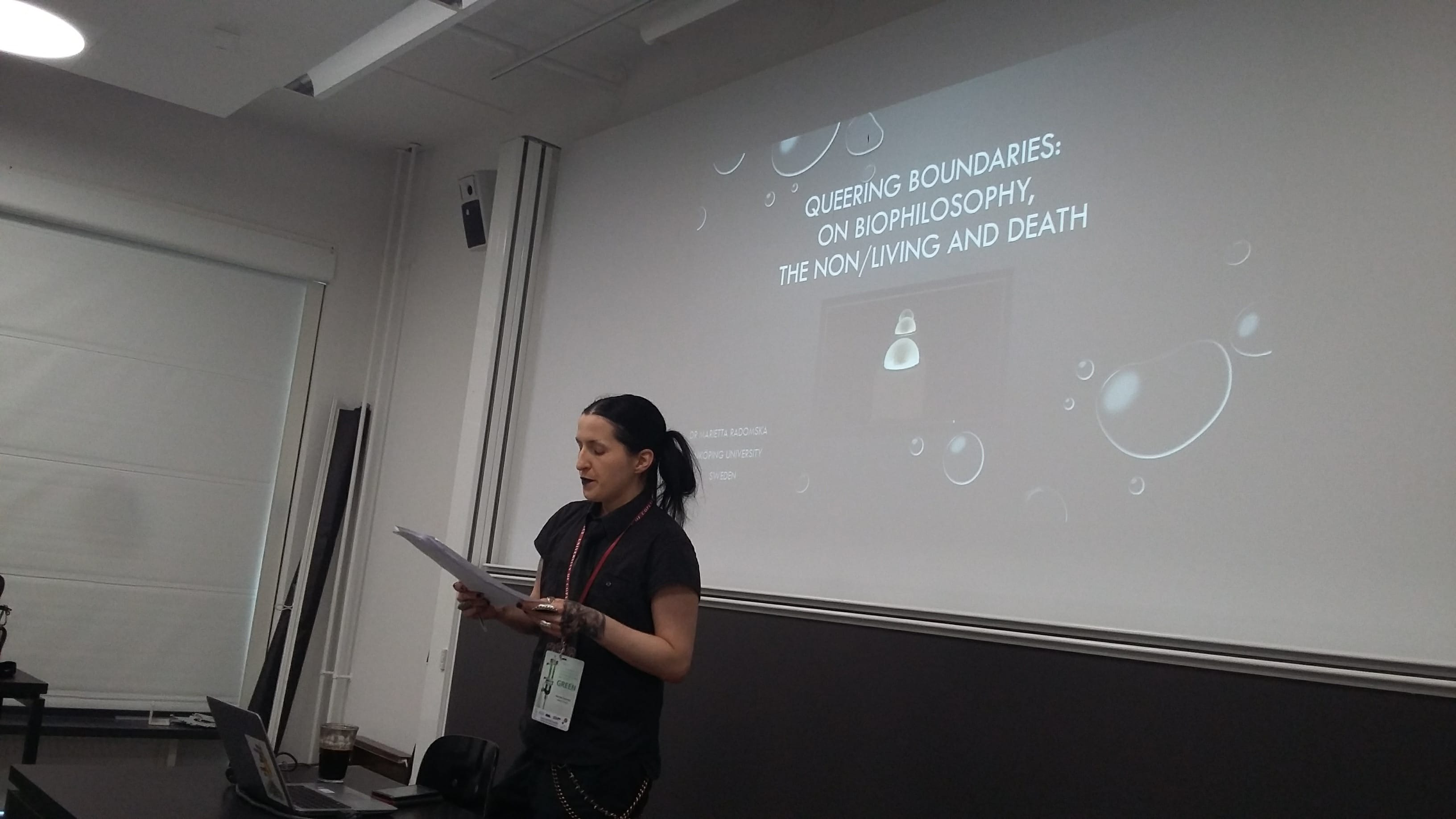
received_10159626006888504
Dr. Marietta Radomska on ‘Queering Boundaries: On Biophilosophy, the Non/Living and Death’

20180614_093603
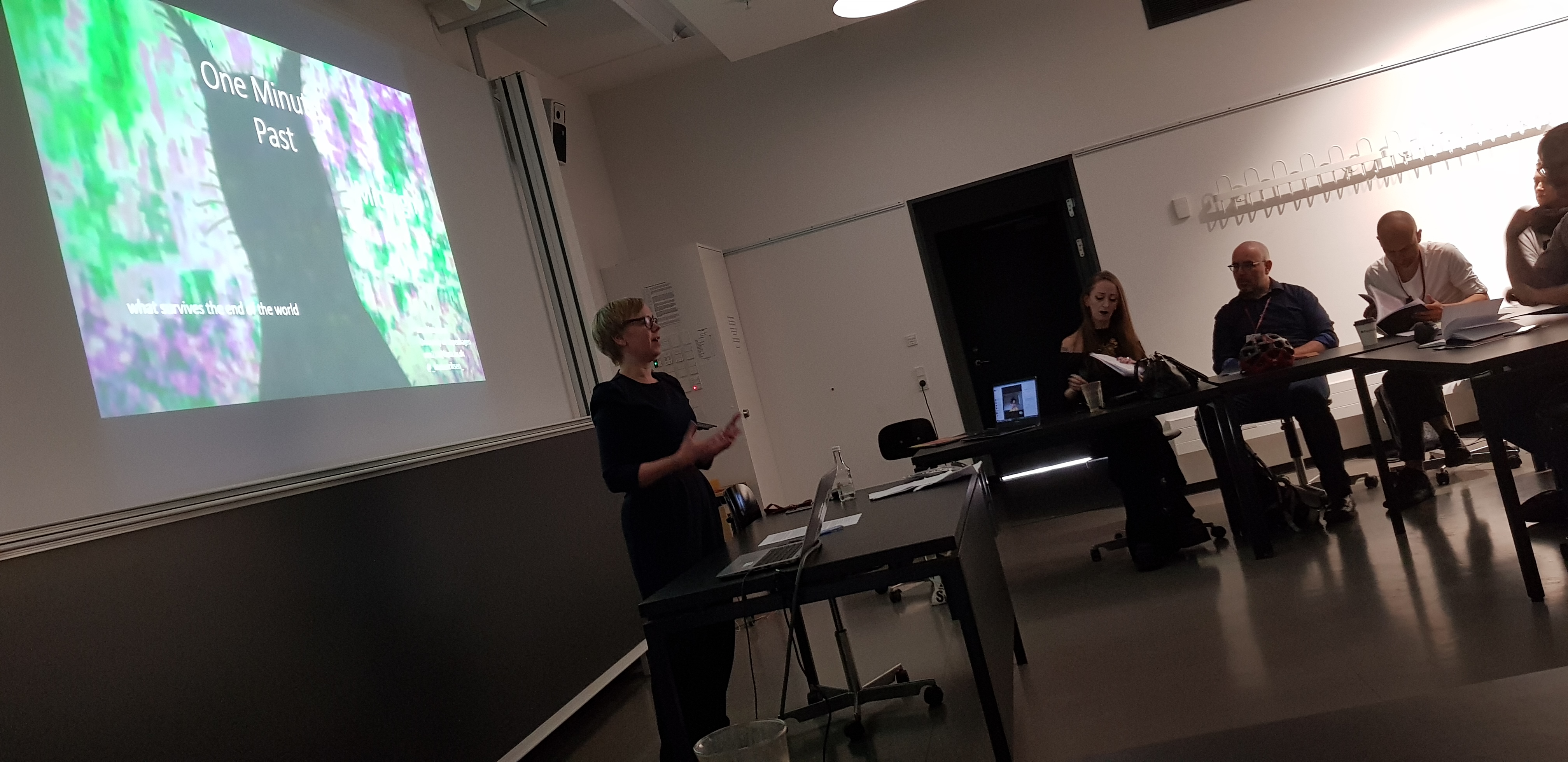
Dr. Line Henriksen on ‘One Minute Past: What Survives at the End of the World’

IMG_20180614_182728
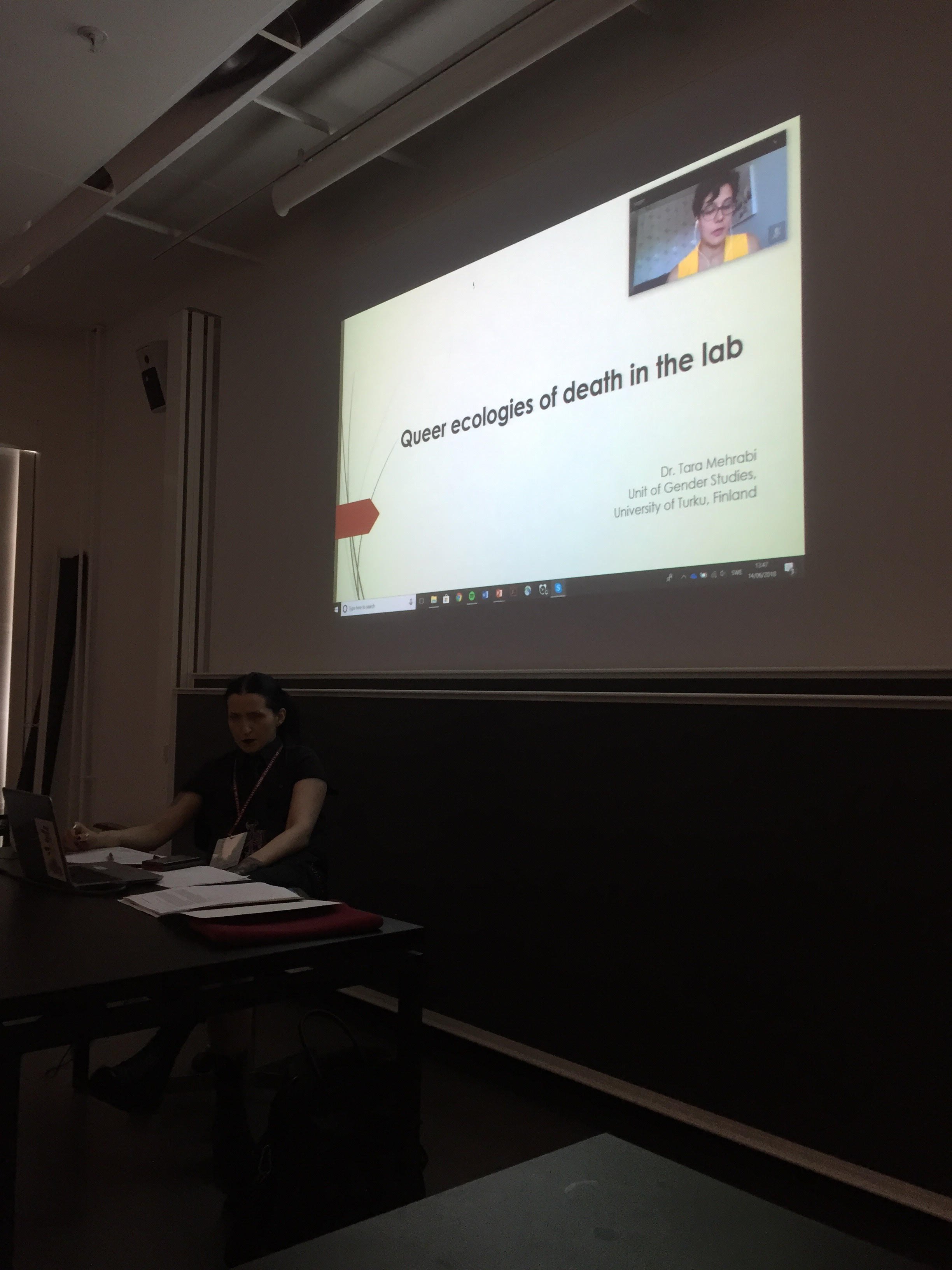
Dr. Tara Mehrabi on ‘Queer Ecologies of Death in the Lab’

20180614_141100
Prof. Margrit Shildrick on microbiome, microchimerism and death

20180614_145318
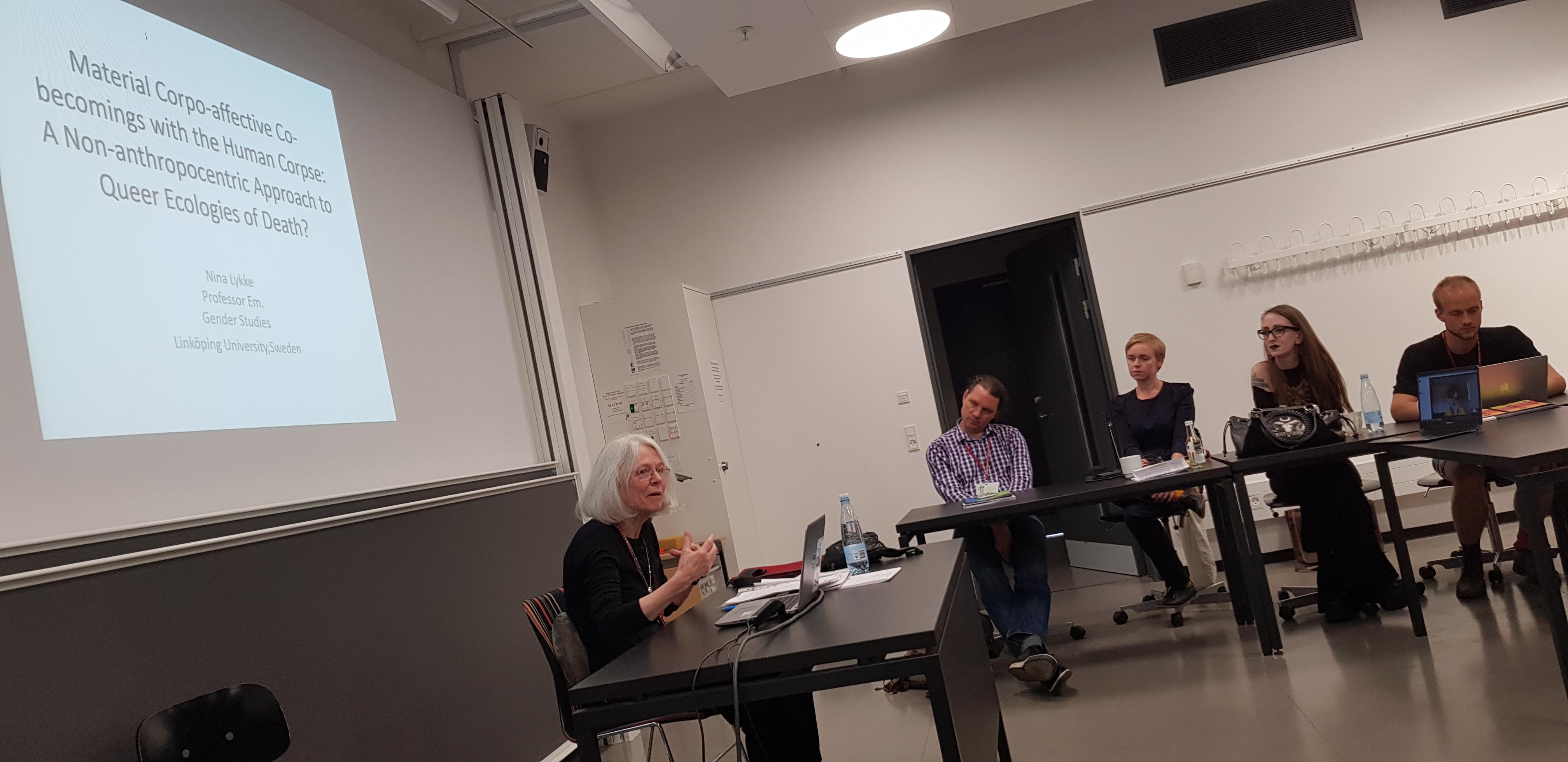
Prof. Nina Lykke on ‘Material Corpo-affective Co-becomings with the Human Corpse’

Full programme of The Third International Queer Death Studies Workshop is out now!

Dear all,

Please, check the full programme – including abstracts and bios – of The Third International Queer Death Studies Workshop Death Matters: Death and Dying in a Queer Context, taking place on 30-31 May 2018 in Linköping, here.

If you would like to attend the event, but haven’t registered yet, please do so by sending an email to: tara.mehrabi[at]liu.se by 23rd May 2018 at the latest.

You can also find the event on Facebook.

CfP for a special issue of Women, Gender & Research on Queer Death Studies

Cfp: KKF 2019/2-3: Queer Death Studies

Call for Papers:
Queer Death Studies: Coming to Terms with Death, Dying and Mourning Differently

Special issue
Women, Gender & Research, 2019/2-3

Queer Death Studies (QDS) refers to an emerging transdisciplinary field of research that critically and (self) reflexively investigates and challenges conventional normativities, assumptions, expectations, and regimes of truths that are brought to life and made evident by death, dying, and mourning.

Since its establishment as a research field in the 1970s, Death Studies has drawn attention to the questions of death, dying, and mourning as complex and multifaceted phenomena that require inter- or multi-disciplinary approaches and perspectives. Yet, the engagements with death, dying and mourning, constitutive of conventional Death Studies’ investigations, tend to remain insufficient and reductive. They are often governed by the normative notions of: the subject; bonds between humans, as well as between humans and (their) animals; family relations and communities; rituals; and finally, experiences of grief, mourning, and bereavement. Moreover, these engagements are frequently embedded in constraining beliefs in life/death divides, constructed along the lines of conventional religious and/or scientific mind/body dualisms, characteristic of the Western cultural imaginaries.

Against this background, QDS offers a site for ‘queering’ traditional ways of approaching death both as a subject of study and philosophical reflection, and as a phenomenon to articulate in artistic work or practices of mourning. Here, the notion of ‘queer’ conveys many meanings. It refers to researching and narrating death, dying, and mourning in the context of queer bonds and communities, where the subjects involved/studied/interviewed and the relations they are involved in are recognised as ‘queer’. Simultaneously, the term ‘queer’ can also function as an adverb and a verb, referring thus to the processes of going beyond and unsettling (subverting, exceeding) binaries and given norms, normativities, and constraining conventions. In other words, ‘queer’ becomes both a process and a methodology that is applicable and exceeds the focus on gender and sexuality as its exclusive concerns.

This special issue invites academic as well as artistic contributions that focus on and explore the ways queer theory and queer perspectives can help us rethink death, dying, remains, afterlife, mourning and the life-death dichotomy.

The topics may include, but are not limited to:
– Queer methodologies of researching death, dying and mourning
– Queer practices of mourning and bereavement
– Materiality of death and corpses
– Death/life ecologies
– Necropolitics and borders
– Un/grievable lives and deaths
– Death and biotechnology/biomedicine
– Queering cancer and other life-threatening diseases
– Suicide
– Technologies of life/death
– Queer widowhood
– Decolonialising death
– Illness narratives and death
– Ethico-politics and practices of killability
– Nonhuman death and dying
– Extinction and annihilation
– Death and acts of resistance
– ‘Slow death’
– Queering temporalities of death
– Queer spiritualities

Editors:
Marietta Radomska, postdoc, Linköping University, Sweden
Tara Mehrabi, postdoc, University of Turku, Finland
Nina Lykke, professor emerita, Linköping University, Sweden

Deadline for abstracts (max 300-word + up to 100 word author bio): June 25, 2018
Deadline for articles: December 1, 2018

All contributions must be in English and should be submitted to: redsek@soc.ku.dk

Guidelines for contributors: http://koensforskning.soc.ku.dk/english/kkof/guidelines/

Download the call as pdf.

For more information about the journal Women, Gender & Research / Kvinder, Køn & Forskning, see:
http://koensforskning.soc.ku.dk/kkf or http://koensforskning.soc.ku.dk/english/kkof

See also: http://koensforskning.soc.ku.dk/english/kkof/call-for-papers/cfp-kkf-20192-3-queer-death-studies/

The Third International Queer Death Studies Workshop “Death Matters: Death and Dying in a Queer Context”: the programme & registration!

Dear all,

It is our great pleasure to announce the programme of the upcoming Third International Queer Death Studies Workshop: Death Matters: Death and Dying in a Queer Context that takes place on 30th and 31st May 2018 at Linköping University. The workshop starts at 10:15 on 30th May and finishes at 16:00 on 31st May.

In order to register, please send an email to: tara.mehrabi [at] liu.se.

Registration DEADLINE: 23rd May 2018.


Programme:

30th May (Wednesday)

10:15 – 11:00 Introduction

11:00 – 12:30 Session I:

Margrit Shildrick (Stockholm University, SE/York University, Toronto, CA), Temporalities and Onto-epistemologies of Death and Dying

Natashe Lemos Dekker (University of Amsterdam/Leiden University, NL), Valuing Life: Normative and Moral Frames at the End of Life with Dementia

12:30 – 13:45 Lunch (on a self-paid basis)

13:45 – 15:55 Session II

Andria Nyberg Forshage & Eliot Eklöw (Södertörn University/Stockholm University, SE), Lilies of Sterile Pleasure. On Indolence, Deathliness, Deproduction, and Double Affirmation

ida Hillerup Hansen (Central European University, HU), ‘Falling Apart’: Prisms of Living with Loss

Magdalena Górska (Utrecht University, NL), Suffocations

15:55 – 16:10 Break (fika)

16:10 – 18:10 Session III

Órla O’Donovan (University College Cork, IE), Death, Dying and the ‘Commons’

Anne Bettina Pedersen (Aarhus University, DK), (Un)Making Sylvia Likens: Towards a Theory of Femicide Narratives

Saad Khan (independent researcher, BD), Dying Inside Black Mirror’s Posthumanist World

18:10 – 18:30 Discussion

19:30 – … Dinner downtown (on a self-paid basis)


31st May (Thursday)

10:15 – 11:45 Session IV

Agnieszka Kotwasińska (University of Warsaw, PL), Self/Haunted: Death and Mourning in Recent Horror Cinema

Line Henriksen (University of Copenhagen, DK) & Tara Mehrabi (Linköping University, SE), Hosts, Ghosts and Flies: Thinking Life, Death and Ethics through HBO’s West World

11:45 – 13:15 Lunch (on a a self-paid basis)

13:15 – 14:45 Session V

Alexandra Løvås Kristinnsdottir (University of Oslo, NO), Death Positivity and Its Potentials

Kristin Gupta (Rice University, US), Death (Feminist) Futures

14:45 – 15:00 Break (fika)

15:00 – 16:00 Final discussion