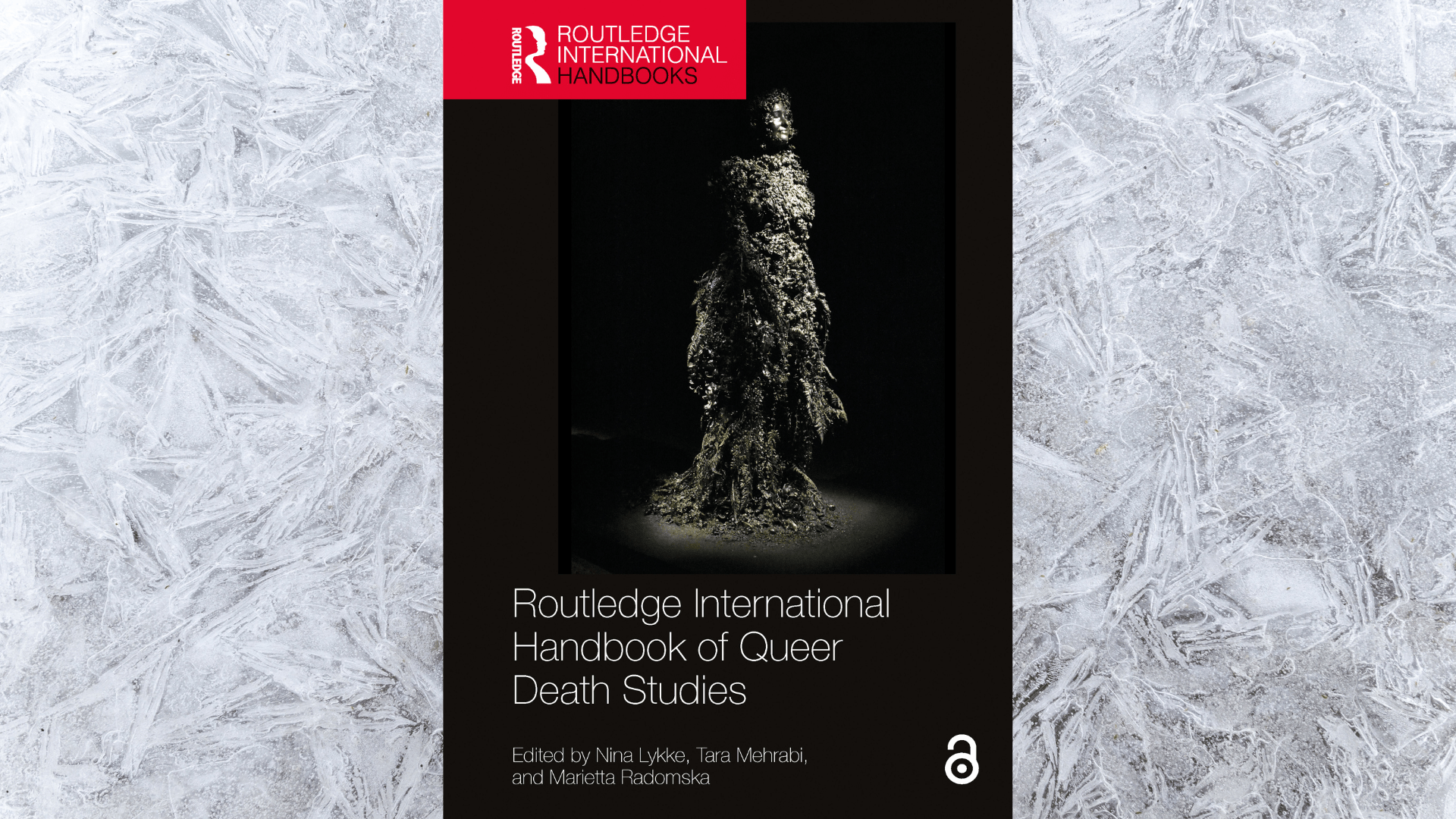
Routledge International Handbook of Queer Death Studies is OUT!

At the end of October 2025 – which means already five months ago – the long awaited major publication came out!

The 758-page volume: Routledge International Hanbook of Queer Death Studies, edited by Nina Lykke, Tara Mehrabi, and Marietta Radomska encompasses 63 chapters, written by 75 authors. The book consists of seven thematic sections: I. Rethinking  Life/Death Ecologies and Temporalities; II. Anthropocene Necropolitics and Extinction; III. Caring Death Activism; IV. Aesthetics and Mediated Imaginaries of Death; V. Politics and Ethics of Grieving Practices and Remembrance; VI. Co-Becoming with the Dead and Spectral Mourning; and VII. Imagining Life/Death Entanglements Differently.

Broadly speaking, the Handbook aims to provide a comprehensive, international cartography of Queer Death Studies, offering broad, in-depth insights into the field and its emergence through tentacular transdisciplinary networking. Taking research and art-making on death, dying, mourning, and afterlife into new directions, it explores the multiple effects of contemporary necropolitics and the proliferation of death-worlds during the current period of Earth’s history, ‘The Anthropocene’ or ‘the Age of Man’.

Informed by queer, critical posthumanist, decolonial, and feminist approaches, the Handbook presents a unique variety of both critical and affirmative reflections upon the world’s intersecting necropowers, and ethico-political potentials for social and environmental change. Contributors speculate on ways to reimagine life/ death-relations as vibrant entanglements. They also investigate modes of mourning differently, resisting necropolitical regimes that deem human and non-human individuals and populations to be disposable and non-grievable when they differ too much from the normative modern subject, Universal Man, in terms of intersections of gender, racialisation, class, sexuality, embodiment, embrainment, geopolitical positioning, or species.

A thought provoking read, this Handbook is intended for broad global audiences of researchers, artists, teachers, students, death-professionals, (health)careworkers, activists, and NGOs interested in tools to rethink and reimagine death, dying, mourning, and afterlife from intersections of queering, decolonising, posthumanising, and feminist perspectives.

The volume includes two chapters that are available in OPEN ACCESS.
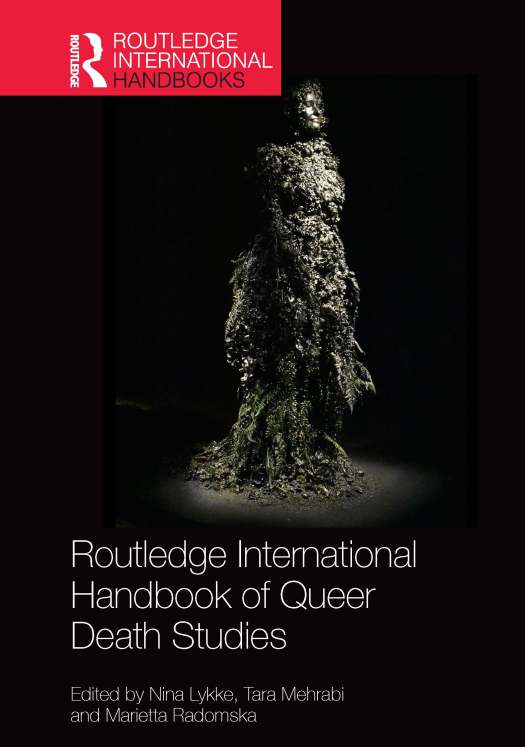
The cover of the Routledge International Handbook of Queer Death Studies

New special issue of Research in Arts & Education focused on Death is OUT now!

We have a pleasure to share with you the latest update from the editors of the OPEN ACCESS journal Research in Arts & Education, namely, that the special issue focused on topic of death and guest-edited by Helena Sederholm has now been published! Below we include a brief summary from the editors of the journal and the table of contents.

Check it out!

Research in Arts and Education Thematic issue on Death is now published. 

Guest Editor: Helena Sederholm

In this thematic issue, we have a compilation of articles, visual essays, and a commentary dealing with death from diverse viewpoints. In many texts, posthuman and more-than-human-aspect, that is, the relation to other species, has been emphasized. Nevertheless, it is impossible to avoid the perspective of humans, especially when dealing with art, philosophy, and education.

TABLE OF CONTENTS

Thematic issue: 

1–6
Editorial 
We are all necronauts
Helena Sederholm

7–20
Ecologies of Death, Ecologies of Mourning: A Biophilosophy of Non/Living Arts
Marietta Radomska

21–31
Reimagining Death in an All-Too-Human World: A Pedagogical Exploration of Pinar Yoldas’ Ecosystem of Excess
Juliette Clara Bertoldo

32–44
The Spores of Life and Death
Tiina Pusa

45–52
The Bouquet of Death and Decay
Eeva-Liisa Puhakka
                        

53–61
Corpses in Training: Blanchot and The International Necronautical Society’s Experimental Expeditions Beyond Life
Sami Sjöberg

62–75
To the Other Side with Bees
Ulla Taipale

76–84
Unravelling Haptic Visuality and Notions of Care Through Two Videos About Death
Anna Walker and Jo Milne

General Articles          

85–98
Arctic Wool
Fabiola Hernández Cervantes

99–110
Children of Drama: An Arts-Based Educational Action Research Project Applied to a Group of In-Service Educators
Theodora Salti

Exciting NEW PUBLICATION: Death’s Social and Material Meaning Beyond the Human

It is our great pleasure to feature here on our blog the latest publication coming out via Bristol University Press and edited by Jesse D. Peterson, Natashe Lemos Dekker and Philip R. Olson – a collection entitled Death’s Social and Material Meaning Beyond the Human (out on 9th January 2024).

The Bristol University Press website includes the following book description:

Death studies typically focus on the death of humans, overlooking the wider factors involved in social and natural processes around death.

This edited volume provides an alternative focus for death studies by looking beyond human death, to reveal the complex interconnections among human and more than human creatures, entities and environments.

Bringing together a diverse range of international scholars, the book sheds light on topics which have previously remained at the margins of contemporary death studies and death care cultures.

Organised around three themes – Knowledge and Mediation, Care and Remembrance, and Agency and Power – this book pushes the boundaries of death studies to explore death and dying from beyond the perspective of a nature/culture binary.

Check out this exciting book once it’s out and make sure your local/university library includes it in its collection!

Call for short contributions (500-2000 words): What do we talk about when we talk about queer death? (Whatever Journal)

Whatever. A Transdisciplinary Journal of Queer Theories and Studies (https://whatever.cirque.unipi.it/) is inviting submissions for short contributions (500-2000 words) to be collected in a multi-authored article entitled “What do we talk about when we talk about queer death?”. The article will introduce the themed section Queer thanatologies (edited by A.C. Corradino, C. Dell’Aversano, R. Langhi and M. Petricola) that will appear in Whatever’s next issue in summer 2021.

Queer death studies has recently emerged as a transdisciplinary field of inquiry investigating the cultural performances related to death, dying, grief, and disposal from the perspective of queer theory, defined as a hermeneutical stance whose premises could be summed up as follows: «queer states that any construction of identity (including LGBT ones) is a performance constituting a subject which does not “exist” prior to it, and encourages to bring into being (both as objects of desire, of fantasy and of theoretical reflection and as concrete existential and political possibilities) alternative modes of performance» (Dell’Aversano 2010: 74-75). Driven by the will to «reconceptualis[e] death, dying and mourning in relentlessly norm-critical ways» (Radomska, Mehrabi, and Lykke 2020: 82), the field of queer death studies is developing and expanding in a number of directions. Some center on an «overall attention to necropolitics and necropowers» (ibidem: 85); some focus on peripheral, non-normative, and anti-normative identities, among which are those falling within the LGBT+ spectrum; some devote to non-humans as both subjects and objects of grief; some explore the construction of corpses as objects of desire in literature and the arts, as well as their position in spiritual and other kinds of political activism; some are grounded in category theory and the social sciences and aimed at the theoretical deconstruction of the life/death polarity itself, considered as one of the most fundamental constructs for the development of every human culture; some critically-affirmatively take a posthuman and/or decolonial point of departure in life/death, considered as a spiritual-material continuum, encouraging an ecophilosophical focus on the vibrancies of all non/living matter beyond the dualisms (mind-soul/body, culture/nature, human/non-human), cherished by Western modernity.

We encourage scholars, activists, thanatologists, and other queer death friends working in any field to contribute to the ongoing development of queer death studies by answering the question “what do we talk about when we talk about queer death?” in a bite-sized format. Your theoretical reflections, case studies, notes, and thoughts are invaluable for mapping this ever-expanding field.

Short contributions should be sent to Mattia Petricola (mattia.petricola[at]gmail.com) by January 27, 2021. For any question or information, for expressing your interest in this publication or discussing your contribution, do not hesitate to get in touch.

References

Dell’Aversano, Carmen. 2010. ‘The Love Whose Name Cannot Be Spoken: Queering the Human-Animal Bond’. Journal for Critical Animal Studies VIII (1/2): 73–125.

http://www.criticalanimalstudies.org/wp-content/uploads/2009/09/JCAS-Vol-VIII-Issue-I-and-II-2010-Full-Issue1.pdf.

Radomska, Marietta, Tara Mehrabi, and Nina Lykke. 2020. ‘Queer Death Studies: Death, Dying and Mourning from a Queerfeminist Perspective’. Australian Feminist Studies 35 (104): 81–100.

https://doi.org/10.1080/08164649.2020.1811952.

You can also download the CfP as a pdf file below:

New Publication: Special issue of the journal Australian Feminist Studies focused on Queer Death Studies

We are delighted to say that the special issue of the journal Australian Feminist Studies focused on the topic of “Queer Death Studies” and co-edited by Marietta RadomskaTara Mehrabi and Nina Lykke, has finally been published.

The issue contains contributions by QDS scholars: Patricia MacCormack, Marietta Radomska, Tara Mehrabi, Stine Willum Adrian, Margrit Shildrick, Hema’ny Molina Vargas, Camila Marambio and Nina Lykke.

The collection strives to advance queerfeminist methodologies and ontological, ethical and political understandings that critically and creatively attend to the problem of death, dying and mourning in the current environmental, cultural, and socio-political contexts.

In order to learn more, do check out the introduction “Queer Death Studies: Death, Dying and Mourning From a Queerfeminist Perspective”, co-authored by myself, Tara and Nina, available in OA here.