New Exciting CfP: Special issue on Death

Dear all – it is our pleasure to draw your attention to a new exciting call for papers, which has been announced by the journal Research in Arts & Education.

Abstract submission deadline is soon: 9th November 2022.

In order to learn more, please CLICK HERE.

CALL FOR PAPERS: SPECIAL ISSUE ON DEATH

Death studies have been a discipline since the 1970s. Currently, death is a topical issue not least due to the war in Europe. Also, Covid-19 made the idea of death a little less remote in peoples’ ordinary life. But death does not concern only humans. The ongoing extinction prompts us to ponder if there are deaths we dismiss as not worth enough of our attention.

Death is an aesthetic, ethical, and ecological issue. Graveyards might be historically meaningful places as in Ulla Taipale’s environmental installation The Other Side in Barcelona 2018, but they take up space, and decomposing of bodies needs ecological solutions. Recently, interest in the materiality of death has increased, and many artists have dealt with death and dying. Photographs of Perttu Saksa, bioart works of Svenja Kratz, bronze sculptures of dead animals by Anne Koskinen, decomposed corpses on brass by Toni R. Toivonen, and Terike Haapoja’s Community (2007) serve as examples. From an artistic point of view, the binary of life and death might not be self-evident, but a threshold between life and death can be seen as a matter of varied discourses.

Nevertheless, there are aims to abolish death through technoscientific means. In his book, Karhun nimi [The Name of The Bear] (2006), philosopher Tere Vadén criticises natural sciences for promoting survivalism by developing new medicines and technologies to endure and enhance life. However, biological organisms strive at least as much toward death as toward survival. Deterioration and death are natural parts of life.

There has been a need to reconceptualise death. Queer Death Studies (QDS) is an emerging transdisciplinary field of research “that critically, (self-)reflexively and affirmatively investigates and challenges the conventional normativities, assumptions, expectations and regimes of truths that are brought to life and made evident by death, dying and mourning,” as Marietta Radomska, Tara Mehrabi, and Nina Lykke write in Queer Death Studies: Death, Dying and Mourning from a Queerfeminist Perspective (2020). QDS focuses on necropolitics and asks, who are ignored in dominant stories of death, loss, grief, and mourning?

We invite articles, visual essays, and commentary papers dealing with artistic research, art practice, or theoretical and critical viewpoints on contemporary art of death, dying, and mourning.

Call for abstracts

Please submit a max. 150-word (not including references) abstract by November 9th, 2022, through Research in Arts and Education’s online platform: https://journal.fi/rae/about/submissions. Please note that you must register to the platform to submit your abstract. Make sure you use the submission section “Abstracts” when submitting the file. In “Comments to the editor,” write “CFP Death” and the manuscript format listed below (Practice-based/visual essay; Research-based article; Commentary paper).

The authors will be notified of the status of their abstract by November 15th, 2022, and are expected to send their full manuscripts by January 16th, 2023.

Research in Arts and Education grants open access to all publications and is ranked in the Publication Forum of The Federation of Finnish Learned Societies.

There are three recommended manuscript formats for Research in Arts and Education:

  • Practice-based / visual essay that studies the topic through artistic means. Artistic content must be accompanied by a written component in which the author describes, analyses, and/or reflects their artistic practice. The recommended length for this format is 3,000 words, including references.
  • Research-based article that studies the topic through academic means. The recommended length for this format is 6,000 words, including references.
  • Commentary paper that partakes in a topical discussion on art and/or research. The recommended length for this format is 3,000 words, including references.

Each format can include visual material as well as multimedia content (e.g., performative content, video, internet, or sound work, etc.). Since Research in Arts and Education is published in PDF format, multimedia content must be included as external links. Authors are responsible for hosting all external content as well as ensuring its accessibility, as Research in Arts and Education does not currently provide online hosting services.

Please email Eva Tordera Nuño (eva.torderanuno@aalto.fi) if you have any questions about submission procedures. This special issue is guest edited by Helena Sederholm (helena.sederholm@aalto.fi).

Key dates for authors

Deadline for abstracts: November 9th, 2022

Notification for abstract submissions: November 15th, 2022

Deadline for full contributions: January 16th, 2023

Reviewers’ deadline (1. round): February 15th, 2023

Revised manuscript due date: March 19th, 2023

Reviewers’ deadline (2. round): April 9th, 2023

Final manuscripts due date: May 5th, 2023

Publishing in June 2023

Submission procedure

Prospective authors are invited to submit their papers following the instructions provided on the RAE website: https://journal.fi/rae/about/submissions. The submitted manuscripts should not have been previously published, nor should they be currently under consideration for publication elsewhere.
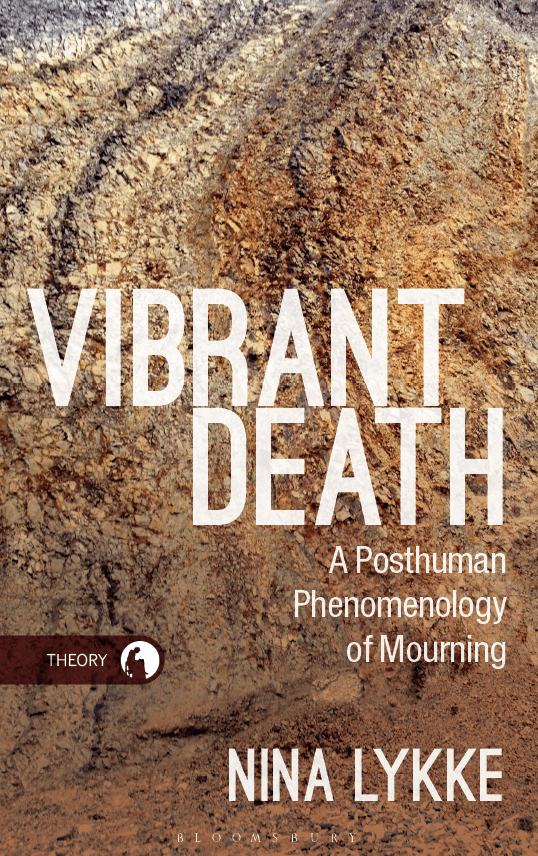
New Book Coming Out Soon!

Nina Lykke:

Vibrant Death. A Posthuman Phenomenology of Mourning.

Bloomsbury Academic, London.

WILL BE AVAILABLE FROM DECEMBER 2021, MORE INFO:

https://www.bloomsbury.com/uk/vibrant-death-9781350149731/


Vibrant Death links philosophy and poetry-based, corpo-affectively grounded knowledge seeking. It offers a radically new materialist theory of death, critically moving the philosophical argument beyond Christian and secular-mechanistic understandings. The book’s ethico-political figuration of vibrant death is shaped through a pluriversal conversation between Deleuzean philosophy, neo-vitalist materialism and the spiritual materialism of decolonial, queerfeminist poet and scholar Gloria Anzaldua. The book’s posthuman de-exceptionalising of human death unfurls together with a collection of poetry, and autobiographical stories. They are analysed through the lens of a posthuman, queerfeminist revision of the method of autophenomenography (phenomenological analysis of autobiographical material).

Nina Lykke explores the speaking position of a mourning, queerfeminine ”I”, who contemplates the relationship with her dead beloved lesbian life partner. She reflects on her enactment of processes of co-becoming with the phenomenal and material traces of the deceased body, and the new assemblages with which it has merged through death’s material metamorphoses: becoming-ashes through cremation, and becoming-mixed-with-algae-sand when the ashes were scattered across a seabed made of fiftyfive million-year-old, fossilised algae. It is argued that the mourning “I”’s intimate bodily empathising (theorised as symphysising) with her deceased, queermasculine beloved life partner facilitates the processes of vitalist-material and spiritual-material co-becoming, and the rethinking of death from a new and different perspective than that of the sovereign, philosophical subject.

Call for abstracts: Queer Death Studies Reader. Edited by Nina Lykke, Marietta Radomska and Tara Mehrabi

The field of Queer Death Studies

The planned reader will gather a wide range of contributions to the field of Queer Death Studies (QDS). This is an emerging, transdisciplinary field of study which takes research on death, dying, and mourning in new directions, inspired by feminist, posthumanist, decolonial, anti-racist, queer, trans, body- and affect-theoretical scholarship, art and activism (Radomska, Mehrabi and Lykke 2020). What distinguishes QDS from conventional Death Studies such as death sociology or anthropology of death is an overall critical focus on the framing of death and extinction in the contemporary world through Anthropocene necropolitics (Mbembe 2003, Lykke 2019) and necropowers of post/colonialism, racial and extractivist capitalism. Death is approached as an ethico-political issue that is embedded in global power structures. QDS pays attention to systematic, necropolitical productions of death, in dialogue with ethico-political critiques emerging from political movements for social, environmental and planetary justice and change. QDS is also based on critiques of the dichotomous divides, characterising Western modernity, and is marked out through a critical focus on normativities and exclusionary notions of the human, casting the death of those who differ from the normative human subject in terms of gender, racialisation, migration status, class, geopolitical situatedness, able-bodiedness, and species as less grievable or disposable and not counting at all (Butler 2004). In short, QDS aligns itself with critiques of the intra-acting multiplicity of hierarchising divides between appropriate and in/appropriate/d others (Minh-ha 1989), articulated by social, environmental and planetary justice movements.

The Call

With this call, we invite abstracts from researchers, students, artists and activists who see their research and activities as aligned with critiques of the necropowers operating in the contemporary world, and who want to contribute to queering, decolonising and posthumanising death and the onto-epistemololgies and politics conventionally framing death.

Queering, Decolonising and Posthumanising

The verbform, queering, which we use here, encompasses a wide range of meanings. It refers to (1) open-ended deconstructing of normativities and processes of normalisation in various forms, as well as (2) undoing of heteropatriarchy, heteronormativity, binary gender and sexualities governed by reproductive biopowers or, in other words, the normative heterosexual matrix. Queering death is thus on the one hand understood as a critical strange-making, and defamiliarising, which may imply affirmative openings of other horizons than Christian and Cartesian dualist approaches to death, for example a focus on the vibrant entanglement of growing and decomposing (Radomska 2017; Lykke 2022). On the other hand, queering means critically focusing on the ways in which misogyny, trans- and queerphobia lead to social as well as physical death, and how violence and hate crimes towards non-normative individuals seek to render their lives and deaths non-grievable (Puar 2007; Chen 2012; Snorton 2017). Together with this broad spectrum of meanings, we also want to emphasise that queering should be understood in its intersections with decolonising and posthumanising efforts

Decolonising death involves critically dismantling the violent necropowers of colonisation, racial and extractivist capitalism, which for centuries have made death become ”life’s quiet companion” (Lehman 1997) for racialised and indigenous people worldwide, as well as confronting the over-arching racisms which continue to produce (physical, social and cultural) death along racialised lines. Moreover, decolonising death signals a turn towards pluritopic hermeneutics (Tlostanova and Mignolo 2009), i.e. hermeneutics which do not universalise Western modern frameworks, and which reevaluate indigenous philosophies, cosm-ontologies and sensibilities. In terms of life/death thresholds, this implies critically-affirmatively shifting the meanings of death, for example, substituting conceptualisations and imaginaries of death as a final endpoint within a chrononormative linear temporality, and instead opting for understandings, situated in geo- and corpo-political frameworks outside of Western modernity (e.g. Smith 1999; Anzaldua 2015).

Posthumanising death refers to the systematic problematisation of the planetary-scale mechanisms of annihilation of the more-than-human world in their ontological, epistemological and ethico-political dimensions. It involves critical analyses of the human/nonhuman divide and power differentials that have allowed for the reduction of the nonhuman to mere resource and instrument for human endeavours. Furthermore, the posthumanising move entails unpacking philosophical and cultural meanings of extinction and the ways in which it fundamentally disrupts life processes in relation to time, death and generations (e.g. Rose 2012); it draws attention to environmental violence, environmental grief, as well as nonhuman death manufactured en masse through anthropocentric habits of consumption and mechanisms of extractivism.

Consequently, posthumanising death takes seriously the issues of responsibility, accountability and care for/in dying more-than-human worlds, while remaining grounded in radical critiques of human exceptionalism, and affirmative embrace of alternatives (eg. Braidotti 2013; Haraway 2016; MacCormack 2020).

Formats and deadlines:

We call for abstracts of approximately 300 words, to be accompanied by a bio-note of approximately 200 words, as well as by a title of the proposed chapter and an indication of how the chapter relates to the below main themes to be covered in the reader.

Please, send your abstract etc to ninly[at]fastmail.fm , cc: <marietta.radomska[at]liu.se> and <tara.mehrabi[at]kau.se>

Abstract DEADLINE: 1st NOVEMBER, 2021

We will respond to your abstract by MID-JANUARY 2022, and foresee submissions of FIRST DRAFT CHAPTERS by August 1, 2022.

We plan a reader with around 50 contributions, including a few reprints of classics. Scholarly as well as creative and artistic contributions are welcome! We hope together with contributors to build a reader which will be significant and agenda-setting for the field

Thematic clusters:

*Queering Death: Rethinking life/death ecologies

*Histories of necropowers and Anthropocene necropolitics

*Decolonising death

*Posthumanising death

*Demedicalising death

*Politics and Ethics of Mourning

*Alternative Spiritual, Aesthetic and Arts Activist Approaches to Death and After-life

The International Network for Queer Death Studies

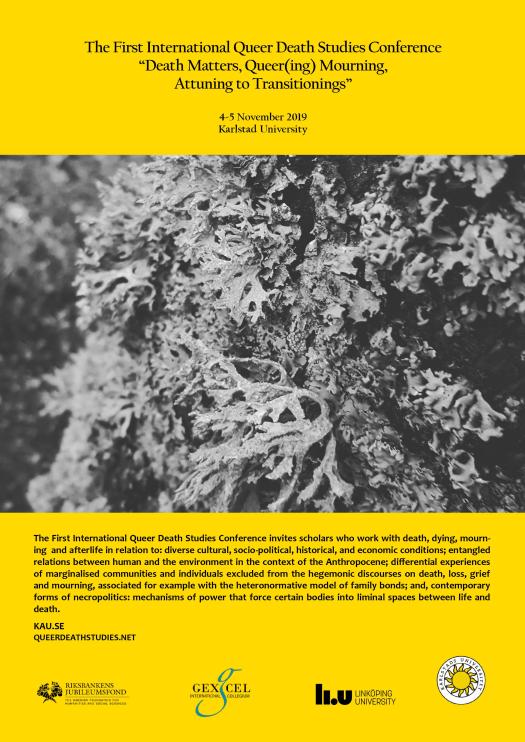
The idea for the reader grew out of the international network for Queer Death Studies, which was founded in 2016, (see https://queerdeathstudies.net/). The network has organised several workshops and an international conference at Karlstad University, Sweden, in 2019.

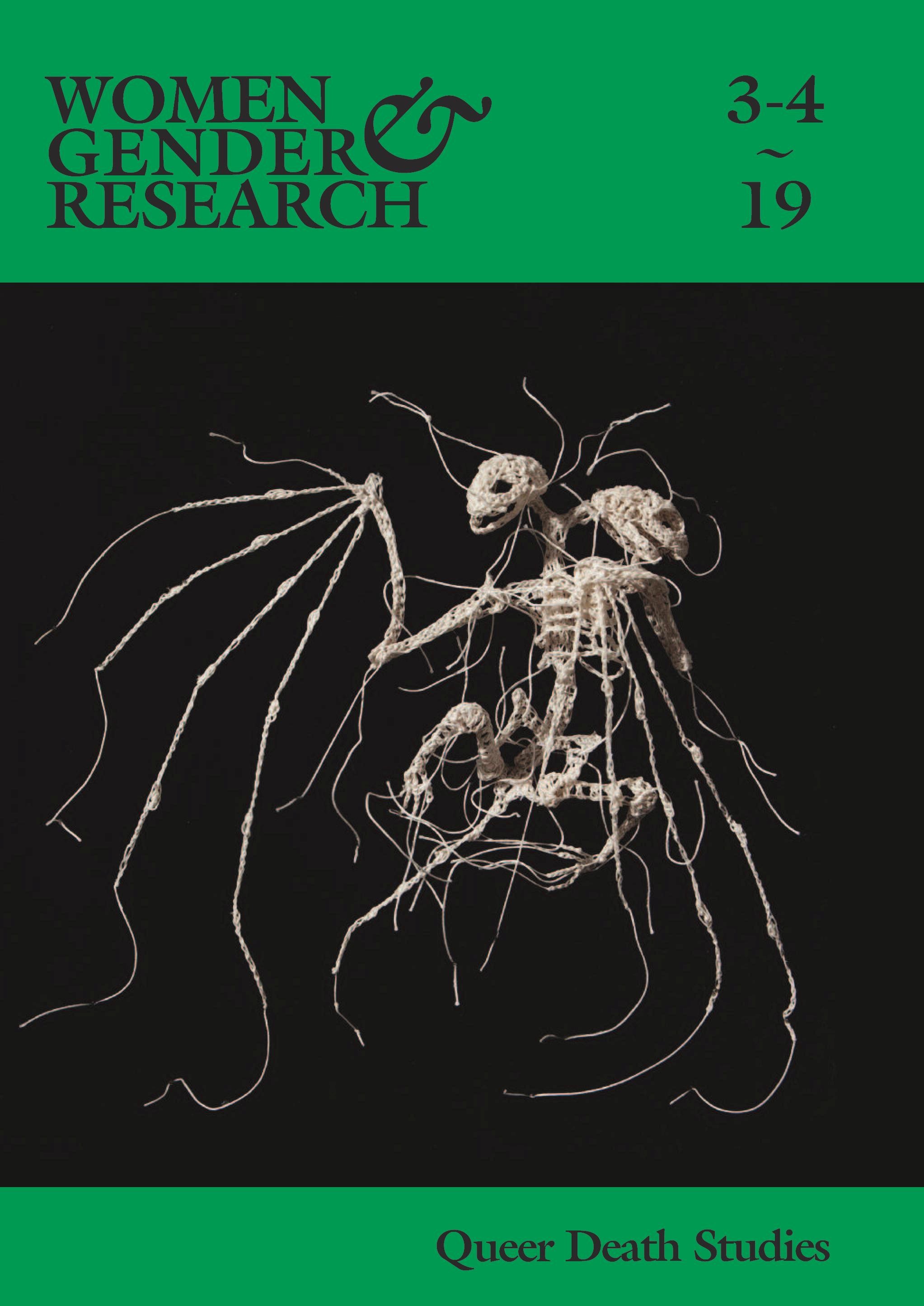
We have earlier published two special journal issues of Australian Feminist Studies (2020, Vol 35 (104)), and Women, Gender and Research (2019: Issue 3-4).

References

Anzaldua, G. E. (2015), Light in the Dark/Luz en Lo Oscuro: Rewriting Identity, Reality, Spirituality, Durham, NC: Duke University Press.

Braidotti, R. (2013), The Posthuman, Cambridge, UK: Polity Press.

Butler, J. (1990), Gender Trouble. Feminism and the Subversion of Identity, London, New York: Routledge.

Butler, J. (2004), Precarious Life: The Powers of Mourning and Violence, New York, NY: Verso.

Chen, M. Y. (2012), Animacies: Biopolitics, Racial Mattering and Queer Affect, Durham, NC: Duke University Press.

Haraway, Donna (2016), Staying with the Trouble: Making Kin in the Chthulucene, Durham, NC and London: Duke University Press.

Lehman, G. (1997), ‘Life’s Quiet Companion’, in G. Carey and R. Sorenson (eds), The Penguin Book of Death, 223–232, Ringwood: Penguin Australia.

Lykke, N. (2019), ‘Making Live and Letting Die: Cancerous Bodies between Anthropocene Necropolitics and Chthulucene Kinship’, Environmental Humanities, 11 (1): 108–36.

Lykke, N (2022), Vibrant Death. A Posthuman Phenomenology of Mourning. London: Bloomsbury Academic.

MacCormack, Patricia (2020a), The Ahuman Manifesto. Activism for the End of the Anthropocene. London: Bloomsbury Academic.

Mbembe, A. (2003), Necropolitics, Public Culture, 15 (1): 11–40.

Minh-ha, T. T. (1989), Woman, Native, Other: Writing Postcoloniality and Feminism, Bloomington and Indianapolis IN: Indiana University Press.

Puar, J. (2007), Terrorist Assemblages: Homonationalism in Queer Times, Durham: Duke UP-

Radomska, M., T. Mehrabi, and N. Lykke (2020), Queer Death Studies: Death, Dying and Mourning From a Queerfeminist Perspective, Australian Feminist Studies, 35(104): 81-100.

Radomska, M. (2017), Non/living Matter, Bioscientific Imaginaries and Feminist Technoecologies of Bioart, Australian Feminist Studies, 32 (94): 377-394.

Rose, D. B. (2012), Multispecies knots of ethical time, Environmental Philosophy, 9(1): 127–140.

Shildrick, M (2020) Queering the Social Imaginaries of the Dead, Australian Feminist Studies, 35(104): 170-185.

Smith, L.T. 1999. Decolonizing Methodologies. Research and Indigenous Peoples. London and New York: Zed books.

Snorton, C.R (2017), Black on Both Sides: A Racial History of Trans Identity. Minneapolis: University of Minnesota Press.

Tlostanova, M. and W. Mignolo (2009), On Pluritopic Hermeneutics, Trans-Modern Thinking, and Decolonial Philosophy, Encounters, 1 (1): 11–27.

The Posthumanities Hub Seminar on ‘Queer Death Aesthetics’ (online)

Join us for The Posthumanities Hub Seminar on Queer Death Aesthetics, which takes place on 27th May at 13:15 – 15:00 CEST and is organised in collaboration with The Eco- and Bioart Lab.

The speakers are: Karolina Żyniewicz (University of Warsaw, PL) and Jacob B. Riis (Aarhus University, DK).

For more details, also on how to REGISTER for the event, see below.

Welcome to the Posthumanities Hub Seminar on Queer Death Aesthetics with speakers: Karolina Żyniewicz (University of Warsaw) and Jacob B. Riis (Aarhus University)!

Queer Death Studies (QDS) is an emerging transdisciplinary field that critically investigates and challenges conventional normativities, assumptions and expectations surrounding the issues of death, dying and mourning in the contemporary world. In particular, QDS pays attention to the ways planetary-scale necropolitics render some lives and deaths more recognised, understood or grievable than others.  If ‘queering’ in QDS is understood in a broad, open-ended sense as strange-making, defamiliarising, where the critical defamiliarisation implied may lead to an opening of other, more affirmative horizons, what would then ‘queer death aesthetics’ mean? During the seminar we will try to tackle this question in depth…

The event is curated by Dr Marietta Radomska and is organised in collaboration with The Eco- and Bioart Lab.

When: 27th May 2021, 13:15 – 15:00 CEST

Where: On Zoom

REGISTRATION: In order to take part in the seminar, please register by sending an email to the.posthumanities.hub@gmail.com by 25th May 2021 at noon (CEST) the latest.

The Zoom link will be sent to you on 26th May.

Speakers:

Safe suicide – becoming immortal and dying anyway.

By Karolina Żyniewicz

How to experience immortal life and death at the same time? How to do it safely, without a risk? Are cells isolated from my body still part of me? These were the main questions which I asked to myself and to my scientific collaborators in the beginning of working on safe suicide project. The project was transmattering on many different levels, a transformation of the body and its notion, understanding of life and death coalition, cognitive production, artistic expression. In the frame of the project I immortalised my cells, B lymphocytes just in order to decide about their death. Technically speaking, it was giving to them/myself immortality to take it back in many different experiments. It was being a donor, an observer, a caretaker and a killer at the same time. The project does not give precise answers for the posted questions but it allows to envision what means being liminal, being many and being constantly reconfigured.

Bio

Karolina Żyniewicz is an artist (2009 graduated from the Academy of Fine Arts in Łódź, Department of Visual Arts) and researcher, PhD student (Nature-Culture Transdisciplinary PhD Program at Artes Liberales Faculty, University of Warsaw). Working in a laboratory (mostly at the Institute of Genetics and Biotechnology, Faculty of Biology, University of Warsaw) locates her works in the field of bio art, although she tries to avoid using this term.

Are we dead yet?

By Jacob B. Riis

One of the defining characteristics in human behavioural modernity is burial of the dead in conjunction with ritual and art – art’s primordial love affair is with putrefying corpses. This project outlines a genre that utilises material corpses to produce contemporary art pieces. I currently conceptualise this art form as Necro Art, which serves to connect it to Mbembian inspired Necro Aesthetics and simultaneously establish it as its own field or genre within Art History. While perhaps being a version of Body Art originating in Viennese Actionism, Necro Art simultaneously aligns along different trajectories. It samples and shuffles in early human ritual, folkloric, pagan and rural art forms usually not present in realms of High/Academic Art, and brings the overlooked, the spectral, the magical, and the illiterate too Art History. Through focus on materiality, agency and constellations of subjectivities, each artwork conjures ghosts, reveals life where there is none, and allows its experiencer to connect with the dead, forcing us to reconsider the boundaries of life.

Bio

Jacob B. Riis, Art historian (graduated from Copenhagen University in 2014), 2009-2014 Curator Assistant at The Danish Museum of National History, Hillerød, 2014-2018 Head of Teaching and Curator at Ordrupgaard in Copenhagen, currently PhD student at Art History, Aarhus University.

Photos included in the poster:
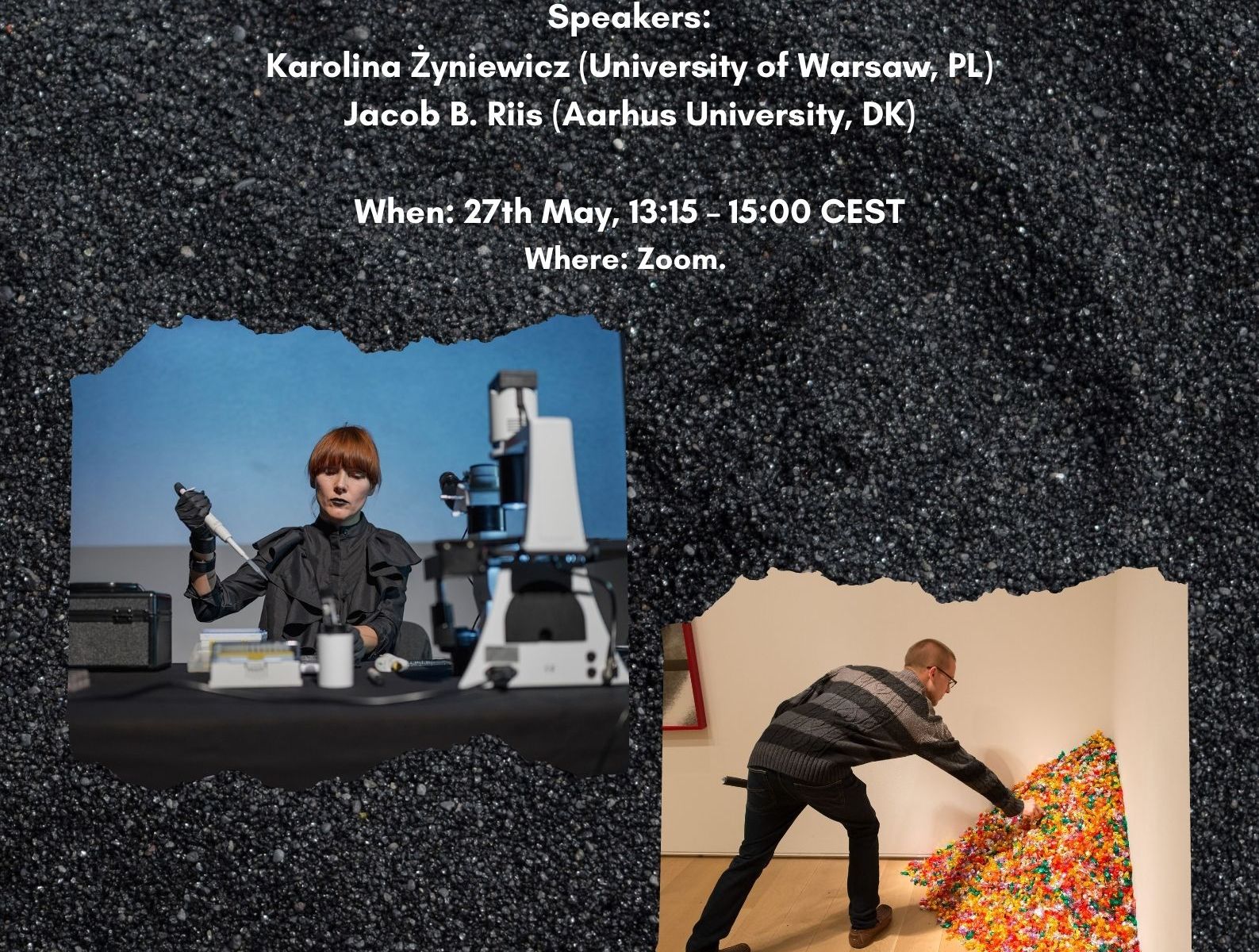
(1) Portrait of Karolina Żyniewicz by Pawel Jozwiak (CSW Laznia, Gdansk; LEFT) and 
(2) Untitled (Portrait of Ross in L.A.), 1991, by Felix Gonzalez-Torres (RIGHT).

Call for Chapters for Edited Book – Death and Dying at the Margins: Material-Discursive Perspectives on Death and Dying (tentative title)

When: DEADLINE for abstracts extended until May 21, 2021; completed drafts due November 1, 2021.

Where: Contact Jesse Peterson <jesse.peterson@slu.se> or Natashe Lemos Dekker <n.lemos.dekker@fsw.leidenuniv.nl> or Phil Olson <prolson@vt.edu>

Invitation

The third and final plate of mushroom risotto arrived. I was seated with Natashe and Philip, the night before we were to convene and discuss papers that explored the material-discursive aspects of death and dying. It seemed fitting, as the mushroom almost cloyed my tastebuds, that each of us would settle on fungus, often a symbol for decay, dissolution, and putrefaction. Fruiting harbingers that, by confronting their observers with the transformation of death back into life, challenge the definitions of the living, dying, alive, dead, not-alive, undead, and more. Reflecting on this moment, I can say that it was this very challenge that brought us together, the question of how materialities, practices, and stories help to organize the ambivalences in human determinations of those deemed dead or dying.

As confirmed by our workshop as well as our 2020 4S conference panel on the same theme, the three of us recognized that this challenge is taken up time and time again in different ways and that it extends beyond human death. The current corona pandemic highlights the significance of asking this question. Yet, this pandemic ought not overshadow the ways by which individuals, governments, and other interest groups negotiate with other kinds of dying, such as the disappearance of a loved one, the loss of a child before it is born, the inability to care for oneself due to dementia, the planned eradication of an invasive plant, the extinction of one species after the next, or the “death” of a river or lake. We all face the inevitable death of our own bodies, but also, through living, the countless deaths of others. Through meeting the messiness in dying, as scholars, we hope to navigate and attend to the complex, often difficult emotions of loss, grief, release, and more.

Gathering momentum from this convergence of how to negotiate the death of the human (literally and as enlightened subject) and nature (physically and as separate space), the three of us invite contributions to a forthcoming edited collection on the material-discursive aspects of dying. We’re excited to hear and learn from you.

The Call

Call for Chapters for Edited Book – Death and Dying at the Margins: Material-Discursive Perspectives on Death and Dying (tentative title)

Edited by Natashe Lemos Dekker (Anthropology, Leiden University), Phil Olson (STS, Virginia Tech), and Jesse Peterson (Environmental Studies, Sveriges Lantbruksuniversitet)

Subject Fields: Including, but not exclusively Environmental History / Studies, History of Science, Medicine, and Technology, STS, Sociology, Anthropology, Cultural History / Studies, Animal Studies, Women’s and Gender Studies, Queer Studies

Death is often assumed to arrive when heart and lungs stop, or when certain kinds of brain activities cease. Yet the borders between life and death are often unclear.  Death may get interrupted, delayed, or come undone, disrupting the “natural” and “normal” forms of a “good” death. We acknowledge such disruptions as material and discursive; that is, bodies, minds, geographies, stories, and more act to challenge human perspectives on how people, animals, plants, or things ought to die and where and how the dead ought to be laid to rest. What seemed coherent no longer is, both due to the breakdown or dissolution of that which is dying and due to the (dis)ordering of worlds and afterworlds. 

The editors seek contributions that will explore socio-ecological networks of the dying and dead that exist at the margins. Such work invites us to pursue and further identify ways to explore and establish connections between dying and death from perspectives that refute a nature/culture binary—to ask questions such as: 

  • What boundary work takes place to construct and maintain the categories of alive, not-alive, dead, dying, and undead for places, objects, and beings? 
  • How do states and processes of acquiescing to, existing in between, manipulating, or overcoming life and/or death affect normative assumptions about dying and death? 
  • What might it mean to reconfigure human understanding of death to a more ecological frame that accommodates more-than-human lives and/or deep time?
  • How might the memories, spirits, or spiritualities related to the dead and dying limit, expand, or explode a material-discursive frame?
  • How do such challenges alter ethical approaches or values attached to dying and death? 

We especially encourage submissions from scholars whose research practices consider feminist and queer studies, new materialism and waste, plant and animal studies, non-western or indigenous studies, and/or death studies.

If you would like to contribute your work, please indicate your willingness to participate by providing

(1) a 400-500 word abstract with title, and 

(2) a short biography of all co-authors.

The deadline for abstract submissions is February 26, 2021. If your proposal is accepted, you will receive a timeline of due dates. The tentative due date for the completed chapter is August 27, 2021.

Inquiries and proposals welcome: Contact Jesse Peterson <jesse.peterson@slu.se> or Natashe Lemos Dekker <n.lemos.dekker@fsw.leidenuniv.nl> or Phil Olson <prolson@vt.edu>

Call for short contributions (500-2000 words): What do we talk about when we talk about queer death? (Whatever Journal)

Whatever. A Transdisciplinary Journal of Queer Theories and Studies (https://whatever.cirque.unipi.it/) is inviting submissions for short contributions (500-2000 words) to be collected in a multi-authored article entitled “What do we talk about when we talk about queer death?”. The article will introduce the themed section Queer thanatologies (edited by A.C. Corradino, C. Dell’Aversano, R. Langhi and M. Petricola) that will appear in Whatever’s next issue in summer 2021.

Queer death studies has recently emerged as a transdisciplinary field of inquiry investigating the cultural performances related to death, dying, grief, and disposal from the perspective of queer theory, defined as a hermeneutical stance whose premises could be summed up as follows: «queer states that any construction of identity (including LGBT ones) is a performance constituting a subject which does not “exist” prior to it, and encourages to bring into being (both as objects of desire, of fantasy and of theoretical reflection and as concrete existential and political possibilities) alternative modes of performance» (Dell’Aversano 2010: 74-75). Driven by the will to «reconceptualis[e] death, dying and mourning in relentlessly norm-critical ways» (Radomska, Mehrabi, and Lykke 2020: 82), the field of queer death studies is developing and expanding in a number of directions. Some center on an «overall attention to necropolitics and necropowers» (ibidem: 85); some focus on peripheral, non-normative, and anti-normative identities, among which are those falling within the LGBT+ spectrum; some devote to non-humans as both subjects and objects of grief; some explore the construction of corpses as objects of desire in literature and the arts, as well as their position in spiritual and other kinds of political activism; some are grounded in category theory and the social sciences and aimed at the theoretical deconstruction of the life/death polarity itself, considered as one of the most fundamental constructs for the development of every human culture; some critically-affirmatively take a posthuman and/or decolonial point of departure in life/death, considered as a spiritual-material continuum, encouraging an ecophilosophical focus on the vibrancies of all non/living matter beyond the dualisms (mind-soul/body, culture/nature, human/non-human), cherished by Western modernity.

We encourage scholars, activists, thanatologists, and other queer death friends working in any field to contribute to the ongoing development of queer death studies by answering the question “what do we talk about when we talk about queer death?” in a bite-sized format. Your theoretical reflections, case studies, notes, and thoughts are invaluable for mapping this ever-expanding field.

Short contributions should be sent to Mattia Petricola (mattia.petricola[at]gmail.com) by January 27, 2021. For any question or information, for expressing your interest in this publication or discussing your contribution, do not hesitate to get in touch.

References

Dell’Aversano, Carmen. 2010. ‘The Love Whose Name Cannot Be Spoken: Queering the Human-Animal Bond’. Journal for Critical Animal Studies VIII (1/2): 73–125.

http://www.criticalanimalstudies.org/wp-content/uploads/2009/09/JCAS-Vol-VIII-Issue-I-and-II-2010-Full-Issue1.pdf.

Radomska, Marietta, Tara Mehrabi, and Nina Lykke. 2020. ‘Queer Death Studies: Death, Dying and Mourning from a Queerfeminist Perspective’. Australian Feminist Studies 35 (104): 81–100.

https://doi.org/10.1080/08164649.2020.1811952.

You can also download the CfP as a pdf file below:

New Publication: Special issue of the journal Australian Feminist Studies focused on Queer Death Studies

We are delighted to say that the special issue of the journal Australian Feminist Studies focused on the topic of “Queer Death Studies” and co-edited by Marietta RadomskaTara Mehrabi and Nina Lykke, has finally been published.

The issue contains contributions by QDS scholars: Patricia MacCormack, Marietta Radomska, Tara Mehrabi, Stine Willum Adrian, Margrit Shildrick, Hema’ny Molina Vargas, Camila Marambio and Nina Lykke.

The collection strives to advance queerfeminist methodologies and ontological, ethical and political understandings that critically and creatively attend to the problem of death, dying and mourning in the current environmental, cultural, and socio-political contexts.

In order to learn more, do check out the introduction “Queer Death Studies: Death, Dying and Mourning From a Queerfeminist Perspective”, co-authored by myself, Tara and Nina, available in OA here.

InterGender course “Queer Death Studies – Analyzing and Resisting Necropower”

NEWS via InterGender, Consortium and Research School in Interdisciplinary Gender Studies www.Intergender.net

For this course PhD students, but also Master’s students are eligible to apply.
Title of the Course:

Queer Death Studies – Analyzing and Resisting Necropower

The recommended accreditation is: 7,5 + 7,5 credits
 
Time:
December 8, 2020
 
Location: Online
 
Deadline for applications: September 20, 2020
 
Applications should be sent to: InterGender Consortium Coordinator Edyta Just (edyta.just[at]liu.se)
 
Maximum number of participants: 20 participants
 
Organized by: InterGender, Consortium and Research School in Interdisciplinary Gender Studies and Linköping University, Sweden
 
Course coordinator:
InterGender Consortium Coordinator Edyta Just (edyta.just[at]liu.se)
 
Teachers:
Professor Em Nina Lykke, Linköping University, Sweden
Senior lecturer Tara Mehrabi, Karlstad University, Sweden
Postdoc Marietta Radomska, Linköping University, Sweden
 
Course description:
The course gives an introduction to the emerging field of Queer Death Studies, its critiques of necropowers, and its framings of resistances to current necropolitics, moulded by neoliberal and extractivist capitalism and post/colonialism. It raises the question: What does it mean to bring the notion of queering to bear on the analysis of death, dying, mourning and afterlife in current political climates and contexts of crises? In response, the course takes a point of departure in a broad conceptualization of queering. This means that queer will be understood in its verbform, queering, which refers to processes of undoing and unmaking of norms and structurally oppressive societal normativities in a broad sense, which in the case of death, dying, mourning and afterlife is related to clusters of intersecting necropowers. But it will also be emphasized how such an understanding opens horizons towards politically much needed reflections on resistance and reontologizations, based on entanglements of queering methodologies with posthumanizing and decolonizing ones. The lectures will draw on different analytical examples, focusing 1) on the issue of killability and disposable bodies related to lab animals; 2) on bioart practices and the ways in which they call for reflections on the non/living; 3) on viral ontologies and necropowers, related to the CoVid19 pandemic.


Online format:

The course will be organized as a one-day online event in real time (Dec 8, 10.00-12.30 + 13.00-17.45), see time schedule below.
Lectures by each of the three teachers will be prerecorded and made digitally accessible to registered participants 2 weeks before the online event in real time. Preparation for the online event will entail listening to the lectures, submitting a paper (2–5 pages describing research problem related to the participant’s PhD thesis project (or master thesis project)), and read the papers of 5-6 fellow participants. A reading list, also to be prepared before the online event, will be sent to participants when admitted to the course. (See also general remarks on course preparation below).
The one-day online event in real time will be divided into plenary and group sessions, shifting between discussions of lectures and readings, and students’ presentations. Body exercises and creative moments will be included – in order to make the online event more lively.
 
Schedule:
Time schedule:
10.00-10.30 – Welcome and round of short presentations.
10.30-10.45 – Shared creative exercise
10.45-11.30 – Discussion of lecture 1 and related readings from the reading list.
11.30-11.45 – Shared creative exercise
11.45-12.30 – Discussion of lecture 2 and related readings from the reading list.
12.30-13.00 – Lunch break
13.00-13.45 – Discussion of lecture 3 and related readings from the reading list.
13.45-14.00 – Shared creative exercise
14.00-17.00 – Group work on students’ projects (3 groups, each chaired by one of the teachers – creative moments and breaks will be decided in the group)
17.00-17.45 – Wrap up, evaluations, and creative farewell moment.
 
 Preparation (after the acceptance to the course):
• Course readings: will be sent to participants, when admitted to the course.
• Paper (2–5 pages describing research problem related to the participant’s PhD thesis project (or master thesis project) to be sent to the Local InterGender Course and the InterGender Consortium Coordinator Edyta Just (edyta.just[at]liu.se) Remember to mark it with your name and the course name.
• All participants are expected to read the paper of their fellow group members before the course and be prepared to offer constructive comments in the group sessions and workshops. The papers will be made available online.
 
Essay:
• 10-15 pages to be handed in no later than 3 months after the course. One copy should be sent to the teacher, who chaired the group in which the student presented their paper at the course and who is going to evaluate it, and one to the InterGender Consortium Coordinator Edyta Just (edyta.just[at]liu.se). The teacher has 3 months to evaluate the essay.
• The essay should strike a balance between addressing a theme that has been part of course (lectures, discussions, reading material), and be relevant for participant’s own research.
• The essay should, moreover, be considered as an exercise in doing a written presentation aimed at an academic readership not familiar with the author’s PhD research. The essay should constitute a whole and explain relevant contexts.
 
Accreditation and examination:
1. 7,5 ECTS credits are recommended for active participation and a short paper, 2-5 pages describing research problem related to the participant’s PhD thesis project (or master thesis project).
2. 15 ECTS credits are recommended for active participation plus an essay (graded pass/fail).
3. The essay should be 10-15 pages. The selected topic shall be related to the course content and readings, and relate to the student’s own research area. The essay is to be sent to the teacher as well as to the InterGender Consortium Coordinator no later than 3 months after the final day of the course. The teacher has 3 months to evaluate the essay.
 
It is the students’ own responsibility to ask their institution about its accreditation rules and get the credit points registered at their respective higher education establishment.


Course Certificate:

In order to request the certificate, please send an e-mail to Edyta Just (edyta.just[at]liu.se).

The Consortium Coordinator issues, upon request, a certificate indicating to how many ECTS credits course participation is considered equal. It is the students’ own responsibility to ask their institution about its accreditation rules and get the credit points registered at their respective higher education establishment.

InterGender cannot issue a regular InterGender Certificate to MA students but a Certificate of Attendance. For MA students, the coordinator can state what the course was about content and format wise, what the requirements were for all in terms of readings and participation and the number of the credits it was equivalent to.
 
Applications should be written in English and include:
* name, affiliation, full address, e-mail, phone
* name and affiliation of PhD supervisor (MA supervisor)
* brief CV
* description of PhD project (MA project) (1-2 pages)
* motivation: why do you want to participate in the course (1-2 pages)
* please, indicate if you are in the first/middle/last phase of your PhD research or if you are a MA student
 
MA students will be selected on the basis of an evaluation of their CV, project description and a letter of motivation.
 
Information on Admission for PhD students:
 
1. Participants have to be registered as PhD students.
 
2. PhD students from all disciplines and countries are eligible.
 
3. Participants will be selected on the basis of an evaluation of their CV, project description and a letter of motivation.
 
4. If there are more applicants who qualify for participation, than there are places, the places will be distributed along the following criteria:
 
a) Students registered as PhD students at Partner Units will be prioritized for a maximum 80% of places. When the places are distributed among the Partner Unites, a good spread between these units will also be ensured.
 
b) Students registered as PhD students in other units at the Partner Higher Education Establishments will be prioritized for 20 % of the places. When the places are distributed among the Partner Higher Education Establishments, a good spread between these establishments will also be ensured. If places remain of the 80 % prioritized for PhD students registered at the Partner Units, these places will instead be prioritized for PhD students registered at the Partner Higher Education Establishments.
 
c) If the students according to a) and b) do not fill all the places, remaining places will be open for competition between all eligible and qualifying applicants from any higher education establishment.
 
5. If there are more eligible and qualified applicants for the a selection process will take place, which, in addition to academic quality and motivation/relevance, will use non-discriminatory selection criteria, which will ensure a spread of nationalities, regions, institutions and disciplines.
 
6. An additional lot drawing procedure will be used, if several eligible and in all respects
equally qualified applicants are competing for the limited number of places in the different categories
 
7. In case of too many eligible and qualifying applicants, a waiting list will also be organized, and places will be offered to applicants on this list, should some of the selected participants have to cancel.
 
8. The consortium coordinator selects participants under the auspice of the board, and is required to report to the board how selection is distributed between the consortium partners. If the board finds that the distribution is uneven, the consortium coordinator shall compensate for this in future selections.
 
There is no tuition fee for the course.